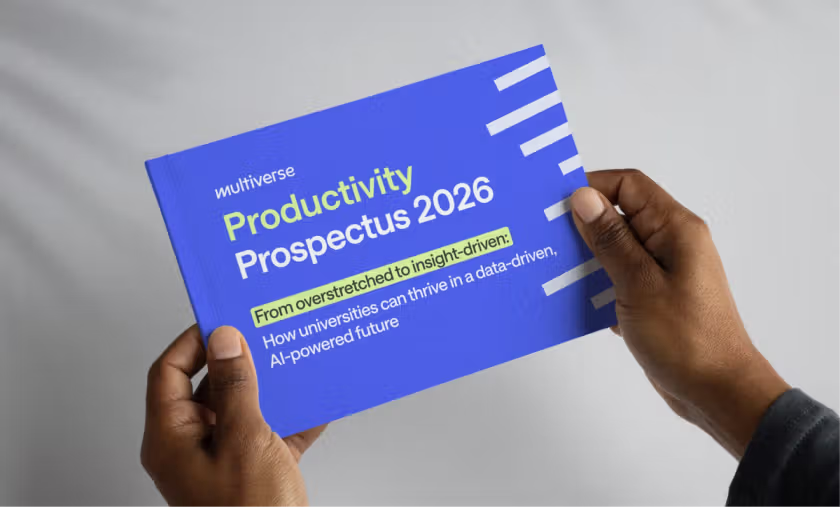
Powering productivity through AI and tech adoption at scale.
In 2026, the European economy has reached a critical inflection point. While AI infrastructure spending has run into the billions, tangible economic growth remains sluggish. In a landscape of high interest rates, tight fiscal policy and a persistent productivity problem, the AI mandate for business leaders has shifted.
Experimentation is over.Outcomes are everything.
Multiverse’s mission is to equip the workforce to win in the AI era. Driving tech and AI adoption through skills and measuring meaningful outcomes is central to this. That’s why our annual Impact Report focuses this year on the metric that matters most in the age of AI: productivity.
We believe skills are the most important driver of economic output. And our data backs it too. In the face of AI disruption, that conviction is more relevant than ever, and our mission more urgent.
Skills drive a flywheel for prosperity. Every pound and every hour invested in workforce capability contributes to a positive cycle: pay rises, promotions and increased long-term job security for people of all ages and career stages; greater efficiency and increased revenue for employers, both private and public sector; and higher, more sustainable economic growth for the country.
But these benefits are not guaranteed. Employer investment in training has fallen by nearly £10 billion in real terms over the past decade, and more than a quarter of all employer vacancies are skills related. We’re changing that. Our customers are changing that. Our learners are changing that. All by contributing to the growth and success of the skills system. And we’ve got the numbers to prove it.
40,000+
Learners to date
1,600+
Employer partners to date
£2bn+
Confirmed ROI for customers
Source: Multiverse data, including Stackfuel learners in Germany.
Our belief
Skills are the engine of productivity.
Skills drive a virtuous cycle of prosperity, by creating career mobility for individuals and costs saved, costs avoided and revenue generated for businesses. These outcomes fuel economic growth, unlocking further opportunities for individuals and employers. And the cycle starts again.
BUILDING THE WORKFORCE OF THE FUTURE FOR INDIVIDUALS
+15%
Increase in earnings for workers who receive training compared to those who don’t.
Skills propel people up the value chain, helping them secure increased seniority, pay rises and promotions. This also creates space for the next generation to grow into.
Productivity gains reported by companies who have effectively adopted AI.
Skills translate into tangible business outcomes as they contribute to tech and AI adoption: costs saved, costs avoided and revenue generated. They should be treated and measured like any other investment.
Economic value driven by apprentices over their lifetime.
The economic value of apprenticeships has nearly doubled since 2018. Today, they contribute at least £25bn to the economy - and that’s in England alone.
Source: Learning & Work Institute; Morgan Stanley; Department for Education.
“The most critical test of any adult learning should be whether it actually changes something - for an individual, for an organisation, or for the economy. Every day we ask ourselves: are people better equipped to create value for themselves and their employer because of their time working with us? That’s what we measure, and that’s what we hold ourselves accountable for.
AI is completely rewriting the rules of work. Having the capability among your people to grasp that opportunity with both hands is going to be critical to futureproofing the workforce, delivering meaningful value through adoption, and driving productivity for the European economy.”
Euan Blair, Founder & CEO, Multiverse
Impact at a glance
Data, not dreams.
Every Multiverse customer gets the value driven by their learners played back to them in numbers, through the projects submitted on our platform: whether it’s cost saved, revenue generated, waiting list numbers reduced or customers served.
At the same time, nearly three in five of our alumni (57%) report that they secured a promotion, payrise or increased responsibility during or in the 12 months after their programme.
£340m
Projected revenue generated by Multiverse learners for their employers
2 months
Of working time saved per learner last year due to efficiency driven through skills
£557m
Projected cost saved by Multiverse learners for their employers
57%
Gain a promotion, payrise or increased responsibility
£181,970
Projected financial return per learner
77%
Said their programme made them more productive
Source: Multiverse, FY26. Impact data is reported by Multiverse learners and alumni. Some projects are still in the opportunity stage. Two working months based on 3.4m hours saved last financial year by Multiverse learners and divided by number of learners; calculated on a 7.5 hour working day. Financial return figure calculated based on cost saved, cost avoided and revenue generated, divided by number of learners.
For individuals
Skills shape futures.
Upskilling is not learning for its own sake. Skills help people secure pay rises, promotions and increased responsibility at work. The number of hours you spend learning isn’t what moves the needle - it’s what you can achieve because of them. And with AI transforming life and work, we need a modern, equitable skill system that keeps up with the pace of disruption.
3 in 5
Receive a promotion, pay rise or increased responsibility during or after their programme
64%
Achieved a distinction in their programme
Source: Multiverse, 2026. 57% achieve a promotion, pay rise or increased responsibility. Distinction rate is for FY26.
Let’s put some faces to the data
Say hi to Cali
Data Analyst at a major builders’ merchant
New role secured
Cali
Data Analyst at a major builders’ merchant · New role secured
“Multiverse ensured that my lack of formal education never hindered my learning, and my employer noticed.”
Cali’s path has been shaped by years of adversity including homelessness at 21 and a life-changing motorbike accident at 24. Her Multiverse apprenticeship gave her access to technical skills her unconventional path had never opened up, and she put them straight to work, building a chat app for an internal function that’s now used by over 2,000 people across the organisation. Her employer took notice, and created a brand-new Data Analyst role specifically for her.
Meet Oluwasola
Interface Worker, South West London and St George’s Mental Health NHS Trust
Distinction achieved
Oluwasola
Interface Worker, South West London and St George’s Mental Health NHS Trust · Distinction achieved
“I’ve always aimed for a Distinction. I finally got there, I earned a promotion, and I’m proud of the outcomes I’m driving for mental health and wellbeing in this community.”
From self-doubt to Distinction. NHS worker Oluwasola turned data into faster decisions — this is his story: Oluwasola’s role is supporting discharge planning to get vulnerable mental health patients home safely. Taking on an apprenticeship alongside his complex, community-focused role was never going to be easy. But fast forward to today: Olu has finished with a Distinction, built a live dashboard that cut analyst waiting times and accelerated decision-making, while also earning a promotion to Community Interface Deputy Team Manager. “I had a lot of moments where I doubted my abilities,” he said. “But once I start something, I’m determined to see it through.”
Hear from Olly
AI learner at brickmaker Michelmersh
Levelled up career
Olly
AI learner at brickmaker Michelmersh · Levelled up career
“I can analyse what’s happening on the factory floor and connect it to the wider business strategy. That shift in perspective is what got me promoted.”
How Olly, 44, used his new skills to take the factory floor to the AI frontier: Through Multiverse’s AI programme, he moved from learner to leader — earning a promotion and taking on real responsibility for how the business thinks about artificial intelligence. “In recent months I’ve been part of a team using Microsoft Fabric to gather factory data and analyse it with AI, all to reduce gas consumption and bring down energy costs. What surprised me most isn’t the technology itself, it’s how differently I now think about a project. I can analyse what’s happening on the factory floor and connect it to the wider business strategy. That shift in perspective is what got me promoted.”
Introducing Beth
Digital Transformation Manager, Young Lives vs. Cancer
Two promotions achieved
Beth
Digital Transformation Manager, Young Lives vs. Cancer · Two promotions
How a charity worker transformed cancer support volunteer systems.
From Project Officer to Digital Transformation Manager. Here’s Beth’s story: When Beth joined Young Lives vs. Cancer, managing the volunteers who support families facing childhood cancer meant relying on fragmented, manual systems. Beth used her digital skills to help implement a unified digital volunteer management system. This project transformed the charity’s operations, earning her two consecutive promotions to Digital Transformation Project Manager and a distinction in her final assessment. Most importantly, the new system streamlines volunteer coordination, ensuring that families navigating the trauma of a cancer diagnosis receive targeted, reliable support when they need it most.
Over to Zainab
Degree Apprentice, KPMG
Career boost without cost
Zainab
Degree Apprentice, KPMG · Career boost without cost
“Choosing a degree apprenticeship meant I could take control of my finances and build genuine experience at the same time — that freedom has been huge.”
From Bookkeeping to Big Data: here’s Zainab’s story: Zainab joined KPMG as a degree apprentice, choosing the earn-while-you-learn route of Multiverse’s Level 6 Advanced Data Fellowship over a traditional university degree - a decision that gave her financial independence alongside real professional experience. She has since built hands-on expertise in Python, SQL, and Power BI, co-developing a project management dashboard that has sharpened stakeholder communication across her team. And through her involvement in the Asian Arab Network, Zainab has in turn helped her peers with their own career growth.
Source: Multiverse, 2026.
Tearing down barriers to opportunity
Our learners don’t fit into any one box. Gender, socio-economic status, age, previous education - none of it should act as a career ceiling. One in ten have an additional learning need. More than a quarter (26%) meet a marker of socio-economic disadvantage. More than two in five (41%) didn’t previously hold a degree. And we’ve trained more than 5,000 young people. Because the skills that will matter in tomorrow’s workplace shouldn’t be constrained to the hands of just a few.
47%
Multiverse learners on AI programmes are female
At a time when research shows women are significantly less likely to be in AI-skilled roles.*
26%
Meet one or more markers of socio-economic disadvantage
Such as being care-experienced.
* 51.62% male; 46.95% female; 1.43% other or prefer not to say - compared to 29% of AI-skilled workers who are women (Randstad).
For the public sector
Powering up the public sector.
Multiverse has trained more than 9,000 learners at over 150 UK public sector organisations, including NHS Trusts, local councils, police forces and government departments. These individuals have used their new skills to reduce waiting lists for patients, deliver smarter services for local residents and make communities safer.
1m+
Hours saved through increased productivity
£366m
Costs saved for the public sector
2,500+
Public sector learners trained in the last year
Source: Multiverse, 2026. Impact data is reported by Multiverse learners and alumni. Some projects are still in the opportunity stage.
For employers
Applied learning. Accelerated transformation.
More than half of CEOs say AI isn’t delivering. But we say the question isn’t whether AI works. It’s whether your workforce knows how to use it. Here’s what happens when they do.
Our trusted partners
Who we’ve worked with
1/3
of FTSE 100 organisations
70%
of Russell Group universities
100+
NHS Trusts
Source: Multiverse, all time data. 31% of FTSE 100 companies. 17 of 24 Russell Group universities.
AI IN ACTION
How a City Council Worker integrated AI to shrink a four-hour rota planning process to under an hour
How we do it: expert human-led coaching supported by adaptive AI tooling
In the past year alone, thousands of Multiverse learners have submitted over a hundred thousand projects on our platform, with the support of our expert coaching team - and a little help from Atlas, our in-house AI coach. This is what tech adoption at scale looks like. And our coaches are the ones that make it possible, while AI handles the admin, freeing them up to spend more time driving outcomes and giving each learner the support they need.
240+
Coaches and instructors
140,411
Projects submitted by Multiverse learners in FY26
2.25m
Atlas chats from 25,000+ users
5+ yrs
Average industry experience among our coaching team
70+
Coaches and instructors with advanced degrees
139
Career-boosting events run by coaches, instructors and external experts in the Multiverse community
Source: Multiverse 2026.
Meet the employers taking control of change
Rapid advances in tech, software and systems are fundamentally changing what organisations need from their teams — these employers are making that change work for them.
Disrupting themselves before someone else does: how QS is building a future-ready workforce and saving £675,000 in the process
“Our reputation with universities worldwide is based on the capability and impact of our people.”
Buckinghamshire New University is revolutionising student and campus experiences with digital literacy skills
“Upskilling staff in university is really important for our vision of a digital campus, because we want to create a digital environment which is accessible, inclusive, and empowering.”
Cambridge University hackathon goes from 51,592 records to a board-ready recommendation
“It was interesting to see what they put together and that’s obviously skills that they can bring back to their own workplaces, work efficiently and work smarter with the data that they’ve got.”
Fiona Hall, Deputy Head of Admissions & Data Services
By improving individual productivity and employer output, we’re promoting collective growth, contributing to economic stability and making the UK and Europe more investable.
£430m+
Invested in the European skills system by Multiverse
£2bn
Tracked ROI unlocked for customers
£181,970
Projected financial impact per learner
Present across every priority sector
The UK Government’s Industrial Strategy identified eight high-growth, high-priority sectors - and Multiverse is proud to be present across all of them, training over 800 organisations and more than 20,000 learners since 2016.
Advanced ManufacturingClean Energy IndustriesCreative IndustriesDefence
Digital & TechnologiesFinancial ServicesLife SciencesProfessional & Business Services
Financial Services
How a Product Manager at a major bank developed an AI agent to address customer queries, boosting customer satisfaction.
Skills are a cause of economic growth, not a by-product. Industrial, regional and national strategies already reflect this - and Multiverse is building the skills ecosystem needed to turn policy into prosperity.
Source: Multiverse, all time.
National reach
Talent is evenly distributed…
… but opportunity is not. We’ve reached tens of thousands of learners from every corner of the country, and have just as many in the North West as we do in the East and in the South West. This is what happens when you stop searching for talent in the same places every time.
Unlocking true economic impact depends on getting the right skills to the right people in the right places.
Download the data. Share the stories.
Let’s talk about turning skills into impact for your organisation.
This report combines an assessment of Multiverse’s past activity with forward-looking statements about our goals, expectations, and future work. Forward-looking statements are not promises or guarantees. They reflect our current views only and are subject to risks and uncertainties — including economic conditions, technological change, regulatory developments, and customer behaviour — any of which may cause actual outcomes to differ materially.
Except where a third-party source is cited, all data is Multiverse’s own. Impact figures — including revenue generated, cost saved, and financial return per learner — are projections and estimates produced using the methodologies described in the accompanying notes; they are not audited or independently verified results, and some relate to projects still at the opportunity stage. A significant proportion of the underlying data is self-reported by Multiverse learners and alumni and has not been independently validated. Actual figures may differ materially from those shown.
Third-party information is included in good faith and believed accurate as at the date of publication, but Multiverse has not independently verified it and accepts no responsibility for it. All information is provided as at the date of publication and reflects our understanding at that time. We may update this report but are under no obligation to do so.
This report is provided for general information only. It does not constitute financial, investment, legal, or other professional advice, and it is not an offer or invitation to buy or subscribe for any securities or to make any investment.





.jpg)



.png)