
From 51,592 records to a board-ready recommendation: inside a data analytics hackathon
03:09
Four teams of apprentices, one day and 50,000+ data records — it must be a live data analytics hackathon, one of the most hotly anticipated features of our apprenticeships’ curriculums.
These challenges see learners take everything they’ve learned and put it to work in teams on a single, open-ended problem. They’re given a realistic scenario, real and relevant data and a question to answer. They then have just a day to clean the data, analyse it and present recommendations that they can defend.
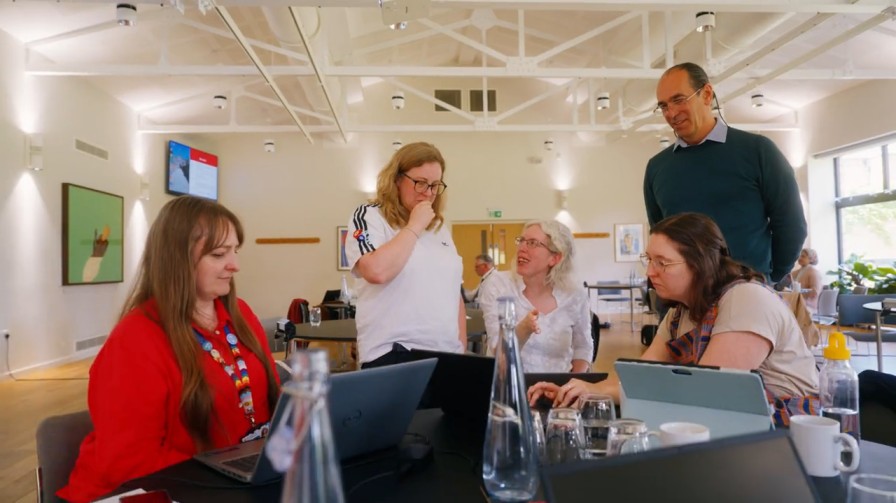
We recently observed a hackathon in action for a cohort of data analytics apprentices from five colleges at Cambridge University.
Here’s how it unfolded.
A real question, real data
The teams were given a broad question to tackle on the day: which under-represented groups are being lost at which stage of the admissions process, and where should outreach be focused to close those gaps?
The dataset was exactly the kind that analysts meet in the real world: large and inconsistent. The team would have their work cut out wrangling a mix of different fields related to socioeconomic indicators and widening higher education participation flags, plus the stage applicants reached and the outcome they received.
Tackling this challenge would require them to flex all the data analytics skills they’d learned to date, using Excel and PowerBI to clean and visualise the data, communicate the trends they’d found and make some concrete recommendations.
Turning messy into meaning
The hackathon compressed the full analytics workflow into a single day. The teams started by cleaning the data, building structured tables, suppressing blanks, fixing inconsistent values and making judgment calls on which incomplete records to exclude. (Nobody ever said data quality was glamorous, but this is where the trust in everything that happens downstream is won or lost.)
Clean data in hand, teams moved to modelling and preparation. Using XLOOKUP they joined datasets on unique identifiers, summarised the data with pivot tables and built out their funnel and conversion-rate calculations.
The teams then used PowerBI to analyse and visualise the data interactively, and built Excel charts and dashboards to compare groups and surface patterns.
The final stage was to turn their analysis into insight and storytelling, and present their findings. By framing a clear problem statement and benchmarking against national data, each team had arrived at a strong set of evidence-led outreach recommendations.
And the process was complete: raw, messy data — the kind universities and indeed businesses — are swimming in, had been transformed into a board-ready proposal.
Fresh eyes, fresh connections
Part of what made the day work was the fact that many participants were analysing admissions information for the first time. Pushing people to test their skills outside of their day-to-day role helps to cement their learning, and gives them valuable experience to bring back to their regular jobs.
“It’s been challenging,” said Elizabeth McWilliams, a participant. “We were given admissions data, and I don’t work in the admissions department, so it’s been quite a steep learning curve.”
For Robert Fone, Senior Instructor at Multiverse, that fresh perspective was the point. “We’ve got people who’ve never seen this sort of data before, so they’re bringing new ideas that people who work with admissions data haven’t thought about,” he said.
The hackathon judges, senior stakeholders overseeing this aspect of the University’s apprenticeship programme, also reflected on the success of the day.
“They all came at it from very different angles,” said Fiona Hall, Deputy Head of Admissions & Data Services, and a hackathon judge. “It was interesting to see what they put together and that's obviously skills that they can bring back to their own workplaces, work efficiently and work smarter with the data that they've got.”
“This is absolutely silo busting activity,” added Owen Roberson, University Data Lead and a judge. “This is about getting people to make connections that are unintuitive.”
The skills that stick
The real success measure of a hackathon is always what participants take back to their desks afterwards.
For this cohort, that is a repeatable way of taking a messy dataset — any dataset — and turning it into something that decision-makers can act on.
Whatever data they come across next, these apprentices are ready to make it work for them.
Get in touch