







.jpg)

We couldn’t find what you are looking for. Please try another way.
The Multiverse blog

Thank you! Your submission has been received!
Oops! Something went wrong while submitting the form.
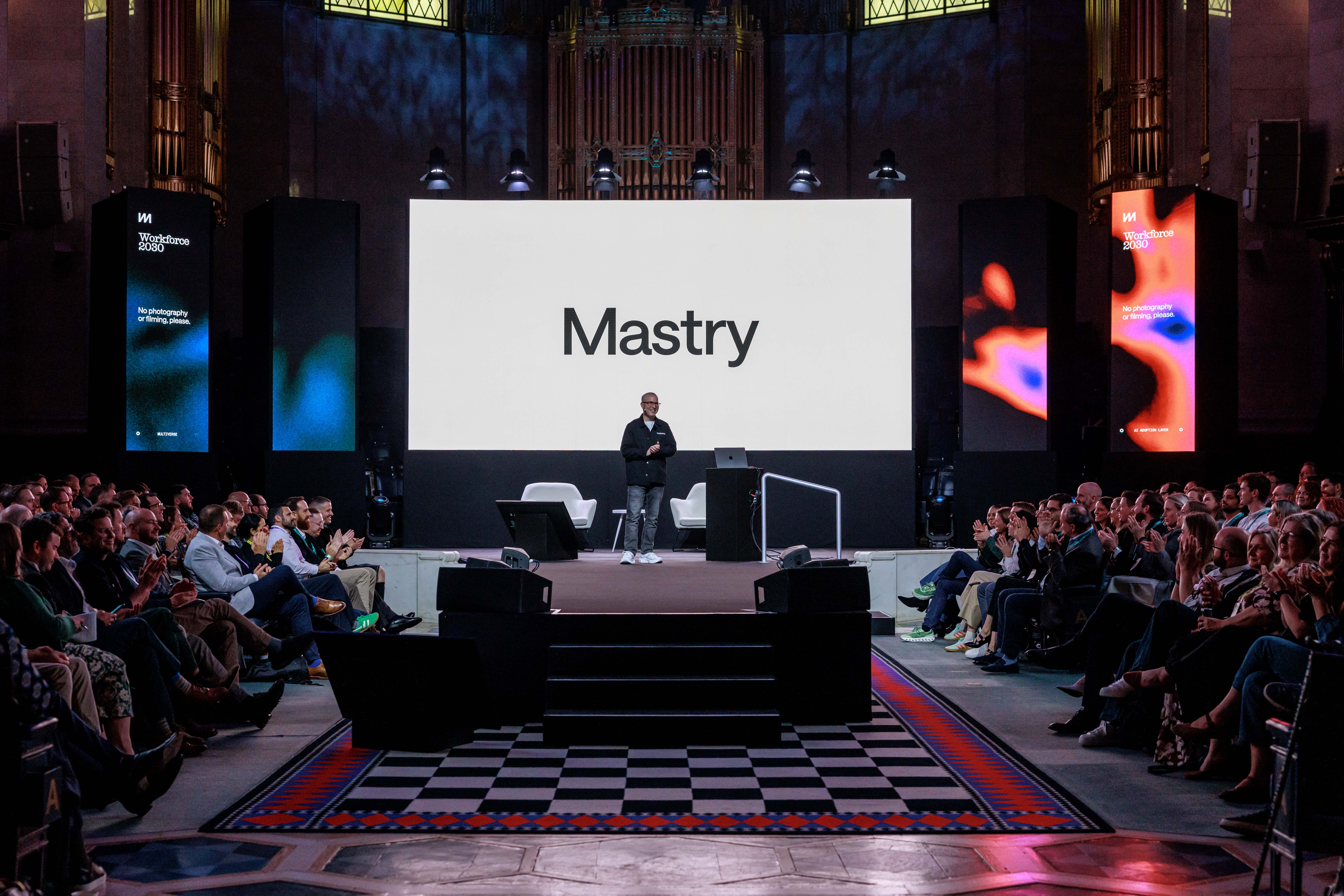
Multiverse launches Mastry, a single platform to take companies from AI ambition to AI adoption
News
Team Multiverse
Earlier this week, we published new data showing that British workers lose 28 working days a year to inefficient work with data. 97% of the workers in our study want to improve their AI skills, while three in four UK adults have never had any AI training.
Knowing where the skills gaps are is one challenge. Closing them is another. Today, at our Workforce 2030 conference in London, we launched Mastry to bring everything together into one platform.
Why AI adoption stalls between investment and results
Buying the tools is the easy part. The difficult part is getting people to use them well in their day-to-day work. A plan on paper doesn’t change how someone works the next day, and neither does training that sits apart from the work. That leaves leaders assembling the answer themselves, from a consultancy, a training provider… and a lot of hope.
What Mastry does
Mastry is an adaptive learning platform that runs a company’s AI workforce change from start to finish. It finds where the skills gaps are, teaches people in the course of their actual jobs, and shows leaders the impact the learning has delivered.
- Diagnose: Each person has a short voice or chat conversation with our AI agent about their role and how they work, and leaders get a view of capability across the organisation, mapped to business goals.
- Guide: Mastry builds a learning plan for each person from what the business needs and what they can already do, using their own work projects as the material. Mae, our AI guide, works alongside people inside Claude, Microsoft Copilot and other workplace tools. She offers guidance on live tasks and records evidence of new skills as people apply them.
- Prove: leaders see progress across teams, so they can report what their AI investment is producing.
Learning that sits inside the work
Jay Richman, our Chief Product and Technology Officer, said: “If learning competes with work, work will always win. So we built Mastry to sit inside the work.”
Mastry can be used on its own or alongside Multiverse apprenticeships, which continue to be delivered with expert human coaches. Both will be run from the same platform.
Built on ten years of training people at work
Multiverse was founded ten years ago as an alternative to university. With Mastry, we are taking a modern approach to ground long held by management consultancies: a single partner for a company’s AI workforce change.
Euan Blair, our founder and CEO, said: "Companies have bought the AI tools, but what most still lack is a workforce that can use them to make a difference. Until now they've had to rely on external consultants, with results often not materialising. We focus on installing expertise across the workforce so they can drive the change themselves, and Mastry puts that provision in one place. It's built on our deep expertise training workers on the job and insights from hundreds of thousands of real workplace projects."
Frequently asked questions
When will Mastry be available?
Mastry is available now to eligible development partners through a waitlist, with full launch planned for early 2027.
How does Mastry work?
It finds where the skills gaps and organisational blockers are, teaches people in the course of their actual jobs, and shows leaders the impact that the learning has delivered in real time.
Mastry works alongside people inside Claude, Microsoft Copilot and other workplace tools. Mae, Mastry’s AI guide, helps people with the task in front of them, so they build skills while doing real work, not in a separate course.
Does Mastry replace human coaches?
No. Mastry runs alongside Multiverse apprenticeships, which are still delivered with expert human coaches. Coaches bring accountability, pastoral care, group coaching and more, and Mae, Mastry’s AI guide, helps with the work in the moment.

Leaders have precise insights for every department. Why not for AI capability, and the barriers to adoption?
Employers
Team Multiverse
Ask a finance director where the business stands on cash and you will get a number, to the penny. Ask a sales director about the pipeline and you will get it by the week.
Now ask the Board what their people can do with AI. Most can’t tell you very precisely. That matters, because companies are spending heavily on AI tools without knowing whether their teams can use them. Our latest data shows what the gap costs.
The numbers: 28 working days lost per worker
Our annual Skills Intelligence data, drawn from 6,690 workers this year, shows British workers now lose an average of 28 working days a year to inefficient work with data. That is almost six weeks. It has risen for the third year running:
- 25 days in 2024
- 27 days in 2025
- 28 days in 2026
We estimate this costs the UK economy £53.37 billion a year in lost productivity, based on the self-reported proportion of the working week spent inefficiently on data, and multiplied by the 8.1 million knowledge workers most affected. The findings arrive two weeks before a Budget that bets on AI lifting productivity: our data suggests the workforce is not yet equipped to deliver that.
The appetite is there. The training isn’t.
Workers want to learn:
- 97% of workers in our study want to improve their AI skills, up from 91% last year
- Yet three in four UK adults have never had any AI training, formal or informal (based on Focaldata polling of 1,830 UK adults, commissioned by Multiverse)
The widest gaps sit in the skills that turn AI tools into results for the business:
- Scaling AI: 80% of self-ratings for AI adoption were “a new area for me”. Just 1% ranked themselves as experts.
- Agents: among learners on our more advanced AI programme, 57% have spotted where an AI agent could help their work. Only 16% have built one.
- Strategy: 70% of self-ratings for data strategy were “a new area for me”, twice the rate for data governance (35%).
There are signs of progress: healthcare cut the share of data time its workers spend inefficiently from 41% to 35%, the biggest improvement of any sector. But financial services and councils moved the other way.
Why employers can’t see the gap
A traditional skills audit usually means a survey that not everyone finishes and a spreadsheet that is out of date before anyone reads it. So leaders have to guess, and what’s missing goes beyond skills - skills can’t fix a procurement problem, or the silos between teams that mean the same thing is being developed in two different places.
That is the problem our voice agent is built to fix. It lets workers pinpoint what is blocking them, and leaders hear it played back. Each employee has a short conversation with the agent, by voice or chat, about their actual job and how they use data and AI. The agent identifies their skills gaps against our skills framework, built on insights from more than 40,000 assessments, and gives each person a view of where to build skills next.
These insights are then anonymised, aggregated and played back, so leaders can see the full picture across a team or the whole organisation, and tell what needs to progress to unlock AI adoption, and why. The technology was developed in our newly opened Edinburgh AI Hub.
Jay Richman, our Chief Product and Technology Officer, said: “Every working week holds an honest account of what's slowing a business down, but most companies never hear it. The agent listens to every person, finds the hours lost and the tools left unused, and plays it back across the whole organisation. That means that leaders can stop guessing where to invest and start knowing.”
Questions every leader should be able to answer
Euan Blair, our founder and CEO, said: “Workers have far greater context on their workplace challenges than anyone else, but until now that rich seam of intelligence has never properly been surfaced. We want to give employers visibility, and workers the opportunity to explain the challenges they’re facing.”
Start with these:
- Where are our people losing time, and what’s blocking them? If you can’t name the teams or the tasks, you can’t fix the problem.
- Which skills do I need to build within my team? Being able to use a tool and being able to roll it out across a team are different skills. You need to know where the gaps are.
- How would we know if it’s working? If the answer is course completions, that measures activity, not evidence.
See your own skills picture
If you want to know what your people can do with AI, talk to Sales and we will show you how it all works.
Frequently asked questions
How many days a year do UK workers lose to inefficient data work?
UK workers lose an average of 28 working days a year to inefficient work with data, almost six working weeks. That’s up from 27 days in 2025 and 25 in 2024. The figure comes from Multiverse’s Skills Intelligence data from 6,690 workers and is based on self-reported hours.
How much do poor data skills cost the UK economy?
Poor data skills cost the UK economy an estimated £53.37 billion a year in lost productivity, according to Multiverse. The estimate is based on self-reported time lost and covers the 8.1 million knowledge workers most affected.
Do UK employees want AI training?
Yes. 97% of workers in Multiverse’s study want to improve their AI skills, up from 91% last year. Yet three in four UK adults have never had any AI training, according to Focaldata polling of 1,830 UK adults commissioned by Multiverse.
What AI skills are UK workers lacking?
The widest gaps are in scaling AI, building AI agents and data strategy. In Multiverse’s data, 80% of self-ratings for AI adoption were “a new area for me”. Among learners on its more advanced AI programme, 57% have spotted where an AI agent could help but only 16% have built one. 70% of data strategy self-ratings were “a new area for me”, twice the rate for data governance (35%).
How does Multiverse’s voice agent work?
Multiverse’s conversational AI voice agent has a short conversation with each employee, by voice or chat, about their actual job, what’s costing them time, and how they use data and AI. It identifies their skills gaps against Multiverse’s skills framework, built on insights from more than 40,000 assessments, and gives each person a view of where to build skills next. The insights are then anonymised and aggregated, so leaders can see what is holding their teams back and where to invest their time.
What do employers get from the agent?
Employers see anonymised, aggregated results across a team or the whole organisation, so they can tell where AI adoption needs to progress and why.
How do I measure my team’s AI skills?
Start with three questions. Where are our people losing time, and what’s blocking them? Which skills do I need to build within my team, and where are the gaps? How would we know if it’s working? If the answer to the last one is course completions, that measures activity, not evidence. Multiverse’s conversational AI voice agent, gives leaders a clearer picture of where help is needed most.
How we're using AI to invest in coach development
News
Team Multiverse
Ask Multiverse learners what makes their programme work and most of them will talk about their team of coaches and instructors. Learners give our coaches a 97% satisfaction rating, and coaching quality is what we guard most closely.
That takes two things: a clear view of how every session goes, and delivering personalised, point-of-need development for every instructor. Until now, one constraint limited both.
The limits of a monthly observation
A Delivery Manager could observe each instructor about once a month. One session gives a narrow view. It can miss a problem that is building, and it gives little basis for development tailored to the person. Managers also spent much of their time gathering evidence, which left less for acting on it. Schools and training providers everywhere face the same problem.
"As a former teacher, I know how hard it is to build an observation system that helps people improve. In my first years in the classroom, I was observed once a month, with feedback based on a 20-minute snapshot of a single lesson. It always felt like putting on a performance, so the feedback didn't reflect what my lessons looked like day to day. Later, when I ran Delivery Enablement at Multiverse, I observed every member of the team once a fortnight. I loved giving that feedback, but I knew the approach couldn't scale. Compass is the result of nearly a year spent working on that problem. Every instructor now gets feedback based on how they teach in every session, and we have a much clearer picture of quality across all our programmes."
Chloe Barker, Senior Director, Quality, Multiverse
What Compass does
The Compass agent is an AI tool that reviews instructors' sessions against the Compass Framework, the skills required to deliver exceptional workshop-based training that we use to hire, train and develop every coach. Before, a manager could review one session a month. Compass reviews every session and combines what it finds with learner feedback.
It produces two things. First, a review for each session, which shows managers where quality may be at risk so human managers can review the session and check if the concern is valid - acting quickly to remediate and mitigate if needed. Second, suggested development areas, which give each instructor individual feedback, with data drawn from across their teaching practice, not just a snapshot.
The first protects the standard learners and employers expect. The second helps instructors raise it. Neither is a verdict on anyone's performance, but both enable us to spot positive trends and innovations across our delivery that can be recognised and promoted.
Where people stay in charge
Our AI principles commit us to keeping a human in the loop and to AI that is open about how it works. We designed Compass around both.
Delivery Managers review what Compass produces, check it against what they know and decide what to do, if anything. The instructor and their manager agree development goals together. Compass is one important data point among many. Performance management rests only on human observation, and the tool makes no decision about anyone's job.
Rolling it out in stages
We've brought Compass in gradually, so that instructors understand it before it plays any part in their development.
- August: we built the reports and tested them with Delivery Managers only.
- September: we introduced the tool to instructors and explained how it works. Reports stayed visible to managers only.
- October: reports move into our internal coaching platform, where instructors will see the same information as their manager.
Later, we plan to use the same approach for learner progress reviews and for Cohort Coaches, and to link what Compass finds to the training we offer our coaches.
In rolling it out, we've reviewed and learnt from similar tools being rolled out across education, including academic research, Stanford's M-Powered Teachers, and IRIS Connect.
Part of a wider approach
Compass follows the path we took with Atlas, our AI guide. Atlas now resolves 88.3% of routine support queries and has answered more than 1.5 million questions, with a 99% helpfulness rating from learners. The share of coach time spent on routine support has fallen from 41% to 18%.
That time has gone back into the work only people can do: mentoring, pastoral care and developmental coaching. We've also kept adding people, hiring 40 new coaches and instructors in a single quarter.
"AI adds real value in the flow of work, for time-constrained tasks and the urgent things you need help with right now. That work does not need a human doing it. But at the core of it, the human coaches are the ones who then have more time to work with learners on their goals, their ambitions, their values, what motivates them."
Kelly Griffith, SVP of Coaching & Delivery
Compass applies the same idea to how we develop our coaches and check their work: AI collects the data and takes a first pass through it, but people take a judgement, and then decide how to act.
What this means for learners and employers
Learners get sessions held to a consistent standard, with problems caught in days where a monthly observation might have taken months. Employers get clearer assurance about the quality of the coaching their people receive. Instructors get personalised development built on their real teaching, which is what keeps the standard rising.
Read our AI principles, or visit our Impact Hub to see how Multiverse coaching turns skills into results.
Meet Kelly Griffith, our new SVP of Coaching & Delivery
Life at Multiverse
Team Multiverse
Today Kelly Griffith joins Multiverse as Senior Vice President of Coaching & Delivery.
Coaching is one of the things our customers and learners tell us they value most. As a company that relentlessly backs human agency, we know the value that a direct relationship with a human expert can provide.
Kelly now leads the largest team at Multiverse. She joins from EZRA, the industry leading professional coaching platform, where she spent seven years as Chief Coaching Officer, building the coaching community from the ground up to over 4,500 professionals in over a hundred countries. A tested, qualified coach herself, she has done the work she now leads.
She also knew us before she joined us. Multiverse has been an EZRA customer, so she watched how we work from the other side of the table.
Kelly Griffith, SVP of Coaching & Delivery:
“The core of an apprenticeship has always been that key relationship between an expert and a learner. Scaling that in the AI era is a critical mission, and the brilliant team of Multiverse coaches have a special role to play.
“I’ve followed Multiverse for many years, including as a customer, but this moment, with the company accelerating growth and impact across Europe, feels like an inflection point. I’m thrilled to join.”
She joins to lead a team of expert practitioners. Multiverse coaches spend an average of five years working in industry before they coach in an area. More than 100 hold advanced degrees and there is an astrophysicist and a former Air Force Lieutenant among them.
Crucially, learners do not get one generalist stretched across the whole programme. The team is structured to ensure learners access the right specialists at each stage: Launch Coaches to set them up, Technical Instructors to teach the content, Cohort Coaches to drive application in the day job, and Success Coaches to see them through end-point assessment.
Calibre on the way in is only half of it. We hire, train and evaluate every coach against our Compass Framework, and coaches then complete an average of 60 hours of technical upskilling a year to stay current. Our learners consistently rate their coaches above 9 out of 10.
Kelly's first priority is time. Specifically, giving it back to that team.
That work is already underway. Atlas, our AI coach, has cut the share of coach time spent on routine support from 41% to 18%, resolving 88.3% of inbound queries about scheduling and platform navigation. Atlas answers the questions that require a response within 5 minutes at 11pm at night. Coaches answer the questions that fundamentally affect how someone works. Kelly now owns how those two things fit together across 40,000+ learners in the UK and Europe.
Euan Blair, CEO and Founder of Multiverse:
“As AI procurement continues at pace, there’s a gap opening up between the capability of the tools and the capability of the workforce to use those tools.”
“Our expert human coaches are a key part of closing that gap: they drive accountability and guide learners to apply their skills in meaningful ways. Kelly built one of the largest coaching operations in the world, and we're delighted to have her now leading the largest team at Multiverse.”
We sat down with Kelly in her first week for a interview on why she joined, and what she's looking forward to most.
What are you most excited about?
"Unlocking time for our coaches. Creating time for them to drive the most impact with learners.
"AI adds real value in the flow of work, for time constrained tasks and the urgent things you need help with right now. That work does not need a human doing it.
"But at the core of it, the human coaches are the ones who then have more time to work with learners on their goals, their ambitions, their values, what motivates them. To help them unblock challenges and become the best they can be in the workplace."
Why Multiverse?
"Every business now has to show how it builds value from AI. Multiverse is a long way ahead of the market on that. That is exciting to walk into."
What will coaches notice first?
"Time with me, and time with each other.
"Coaches are the most wonderful group of people to work with. Many of the best are senior individuals moving into another chapter of their careers, people who see people development as something they love doing. Multiverse coaches are cut from the same cloth.”
Back to work, back to school: How we’ve simplified your Multiverse experience
Employers
Anna Bienias
As teams across the UK return from summer breaks and lock into Q3 priorities, HR and L&D leaders face a familiar seasonal challenge: re-engaging employees, maintaining momentum on long-term development initiatives, and ensuring line managers are actively supporting their on-programme learners.
At Multiverse, we believe that world-class upskilling requires a world-class digital experience - and we've been busy building on your behalf. This back to school season, we're excited to share three key updates designed around three core goals: giving HR teams earlier visibility into learner progress, removing administrative friction from Off the Job (OTJ) time logging, and embedding line managers into the heart of the learning journey.
1. Improving engagement insights in the Learner Performance Dashboard
The Learner Performance Dashboard provides HR and Operational leaders with full visibility across all apprentices in the organisation. This season, it has received its most significant refresh to date.
Historically, the first six weeks of an apprenticeship represented a data blind spot. We've solved this with our Engagement Model (Days 1-42 on a programme) so you can see how your apprentice is getting on and if they need any support. From Day 3, badge tooltips display clear indicators (On track, Almost there, Off track).
Furthermore, we have replaced legacy support factors with data-backed Engagement Levels and rewritten coach guidance to provide managers with concrete, actionable steps so they can decide whether to offer additional support.
2. Making Off the Job logging smarter and faster
Keeping a record of learning shouldn’t feel like a burden for you or your learners. To save your team valuable hours, attendance at live workshops is now logged automatically, with simple, seamless editing for any adjustments. If they finish a self-paced learning unit, a draft entry is ready for them to input into and save. Early results already show a nearly 50% reduction in late submissions, freeing up time for meaningful learning rather than chasing admin.
3. Embedding Line Managers into the Progress Review with their Learner and Coach
Line manager engagement is the biggest predictor of learner success. Every progress review is now a structured, live three-way meeting between Coach, Learner, and Line Manager, supported by platform-native AI to provide Managers with a pre-brief highlighting mastered skills, and post-session action summaries. This ensures time and attention is focused on the learner's achievements and the specific actions needed to stay on track.
These updates are a direct response to the feedback we’ve received from partners like you. By streamlining these core processes, we’re removing administrative friction so you can focus on what matters most: driving measurable learner success.
Log in today to explore these enhancements and see the impact they can have on your team's development.
AI 56: How one retail employee used AI to improve store layouts
News
Team Multiverse
Store layout matters more than most shoppers realise. Get it right and sales rise, aisles stay clear, and customers find what they came for.
At a major UK retailer, one team decides where every product sits across every store. One of its members owned the feedback loop: gather responses from stores, spot the recurring issues, then summarise it for the senior team.
The process was slow.
"The sheer volume of data across two different platforms was a problem," Georgina explains, "and it was taking two hours to complete."
Two hours each round meant updates landed late and inconsistently. He needed a faster route - and AI gave him one.
"The team built a game-changing AI tool," says Georgina. "They open Copilot, upload the Excel file with all the feedback, and use a master prompt to analyse it. Then it creates a PowerPoint to send straight to the senior team for final decisions."
The tool sorts feedback into categories, writes the summaries, and sets out clear actions for the right colleagues in store. The learner still plays a crucial role - using his expertise to sense-check the findings and themes.
"The impact has been significant," Georgina says. "Besides turning a two-hour task into a fifteen-minute one, he can analyse store feedback daily rather than weekly. The senior team gets what it needs immediately, actions go out quicker, and stores feel like they're being heard."
One tool. Fifteen minutes. Better shop floors across the country.
%20(1).jpg)
Speedy Services launches AI Academy to reduce revenue leakage and transform customer service
News
Team Multiverse
Speedy Services, the UK’s leading tool and equipment hire services provider, is accelerating its digital transformation with the launch of a new AI Academy. The academy is designed to equip employees with the skills needed to operate more efficiently and elevate the customer experience.
Delivered in partnership with upskilling platform Multiverse, the academy will see 21 employees enrol on a 13-month AI-Powered Productivity programme. The training will help employees automate repetitive admin tasks, such as complex purchase order approvals, freeing them to focus on higher-value, client-facing work, including advising customers on complex machinery.
By mastering tools such as Microsoft 365 Copilot, employees will be able to streamline workflows, reduce administrative delays and deliver more consistent customer service. The programme will also support Speedy Services' broader goal of reducing revenue leakage by 50% through improved, standardised delivery.
Dan Thompson, Managing Director, Power & Energy at Speedy Hire, said: “At Speedy, AI is reshaping how we operate. This partnership with Multiverse is about building AI capability with the individuals who'll help set the standard for how we work. By giving our people the confidence to use tools like Copilot, we can eradicate inefficient processes, standardise our service delivery, and ensure our workforce has the skills to thrive in a digital-first world.”
The launch builds on Speedy Services' award-winning "People First" culture. Having recently placed 57th globally and 11th in the UK as a Top 100 Inspiring Workplace, the business is ensuring employees feel supported, confident, and skilled in navigating the quickly evolving digital era.
Jay Richman, Chief Technology and Product Officer at Multiverse, said: “Many companies buy AI tools and hope adoption follows. Speedy Hire is going a step further, building the capability to actually put those tools to use. Twenty-one employees are now getting hands-on with Copilot, learning it inside their actual jobs, not in a classroom. That's how you close the gap between what a business buys and what it actually gets out of AI.”
Backing British jobs and skills: Why we welcome the government's new procurement rules
News
Team Multiverse
Yesterday, the government announced that public spending will judge suppliers on the skills and jobs they create. From January 2027, local social value's weighting on government contracts worth £5m or more doubles, from 10% to 20%. Every organisation bidding for a share of the £90bn spent on public contracts each year will now score points for building good jobs, tackling local skills shortages, and helping young people into work.
We welcome it. Here's why, and what it means if your organisation bids for public sector contracts.
Why we welcome the government's procurement changes
For years, social value in procurement has worked like a form to fill in rather than a promise to keep. First Secretary of State Louise Haigh put it plainly: it's "been a tick box exercise that fails to deliver the positive change that people feel in their pocket and see in the places they live." Skills and jobs are now worth a fifth of the score on major contracts: enough to decide who wins.
Two priorities stand out to us.
The first is the focus on young people not in education, employment or training (NEET). Over a million under-25s in the UK currently fall into this group and we’ve published our own plans to support that group here. A procurement rule that specifically rewards suppliers for building pathways for young people is a direction worthy of support.
The second is the accountability mechanism. For major contracts, government departments will increase transparency for performance against these goals and publish annual progress reports. This makes it doubly important that social value commitments are actually upheld.
This is procurement finally rewarding the organisations that build real capability in their workforce, not just the ones that write a good bid.
How Multiverse already invests in skills and early talent
We've worked in this space for ten years, training over 40,000 learners with 1,600+ employer partners, including more than 150 public sector organisations such as NHS Trusts, local councils and police forces. In June, we announced a new AI-first early talent apprenticeship launching this September, aimed at exactly the group this policy is designed to reach: young people who need AI and data skills to compete in today’s job market.
None of this is new work for us. It's the same work, with government now backing it through how it spends £90bn a year.
What the new social value rules mean if you bid for government contracts
If your organisation supplies central government, or wants to, this is worth building into your strategy now.
From January 2027, a fifth of the score on contracts of £5m or more will come from local benefit, including skills development, apprenticeships and support for young people. That means the strength of a company’s commitment to workforce development, backed by real numbers, becomes a genuine differentiator in the bid itself. Vague commitments to social value won't hold up against a competitor who can show concrete plans.
Three things are worth doing before the rules take effect:
- Get your skills investment measurable. If you can't show pay rises, promotions, or productivity gains linked to training, you can't evidence it in a bid.
- Build youth pathways now, not after you've won the contract. Suppliers will likely benefit from a credible pipeline for NEETs and young people before they're asked to prove one.
- Treat public reporting as part of the deal. The government will hold suppliers to their commitments publicly. Bids should only promise what can be delivered and shown.
This is the same discipline we apply to our own impact reporting. Our 2026 Impact Hub shows what that looks like in practice: 57% of our learners gain a promotion, pay rise or increased responsibility, and 77% say their programme made them more productive.
Backing British jobs and skills, together
Public spending backing British jobs and skills, in every postcode, is a change worth supporting. We've built our business around the same premise: that skills investment produces measurable returns for people, employers and the country. Government just decided to score for it.
If you're preparing a bid and want to talk through what a credible skills and early talent story looks like, get in touch.
Announcing our 2026 Impact Report
News
Team Multiverse
Europe has hit an inflection point. AI infrastructure spend has run into the billions, but economic growth hasn't followed.
High interest rates, tight fiscal policy and a stubborn productivity problem is the backdrop every business leader is working against right now.
And that’s why the AI mandate has shifted. Experimentation is over. Outcomes are everything.
Every year, we produce an Impact Report - like an annual report, but without the finance charts. It describes, through data, the outcomes we’ve driven for our learners and for our customers, through developing their capabilities in tech, data and AI.
And this year's Impact Report focuses on the metric that matters most in the age of AI: productivity.
Skills are the engine of productivity
We believe skills drive economic output, and our data backs this belief. Every pound and every hour invested in workforce capability feeds a flywheel: pay rises and job security for people, efficiency and revenue for employers, and higher, more sustainable growth for the country. Break the cycle at any point and everyone loses out.
But there’s challenging context to this too. Employer investment in training has fallen by nearly £10 billion in real terms over the past decade. And more than a quarter of employer vacancies today are skills related.
We want to change that.
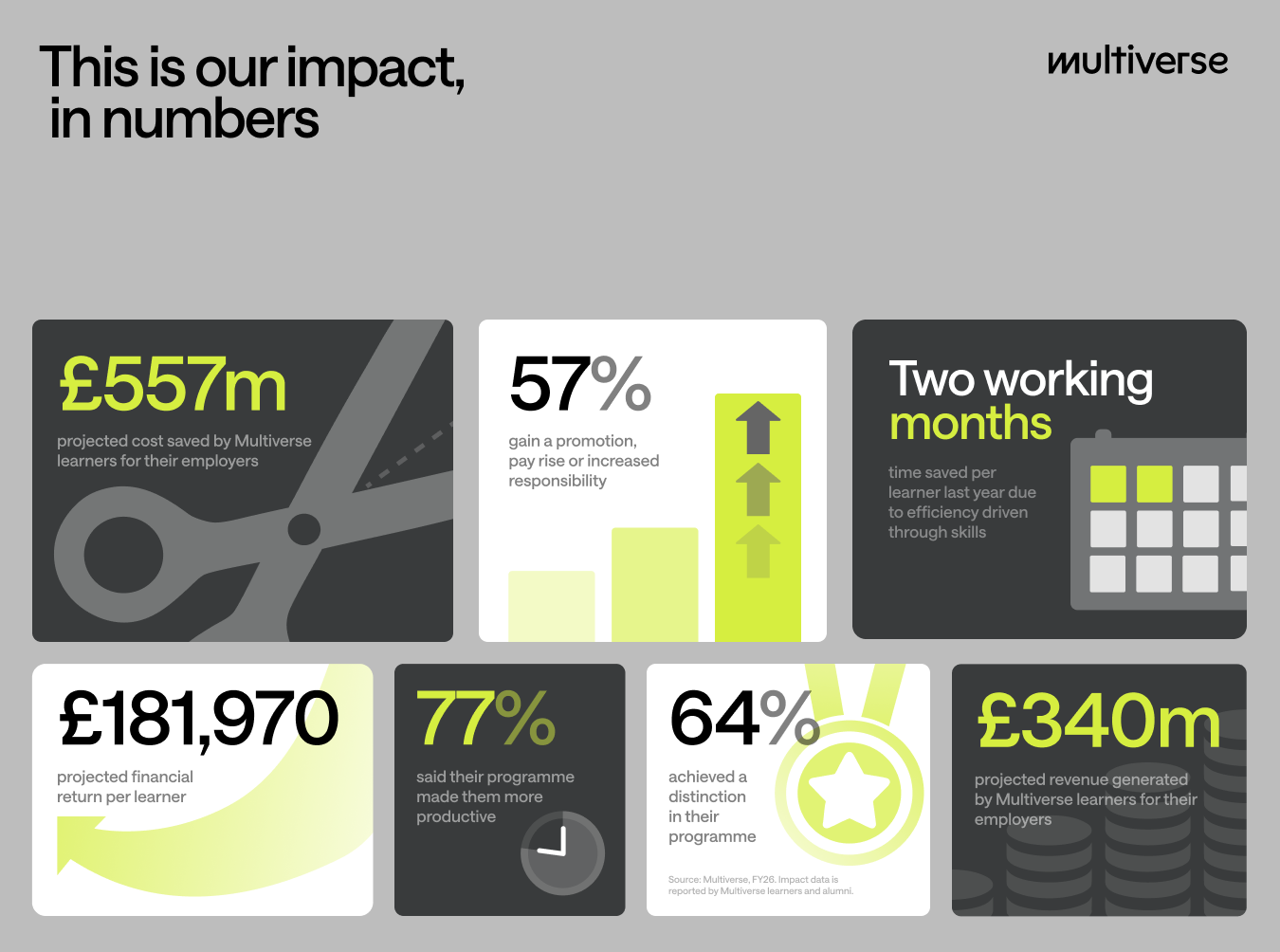
Our impact in numbers
Across 40,000+ learners and 1,600+ employer partners, we've tracked £2bn+ in confirmed ROI.
Last year alone, Multiverse learners generated £340m in projected revenue and £557m in projected cost savings for their employers, as well as saving two working months per learner through efficiency gains.
That's £181,970 in projected financial return per learner.
Meanwhile 77% said their programme made them more productive, and 57% secured a promotion, pay rise or increased responsibility - pushing them up the career ladder.
Data, not dreams.
Real people, real outcomes
Behind every stat is someone who used new skills to move their career forward. Take Cali who went from experiencing homelessness at 21 to having a Data Analyst role created for her by her employer today. She built a chat app for an internal function now used by more than 2,000 people across her organisation - and her employer took notice.
Or Olly, an AI learner at brickmaker Michelmersh. Through Multiverse's AI programme, he moved from learner to leader, helping his team use Microsoft Fabric to cut gas consumption and energy costs. "I can analyse what's happening on the factory floor and connect it to the wider business strategy," he says. "That shift in perspective is what got me promoted."
Built for employers who want proof, not promises
More than half of CEOs say AI isn't delivering. But we think the question was never whether AI works. It was whether the workforce was equipped in how to use it.
One in three FTSE 100 organisations, 70% of Russell Group universities and 100+ NHS Trusts have worked with us to make that change. And every learner is backed by our 240+ coaches and instructors, as well as our AI coach, Atlas, which has fielded 2.25m chats from 25,000+ users to date.
Skills are a cause of economic growth, not a by-product. This report shows what happens when organisations, and the people inside them, treat capability building like the investment it is.
AI 56: How a teacher used AI to ease the classroom workload
News
Team Multiverse
The workload of a teacher can be incredibly demanding: beyond delivering lessons, there’s planning, administrative work, student support, and countless other tasks competing for time. All this can quickly become unmanageable.
As a Multiverse coach working with an education charity, Rachel O'Hehir sees this first-hand. “What every teacher has told me is just how demanding their role is,” Rachel explains. “They’re under a lot of pressure which can easily lead to burnout. So, removing the administrative burden is a no-brainer, allowing teachers to reinvest that time into what’s important.”
Teachers lose 2-3 hours each week on manually preparing and reformatting slide decks, so it was no surprise that one teacher Rachel was coaching wanted to find a smarter way of working. That’s why she enlisted the help of AI to transform the way lessons are planned.
She built a new AI tool: a slide engine that automatically creates lesson decks, applies standard formatting templates, and pulls in the government-required literacy and vocabulary homework content.
“By inputting all the key resources needed for a lesson, teachers receive a slide deck that’s 80% ready for teaching,” Rachel explains, “and from there, they can easily tailor each deck to make sure it’s ready for different lessons and students.”
With the heavy-lifting done for them, the slide engine saves teachers at least an hour a week each – a massive cumulative saving of time across the organisation. It also enforces quality control, automatically integrating school and government requirements without creating extra work.
“At the minute, it’s the teacher’s department using the tool, but the plan is to roll it out to the wider organisation, and ultimately the wider federation of academies, based on how successful she and the team have found it.” A huge achievement for her and her fellow teachers.
Sorry, no results found.