Turning 30,828 parcel scan events into a view of the whole network: inside the Evri hackathon

03:09
Evri moves around a billion parcels a year through more than 500 hubs and depots and over 30,000 couriers. Every one of those parcels leaves a trail of scan data showing where time is lost. But raw scan logs aren't routinely turned into the kind of operational view a depot manager can act on.
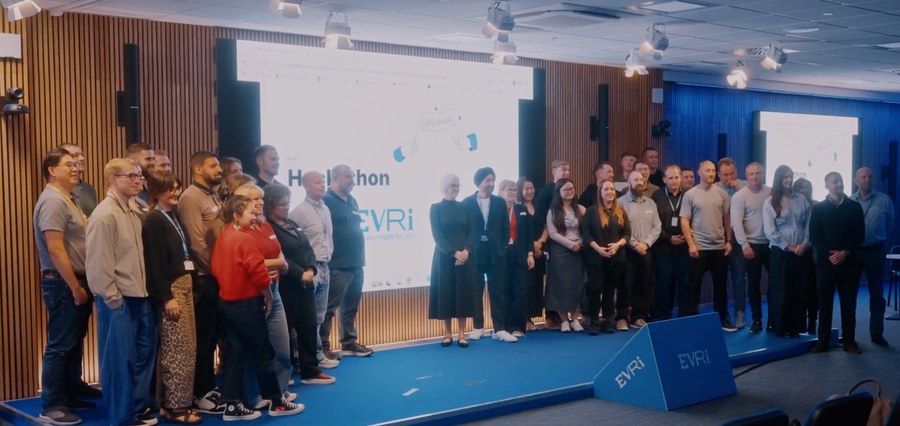
Recently, 30 Multiverse apprentices tackled that problem head on using AI. At Evri's Barnsley Hub, they spent a day turning a real, anonymised extract of 30,828 scan events from 4,000 parcel journeys into a performance benchmark, a working dashboard and a plan for making AI insights part of managers' daily routines.
Discovering where the network loses time, and how to get it back
Multiverse hackathons put apprentices to work in teams on a live problem from their own organisation, then have them present their findings to senior leaders.
There were two parts to the challenge facing Evri's apprentices, who were drawn from a cohort that spans HR, customer, delivery, commercial, sales, IT, planning, marketing, finance and operations.
First, they were tasked with benchmarking service performance across the network and explaining where and why it diverges between sites and service levels. Then they had to design how that insight reaches operational teams. Does it get there via an auto-generated weekly performance narrative, or a daily depot brief delivered by an AI agent? Is there an even better way?
Both aspects severely tested the skills apprentices had been learning during their studies. Speaking on the day, Maria De Maria, Multiverse Coach said: “They're going to use the skills that they've learned so far on the apprenticeship, but also learn from each other and learn new skills to solve real-life problems.”
“We're working on a solution that would improve the service we deliver to customers and also improve revenue protection,” added hackathon participant Andrius Žiukas, Enterprise Business Analyst at Evri and an AI apprentice.
Pitching to the top table
By the end of the day, the teams had produced a range of new insights and solutions, including:
- A benchmark showing where the network loses time, and which sites sit furthest from the average.
- An interactive Power BI dashboard built for daily operational use.
- An AI-in-the-flow-of-work concept, with responsible-AI guardrails and a clear value case
These outputs were presented to a panel of senior Evri stakeholders, including the Head of Intelligent Automation, Chief Data Officer and Chief HR Officer.
The panel treated the proposals as they would any internal innovation initiative, asking the hard questions necessary to decide which were worth taking further.
Because, as Harvinder Atwal, Chief Data Officer at Evri said, "Data only has one purpose, and that's to help you make better decisions. It's really important that we use that data to help us meet our customer and client needs."
The vision behind Evri’s upskilling strategy
The backdrop for the hackathon is Evri's vision to lead the way in creating responsible delivery experiences for everyone, everywhere, by investing in people and building a market-leading technology platform. The Multiverse programme, whose main cohort launched in April 2026 and which now has more than 60 learners, is designed to be the AI adoption layer that brings these two priorities together.
"The big thing we wanted to do with Multiverse as a partner was to take people who don't work in those specialist data or tech areas and help them to develop skills," said Lyn Warren, Chief HR Officer, Evri.
Back to the day job, upskilled and up to the challenge
Matt Watson-Power, UX Design Principal at Evri, is both an AI apprentice and a line manager. "I've been able to apply the things I've been learning to my role immediately," he said.
For Rasa Savickaite, Commercial Operations Manager and a data apprentice, the difference shows in routine work. "I noticed that I'm faster at completing day-to-day tasks, for example the reports I create every day," she said.
In that sense, the hackathon was the upskilling programme in miniature: learn a skill, apply it quickly to real business challenges, and build the confidence to get the result in front of the people who make decisions.
Long term, that will benefit both Evri and its people because, as Waine Greenway, Senior Business Analyst, Evri (AI apprentice) said: “AI is going to become part of our daily lives. I would rather embrace it and be part of that journey.”
Get in touch