

For media enquiries, email press@multiverse.io
Our media kit contains free to use images, including our logo and headshots of our leadership team.

Multiverse in the news

Bloomberg
Bloomberg
Euan Blair: AI Transition Needs An 'All In' Approach
It's clear Artificial Intelligence will transform the way we work. But how should workers - and their employers - position for success? Euan Blair, the CEO of upskilling platform Multiverse, says the key is to go 'all in' on AI. Blair spoke to Tom Mackenzie on "Bloomberg Tech: Europe."


Our recent announcements
Thank you! Your submission has been received!
Oops! Something went wrong while submitting the form.
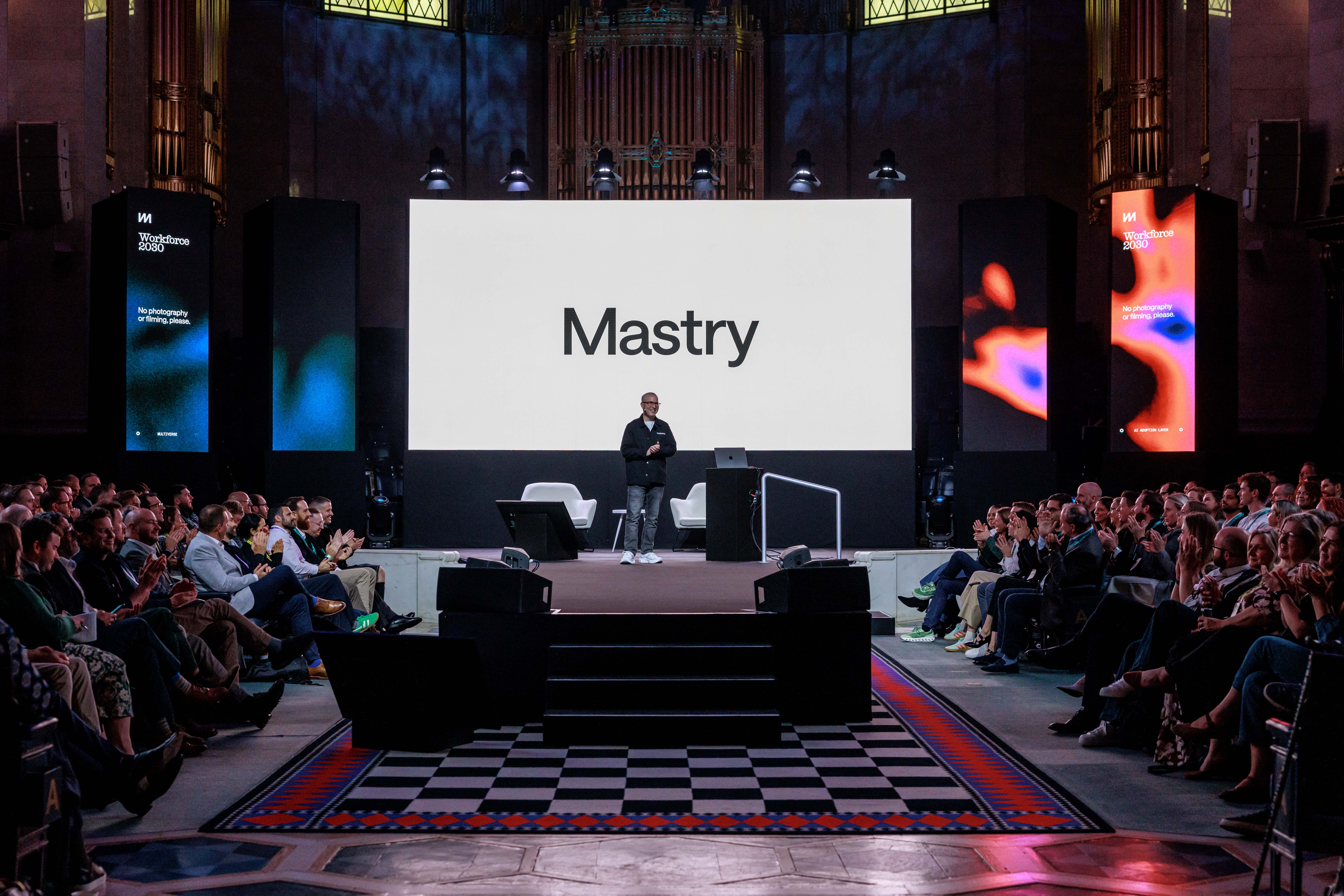

Multiverse launches Mastry, a single platform to take companies from AI ambition to AI adoption
News
Team Multiverse
Earlier this week, we published new data showing that British workers lose 28 working days a year to inefficient work with data. 97% of the workers in our study want to improve their AI skills, while three in four UK adults have never had any AI training.
Knowing where the skills gaps are is one challenge. Closing them is another. Today, at our Workforce 2030 conference in London, we launched Mastry to bring everything together into one platform.
Why AI adoption stalls between investment and results
Buying the tools is the easy part. The difficult part is getting people to use them well in their day-to-day work. A plan on paper doesn’t change how someone works the next day, and neither does training that sits apart from the work. That leaves leaders assembling the answer themselves, from a consultancy, a training provider… and a lot of hope.
What Mastry does
Mastry is an adaptive learning platform that runs a company’s AI workforce change from start to finish. It finds where the skills gaps are, teaches people in the course of their actual jobs, and shows leaders the impact the learning has delivered.
- Diagnose: Each person has a short voice or chat conversation with our AI agent about their role and how they work, and leaders get a view of capability across the organisation, mapped to business goals.
- Guide: Mastry builds a learning plan for each person from what the business needs and what they can already do, using their own work projects as the material. Mae, our AI guide, works alongside people inside Claude, Microsoft Copilot and other workplace tools. She offers guidance on live tasks and records evidence of new skills as people apply them.
- Prove: leaders see progress across teams, so they can report what their AI investment is producing.
Learning that sits inside the work
Jay Richman, our Chief Product and Technology Officer, said: “If learning competes with work, work will always win. So we built Mastry to sit inside the work.”
Mastry can be used on its own or alongside Multiverse apprenticeships, which continue to be delivered with expert human coaches. Both will be run from the same platform.
Built on ten years of training people at work
Multiverse was founded ten years ago as an alternative to university. With Mastry, we are taking a modern approach to ground long held by management consultancies: a single partner for a company’s AI workforce change.
Euan Blair, our founder and CEO, said: "Companies have bought the AI tools, but what most still lack is a workforce that can use them to make a difference. Until now they've had to rely on external consultants, with results often not materialising. We focus on installing expertise across the workforce so they can drive the change themselves, and Mastry puts that provision in one place. It's built on our deep expertise training workers on the job and insights from hundreds of thousands of real workplace projects."
Frequently asked questions
When will Mastry be available?
Mastry is available now to eligible development partners through a waitlist, with full launch planned for early 2027.
How does Mastry work?
It finds where the skills gaps and organisational blockers are, teaches people in the course of their actual jobs, and shows leaders the impact that the learning has delivered in real time.
Mastry works alongside people inside Claude, Microsoft Copilot and other workplace tools. Mae, Mastry’s AI guide, helps people with the task in front of them, so they build skills while doing real work, not in a separate course.
Does Mastry replace human coaches?
No. Mastry runs alongside Multiverse apprenticeships, which are still delivered with expert human coaches. Coaches bring accountability, pastoral care, group coaching and more, and Mae, Mastry’s AI guide, helps with the work in the moment.

How we're using AI to invest in coach development
News
Team Multiverse
Ask Multiverse learners what makes their programme work and most of them will talk about their team of coaches and instructors. Learners give our coaches a 97% satisfaction rating, and coaching quality is what we guard most closely.
That takes two things: a clear view of how every session goes, and delivering personalised, point-of-need development for every instructor. Until now, one constraint limited both.
The limits of a monthly observation
A Delivery Manager could observe each instructor about once a month. One session gives a narrow view. It can miss a problem that is building, and it gives little basis for development tailored to the person. Managers also spent much of their time gathering evidence, which left less for acting on it. Schools and training providers everywhere face the same problem.
"As a former teacher, I know how hard it is to build an observation system that helps people improve. In my first years in the classroom, I was observed once a month, with feedback based on a 20-minute snapshot of a single lesson. It always felt like putting on a performance, so the feedback didn't reflect what my lessons looked like day to day. Later, when I ran Delivery Enablement at Multiverse, I observed every member of the team once a fortnight. I loved giving that feedback, but I knew the approach couldn't scale. Compass is the result of nearly a year spent working on that problem. Every instructor now gets feedback based on how they teach in every session, and we have a much clearer picture of quality across all our programmes."
Chloe Barker, Senior Director, Quality, Multiverse
What Compass does
The Compass agent is an AI tool that reviews instructors' sessions against the Compass Framework, the skills required to deliver exceptional workshop-based training that we use to hire, train and develop every coach. Before, a manager could review one session a month. Compass reviews every session and combines what it finds with learner feedback.
It produces two things. First, a review for each session, which shows managers where quality may be at risk so human managers can review the session and check if the concern is valid - acting quickly to remediate and mitigate if needed. Second, suggested development areas, which give each instructor individual feedback, with data drawn from across their teaching practice, not just a snapshot.
The first protects the standard learners and employers expect. The second helps instructors raise it. Neither is a verdict on anyone's performance, but both enable us to spot positive trends and innovations across our delivery that can be recognised and promoted.
Where people stay in charge
Our AI principles commit us to keeping a human in the loop and to AI that is open about how it works. We designed Compass around both.
Delivery Managers review what Compass produces, check it against what they know and decide what to do, if anything. The instructor and their manager agree development goals together. Compass is one important data point among many. Performance management rests only on human observation, and the tool makes no decision about anyone's job.
Rolling it out in stages
We've brought Compass in gradually, so that instructors understand it before it plays any part in their development.
- August: we built the reports and tested them with Delivery Managers only.
- September: we introduced the tool to instructors and explained how it works. Reports stayed visible to managers only.
- October: reports move into our internal coaching platform, where instructors will see the same information as their manager.
Later, we plan to use the same approach for learner progress reviews and for Cohort Coaches, and to link what Compass finds to the training we offer our coaches.
In rolling it out, we've reviewed and learnt from similar tools being rolled out across education, including academic research, Stanford's M-Powered Teachers, and IRIS Connect.
Part of a wider approach
Compass follows the path we took with Atlas, our AI guide. Atlas now resolves 88.3% of routine support queries and has answered more than 1.5 million questions, with a 99% helpfulness rating from learners. The share of coach time spent on routine support has fallen from 41% to 18%.
That time has gone back into the work only people can do: mentoring, pastoral care and developmental coaching. We've also kept adding people, hiring 40 new coaches and instructors in a single quarter.
"AI adds real value in the flow of work, for time-constrained tasks and the urgent things you need help with right now. That work does not need a human doing it. But at the core of it, the human coaches are the ones who then have more time to work with learners on their goals, their ambitions, their values, what motivates them."
Kelly Griffith, SVP of Coaching & Delivery
Compass applies the same idea to how we develop our coaches and check their work: AI collects the data and takes a first pass through it, but people take a judgement, and then decide how to act.
What this means for learners and employers
Learners get sessions held to a consistent standard, with problems caught in days where a monthly observation might have taken months. Employers get clearer assurance about the quality of the coaching their people receive. Instructors get personalised development built on their real teaching, which is what keeps the standard rising.
Read our AI principles, or visit our Impact Hub to see how Multiverse coaching turns skills into results.

AI 56: How one retail employee used AI to improve store layouts
News
Team Multiverse
Store layout matters more than most shoppers realise. Get it right and sales rise, aisles stay clear, and customers find what they came for.
At a major UK retailer, one team decides where every product sits across every store. One of its members owned the feedback loop: gather responses from stores, spot the recurring issues, then summarise it for the senior team.
The process was slow.
"The sheer volume of data across two different platforms was a problem," Georgina explains, "and it was taking two hours to complete."
Two hours each round meant updates landed late and inconsistently. He needed a faster route - and AI gave him one.
"The team built a game-changing AI tool," says Georgina. "They open Copilot, upload the Excel file with all the feedback, and use a master prompt to analyse it. Then it creates a PowerPoint to send straight to the senior team for final decisions."
The tool sorts feedback into categories, writes the summaries, and sets out clear actions for the right colleagues in store. The learner still plays a crucial role - using his expertise to sense-check the findings and themes.
"The impact has been significant," Georgina says. "Besides turning a two-hour task into a fifteen-minute one, he can analyse store feedback daily rather than weekly. The senior team gets what it needs immediately, actions go out quicker, and stores feel like they're being heard."
One tool. Fifteen minutes. Better shop floors across the country.
Sorry, no results found.
We couldn’t find what you are looking for. Please try another way.

About Multiverse
Multiverse is the upskilling platform for AI and tech adoption. Multiverse has partnered with over 1,500 companies to deliver a new kind of learning that’s transforming the workforce through tech skills.
Multiverse apprenticeships are for people of any age or career stage and focus on critical AI, data and tech skills. Multiverse learners have driven $2bn + ROI for their employers, using the skills they’ve learned to improve productivity and measurable performance.