










We couldn’t find what you are looking for. Please try another way.
Employers

Thank you! Your submission has been received!
Oops! Something went wrong while submitting the form.

The Office for Students has extended Multiverse’s degree-awarding powers, unlocking more opportunities for employers and apprentices
Employers
Team Multiverse
This significant extension allows Multiverse to further its model, enabling more high-impact, debt-free degree pathways.
Multiverse is the UK's only independent training provider with degree-awarding powers, a distinction that confirms the quality of education it provides its apprentices. In the National Student Survey commissioned by the OfS, it has held the highest satisfaction rating within the Digital & Technology Solutions Professional standard for the past two years, currently sitting at 85.6%.
This expansion immediately enables the launch of Multiverse’s newest degree apprenticeship programme, AI Product Engineering (AIPE), which is uniquely designed for the future of the industry, amplifying software engineers' capabilities through AI so they are able to deliver more value, faster. The AIPE programme is focused on training engineers to design end-to-end systems and effectively integrate AI across the Software Development Lifecycle. It teaches engineers how to use AI as a co-engineer to amplify their productivity and deliver better commercial outcomes.
The AIPE programme will be quickly followed by additional degree-level programmes within the Chartered Manager and Project Manager standards.
"This recognition from the OfS reinforces our approach. We are proud to be the UK's only independent provider with this power, and its extension means we can rapidly scale up the creation of vital, high-growth degree pathways," said Euan Blair, Founder & CEO at Multiverse. "By expanding our degree-awarding scope, we can deliver more high-quality, job-relevant qualifications that produce the talent the UK economy desperately needs."
The value of this model is best described by those currently benefiting from it. Louise Gardner, a Multiverse degree apprentice, spoke about the programme’s impact: "Doing a degree apprenticeship has helped me advance my career - after graduating, I was able to step into a secondment in the global corporate responsibility team. But more than that, it provided me with critical insights and skills, which I’ve leveraged to add tangible value to my team by improving how we use data to inform decisions.”
This expansion allows Multiverse to deliver more impactful, degree-level apprenticeships that directly address the skills needs of the UK economy, preparing a new generation of talent for the future of work.
Multiverse’s playbook for delivering impactful learning
Employers
Team Multiverse
Last year, our commitment to empowering our team’s AI use resulted in a 37% growth in revenue per employee. We believe the most powerful AI tool is not a new piece of software, but a workforce that has been taught how to effectively use it.
Our transformation shows that true AI adoption requires more than just access to technology—it demands an entire behaviour change.
Beyond the tool: It's a mindset shift
Many leaders believe their teams just need to learn a new tool to achieve meaningful results, but true transformation demands more. It involves reimagining entire workflows and understanding where the AI tool fits—or where it completely replaces existing processes. Furthermore, it requires focusing on the essential human skills, like critical thinking, to filter results and identify inaccuracies.
Leading a team through this shift, especially when some are reticent to adopt new tech, is a core element of culture change.
How our Learning team uses AI for impact
Our dedicated Learning team is constantly adapting, recognising that in the world of AI, continuous, real-time learning is paramount.
1. Improving the learner experience
We are focused on using AI to deliver a hyper-personalised, contextualised, and enjoyable learning experience.
- Personalisation at scale: AI allows us to move beyond one-on-one mentoring, which was previously necessary for deep customisation, by using the knowledge of LLMs to personalise and contextualise content for each learner.
- Real-time relevance: The world of AI moves fast, so we created protected learning time for our subject matter experts to stay current. We also use AI agents to scan the entire market, collect information, and bring back reports to highlight where we need to focus our attention, ensuring our content is always up-to-date.
- Innovative tools for apprentices: AI is interwoven into the apprentice experience to make learning easier. Our contextual, AI-powered coach, Atlas, helps learners understand why they are stuck and how to unblock themselves, rather than just giving the answer.
- Tools for creators: We've built internal AI tools that remove the challenge of the "blank page" for our learning designers, helping with initial creation, automation, and consistency.
2. Delivering outcome-driven learning
In the AI era, learning is not for learning’s sake; it is for enabling new individual or company capabilities.
- Measuring impact: The rise of AI and modern data systems means we can now connect learning to concrete, measurable results. We can get a "before and after snapshot" to understand the true impact that learning has on outcomes in a way that was never possible before.
- Outcome focus: This capability makes learning truly outcome-focused. We start with what we’re trying to achieve, and work backwards from there to understand what skills our learners need to develop in order to get there.
The foundation of our success is understanding that human adoption drives technology's value. By shifting our internal culture, we are not just keeping pace with AI—we are actively shaping the future of work, delivering personalised experiences for our learners that deliver true transformation.
Multiverse's playbook for creating a culture of experimentation
Employers
Team Multiverse
At Multiverse, we have seen firsthand that investing in AI isn’t just about the technology—it’s about the people building it. This approach has yielded tangible results: last year, we grew our revenue per employee by 37%, a direct result of our investment in AI technology and the cultural transformation that enabled it.
So, how do you shift an engineering mindset from traditional development to AI-first innovation? Here is how we approach AI transformation within our engineering capability:
Embracing experimentation
The key to unlocking innovation lies in individual empowerment, giving team members the freedom to experiment, trusting them and their domain expertise to get things done.
To truly build with AI, teams must shift their perspective on failure. In our engineering team, we encourage engineers to try, learn, and even fail, knowing they might not succeed on the first attempt.
- Learning at pace: We view experimentation not through the lens of risk aversion, but as an instrument for learning at pace.
- Dedicated time: Innovation doesn't happen if it isn't on the calendar. We utilise "Hack Weeks" and allocate 10-20% of our engineers' time specifically for learning and experimentation.
Balancing Speed with Security
A common hurdle in AI adoption is the fear of security risks. How do you balance the need for speed with the necessity of safety?
Our approach is to create guardrails so that our builders don't have to overthink compliance while they are in the creative flow.
- Programmatic boundaries: Whether it is through role-based access control or context-setting files in coding tools, we ensure engineers know it is safe to experiment within specific environments.
- Removing friction: By making security programmatic, engineers don't stumble over administrative fears; they can roll into their creativity and embrace the technology.
Overcoming the fear of failure
With any new movement, there is a natural human fear of humiliation or failure. To foster a true builder’s mindset, leadership must prioritise psychological safety.
By democratising the technology, we remove the fear that AI is rocket science. When the team sees that failure is just part of the process, they gain the confidence to build the future.
- Leading by example: Leaders need to embrace the technology themselves so they’re able to lead from the front.
- Celebrating the losses, as well as the wins: We openly share our mistakes to show that failure is just part of the process. This builds the confidence needed to try something new.
Innovation in action: AI grading
When you combine psychological safety, clear guardrails, and a culture of experimentation, you get tangible results. A prime example of this approach in action is our AI Grading capability.
An engineer on our team identified that grading homework was a prime opportunity to leverage AI and built a solution from scratch to address it. This tool has transformed how we operate:
- Empowering coaches: It reduces a massive amount of hours for our human coaches, freeing them up for higher-order activities like spending actual face time with learners.
- Faster feedback: Learners now receive faster feedback on their work, motivating them in their drive to improve.
This is the power of a builder mindset: when engineers are empowered to experiment, they build solutions that elevate the entire learning experience.
Multiverse's playbook for embedding data literacy
Employers
Team Multiverse
As we learned, successful AI implementation doesn't start with models—it starts with data. For any organisation aiming to harness the full power of AI, establishing the right data foundations and culture is paramount. AI is only as intelligent as the data it is trained on.
Here are three core pillars for building a robust data foundation and culture ready for the AI transformation:
The agility vs. scalability challenge
One of the biggest data challenges in an AI transformation is finding the right balance between agility and scalability. Since AI is a rapidly evolving technology, moving fast often means experimenting quickly, even if initial methods aren't scalable.
- Embrace agility for experimentation: A successful AI strategy involves enabling experimentation and allowing teams to try new things without immediately requiring a massive, fully developed data pipeline. This might mean starting with simpler, non-scalable methods to quickly prove a concept.
- Scale for sustainability: Once a concept is proven, the key is to transition to scalable solutions. An effective strategy involves doing both—experimenting quickly and building scalable structures—by knowing when to do one and when to do the other.
Building a data-first culture
Formal training is essential for building data literacy. However, training alone is not enough; success hinges on integrating data into the very DNA of the organisation.
- Consistency is key: A strong data culture means data is part of the day-to-day language and ways of working. Key metrics and definitions must be clear and consistently used across all settings, including meetings and documents.
- Empowering the whole organisation: Effective AI implementation requires giving data access to everyone, not just data scientists, and teaching them how to use it. Upskilling the entire organisation ensures the best possible use is made of the data.
- The consumption shift: As companies embrace AI, the way people and machines consume data changes. While dashboards were once common, organisations now increasingly need data formats that machines can easily read, such as APIs. Consistency in definitions is critical for trusting AI to correctly interpret the data and provide answers in natural language.
- Security and Compliance: The foundation of a trustworthy data strategy is ensuring that data is handled securely and responsibly. We demonstrate this commitment to our clients and apprentices, ensuring their sensitive information is handled with the highest level of care. Multiverse has achieved SOC 2 Type 1 certification, a result of third-party audit from the American Institute of Certified Public Accountants, confirming our internal controls exceed the necessary, rigorous standards.
Data as your competitive advantage
The most advanced AI applications are widely available to virtually everyone. What truly differentiates a company and drives value is its proprietary data, and what they build with it.
- Unlock internal value: Well-structured, proprietary data can unlock powerful AI solutions. For example, taking unstructured data, structuring it into a knowledge graph, and sharing it can provide valuable insights for customers.
- Move ahead of the pack: If a company wants to build something truly differentiated and make a real difference, it must connect AI to its unique internal data. The sooner an organisation commits to structuring and leveraging its data, the sooner it will gain a competitive edge.
By focusing on structuring data, fostering a company-wide data culture, and strategically balancing speed and sustainability, any organisation can build the solid foundations necessary to deliver powerful and effective AI transformation.
Multiverse's playbook for building an AI-powered workforce
Employers
Team Multiverse
As other People leaders scramble to compete for a scarce pool of highly skilled external AI talent, we have fundamentally shifted our approach to talent development to focus on building our own AI-ready workforce internally.
The shift: Hiring for AI will, not just skill
We recently launched a new hiring framework that focuses on assessing a candidate’s interest in AI. Why? Because we don't want to miss out on brilliant talent just because they haven't had the opportunity to engage with AI tools in their previous roles.
Our framework assesses candidates’ current level of AI competence through a series of questions and tasks built into our hiring process, matching them to one of four levels of AI maturity. The only group we exclude from hiring are those who demonstrate no will towards learning about AI. Everyone else, we’re confident we can equip with the necessary skills to fully adopt AI.
Bespoke onboarding: Building AI skills
This commitment to developing talent continues the moment a new hire joins. We have committed to our employees that they will become the most AI-powered versions of their profession.
Based on their assessed AI maturity, new hires are placed into a custom onboarding programme, receiving more than 20 hours of training in their first three months.
Demonstrable ROI: Quantifying the impact
Our internal upskilling isn’t just a feel-good initiative: it delivers measurable business impact. Last year, we grew our revenue per employee by 37% through strategic investments in AI and a cultural transformation to enable it.
We track several key outcomes, starting with tool usage. We’ve been able to demonstrate that those who engage with our AI upskilling programmes use our AI tools much more frequently than those who don't: for example, they log 73% more Gemini interactions.
We also look for impact stories, quantifying the results of the training, such as the reduced number of hours spent on certain activities or specific cost savings. Across our departments, we’ve logged more than 220 AI use cases created, representing how our team has reimagined their workflows to be more efficient and effective.
If you are a People leader looking to future-proof your organisation, the answer isn't a complex, expensive external hiring spree. The answer is empowering every member of your team with the skills and confidence to excel in the AI-driven future, right now.

Multiverse and NHS Apprenticeship teams collaborate to create a future-ready healthcare workforce
Employers
Team Multiverse
Together, in collaboration with NHS HR, Apprenticeship & Workforce professionals, we've successfully upskilled hundreds of NHS staff members across 100 NHS Trusts. This isn't just a number: it represents a fundamental transformation in how healthcare is delivered, from the frontline to the back office, as staff gain the confidence and expertise to harness the power of technology.
Our partnership was born with the aim of empowering existing NHS staff to drive innovation from within. In a sector with increasing demands and shrinking resources, data and AI present a much needed solution to a growing problem.
“Data more so than ever is a critical commodity in the NHS to support decision making, driving more efficient and effective outcomes for patients. We partnered with Multiverse to upskill our community in data science specialisms, and over the past 18 months, we’ve seen apprentices directly apply their learnings to deliver real results.”
Barbara Begg
Head of Central Commercial Function – Commercial Capability at NHS England
"We identified digital literacy as a key learning need early on, and our partnership with Multiverse supported us in addressing it through high-quality apprenticeships. The Multiverse team has always been responsive and collaborative, making it easy to support learners and keep momentum going.”
Roxanne Moran
Talent, Learning and Development Manager at National Institute for Health and Care Excellence
Apprentices are already putting their new skills to use, building innovative solutions that transform their work.
At Royal Free London NHS Foundation, an administrator migrated patient management processes to a digital system, doubling the daily department case load from 30 to 60 patients and reducing wait times from more than 30 minutes, to only 10.
Meanwhile at Medway Foundation Trust, an endoscopy nurse built a Power BI dashboard to automate the theatre audit processes, reducing delays, minimising errors and enhancing resource allocation.
None of this would have been possible without the hard work of HR, Apprenticeship & Workforce professionals across the NHS, who have supported learners to achieve these incredible results, in partnership with senior executive leadership teams.
"The NHS has the highest potential to benefit from technology of any institution in the UK, and its commitment to upskilling its people with the digital and AI skills needed for the future is a testament to its leadership,” said Euan Blair, Founder and CEO at Multiverse. “We've been consistently inspired by the apprentices and the leadership teams who have championed them—they are the true innovators, driving change to make a tangible difference in patient care and operational efficiency."
“Working with Multiverse has been seamless from our very first conversation. The team is responsive, supportive and willing to adapt to our needs as an organisation. Multiverse has also been very effective at understanding our strategic objectives, ensuring our apprenticeships have maximum impact to improve our processes, and ultimately, the delivery of care.”
Samantha Ibison
Apprenticeship and Employability Lead at Leeds & York NHS Trust
We really have enjoyed working with Multiverse – they’re engaged, responsive, and flexible to the changing (and sometimes conflicting!) needs of a big organisation like ours. The apprenticeships have been really popular and are clearly helping us meet the needs of our workforce. We’re excited to continue our partnership with Multiverse and to see the lasting impact it will have on our staff and the care we provide to patients.”
Susana Lucena-Amaro
Associate Director for Learning & Development and Apprenticeships at Barts Health NHS Trust
By equipping the NHS workforce with the latest digital and AI skills, Multiverse is not only helping individuals grow their careers but also empowering the entire healthcare system to become more efficient, innovative, and resilient.
The staff Multiverse has trained are now the data champions, the digital pioneers and the AI innovators who are helping to make the NHS more ready for the challenges of tomorrow.
The Atlas edge: How our AI coach transforms learner skills into business impact
Employers
Laura Ball
That's why we're evolving the Multiverse Platform to ensure no learner is ever alone on their upskilling journey.
Our 24/7 AI coach, Atlas, is more than a learning companion. Now, Atlas actively suggests, challenges, and offers instant feedback, empowering your teams to hone new skills rapidly and apply them in the workplace.
Keep reading to find out how Atlas helps your teams unleash real business value.
Building the right skills, right now
In the age of AI, competitive advantage isn't just about adopting new tech - it's about how fast your teams build the skills to use it.
A recent study on workforce intelligence reveals how skills velocity (the ability to quickly develop new industry and tech skills) will be the secret to unlocking real competitive advantage in the AI age.
That means continuous upskilling will become more vital than ever. Over two thirds of leaders say new workforce skills will be needed to remain competitive by 2030.
But to drive maximum impact, learning can’t be limited to individuals or specific teams. You need the ability to scale skills quickly across your entire workforce.
Atlas serves as a point-of-need solution, adapting to learner needs, industry, and role contexts, ensuring the development of the right skills at the right time.
Powerful collaboration, with true engagement
A paradox is emerging with many AI tools. They’re designed to make work tasks easier - but that risks making teams less skilled by offloading critical thinking.
An MIT study on 'Cognitive Debt' found that using AI assistants for writing tasks led to reduced brain activity, while other academic papers show that 'Cognitive Offloading' - delegating thinking to AI - is directly correlated with a decline in critical thinking skills.
So, how does Atlas avoid this pitfall?
Rather than simply allowing learners to offload cognitive work, Atlas is designed to foster what academics like Siemens and Moldoveanu (2025) call "interactional intelligence".
Practically, this means Atlas uses a Socratic, context-aware method to encourage critical thinking within the context of a learner's role and industry.
This helps your teams build a crucial skill - using AI not as a shortcut, but as a collaborative partner to deepen understanding and solve complex problems. But we don’t stop there. Learners are also actively taught to critically assess AI outputs, and strategically guide it to respond to their needs.
Our data shows this in action. Our learners are using Atlas as a thinking partner, not an answer machine. They’re conducting complex, goal-oriented activities, that demonstrate true engagement:
- Solving technical & practical problems (34%)
- Understanding & learning (27%)
- Creating & delivering projects (20%)
- Admin support (16%)
Three features, designed to create maximum value
To build this deeper engagement, our expert Product Teams - with deep industry expertise in artificial intelligence, educational psychology, and learning science - are enhancing three features that help learners actively engage with Atlas.
Guidance with context
Atlas is built into every page of the Multiverse platform. It knows exactly what learners are working on and tailors its guidance to that moment.
Whether they ask Atlas to help locate key resources, understand their learning schedule or troubleshoot issues, Atlas leverages its role and context-aware capabilities to provide real-time support.
Sometimes AI isn't enough. If a question is too complex or needs a human touch, Atlas will recognise this and connect your learner to the right person - whether that’s one of our expert instructors, or one of our support teams that help to resolve tooling issues, support additional learning needs and learner wellbeing.

Generating high-value project ideas
Atlas is a transformative partner that empowers learners to engage deeply, think critically, and apply their knowledge with immediate impact.
To close the gap between learning and application, Atlas helps learners to brainstorm high-value project ideas in the context of their industry and role. Atlas acts as an invaluable collaborative partner.
It suggests innovative approaches, challenges underlying assumptions, and provides instant feedback on initial concepts.
This iterative dialogue guides learners toward the most impactful opportunities at work, ensuring learners apply their skills on areas that will have the most benefit to them, their team and their organisation.

Helping learners apply their new skills
As learners embark on applying new skills in a workplace project, Atlas functions as a powerful coach.
Atlas challenges learners to deepen their understanding, helping to explain unfamiliar terms in language that resonates to each learner, and helping to break down complex topics into manageable steps.

When a learner is writing a report, Atlas can act as a thinking, writing, and editing partner, helping to outline, develop arguments, spark counter-arguments, and refine in real-time.
Similarly, in coding, Atlas can assist with code generation and debugging, transforming a traditionally individual task into a collaborative one. This interactive approach ensures that skills are not just learned, but truly mastered and applied.
The future of upskilling is here
The Multiverse Platform, powered by Atlas, champions a future where human potential is amplified, not diminished, by AI. We’ll help you build a workforce equipped with future-ready skills - and provide expert guidance to help your teams power productivity and performance.
Introducing your new Line Manager Dashboard: Clearer insights, better support
Employers
Anna Bienias
At Multiverse, we know that line managers play a crucial role in a successful learning journey. But having the right information at your fingertips is key.
That’s why we’ve launched your new Line Manager Dashboard - a tool designed to give you a clearer view of apprentice progress and empower you to be an even more effective mentor.

A central view of apprentice progress
The new dashboard centralises the progress and support insights you need to effortlessly guide your apprentices.
Gain clear visibility to help your team members as they apply their new skills in practice throughout their learning journey.
Key features include:
- Off-the-Job Hours: Quickly see if your apprentice is on track with their required learning hours, ensuring they meet this core programme requirement.
- Session Attendance: View their attendance in recent coaching and delivery sessions, giving you a clear picture of their engagement.
- Project Status: Understand which projects have been started and submitted, helping you stay informed on their progress with programme deliverables.
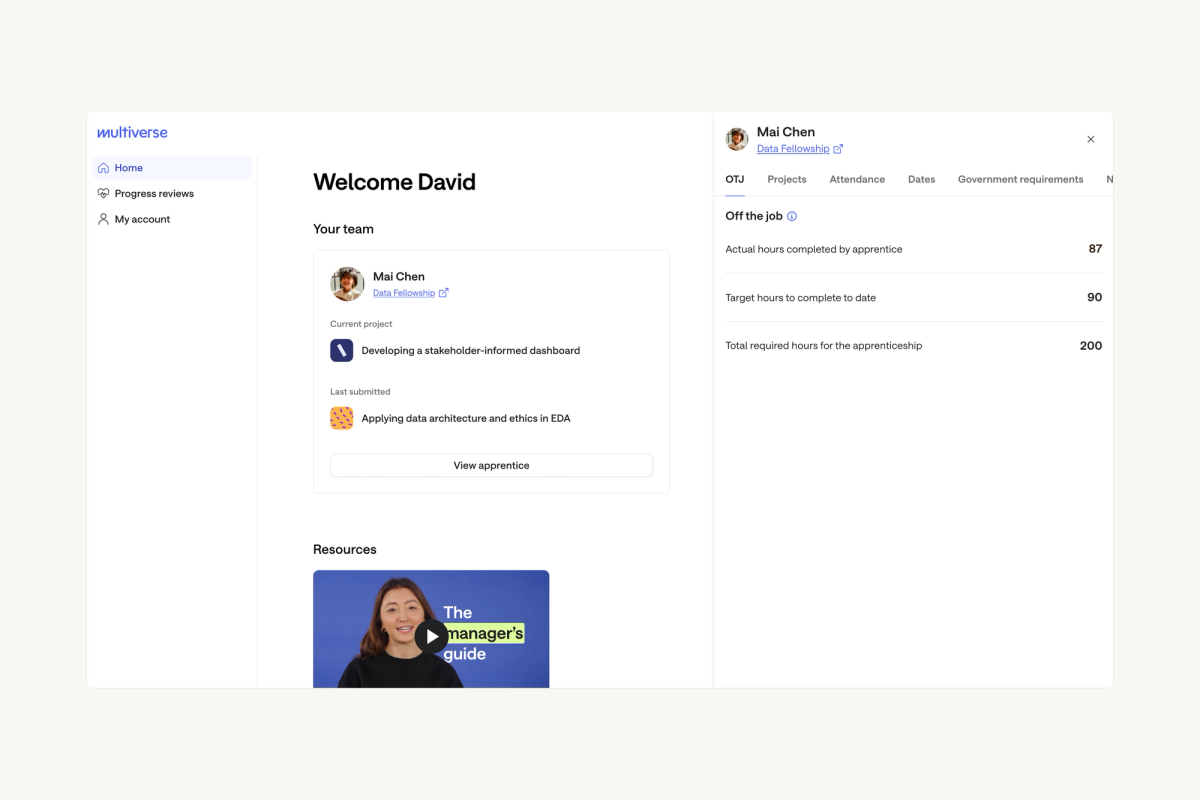
From data to development
This visibility is designed for one primary purpose: to help you have more meaningful, data-informed conversations.
When you can easily see an apprentice’s engagement and progress, you can:
- Celebrate progress by acknowledging when projects are submitted and work is complete.
- Proactively support: The dashboard provides clear flags to help you easily pinpoint apprentices needing support, allowing you to step in with guidance at the right moment.
- Drive meaningful discussions by asking informed questions about the specific projects they are working on.
Ultimately, the dashboard empowers you to support your apprentices proactively and helps you feel more connected to their learning journey.
Keen to see it in action?
The Line Manager Dashboard is another step in our journey to build a truly exceptional learning platform - helping you unlock the full potential of your teams and deliver measurable impact for your organisation.
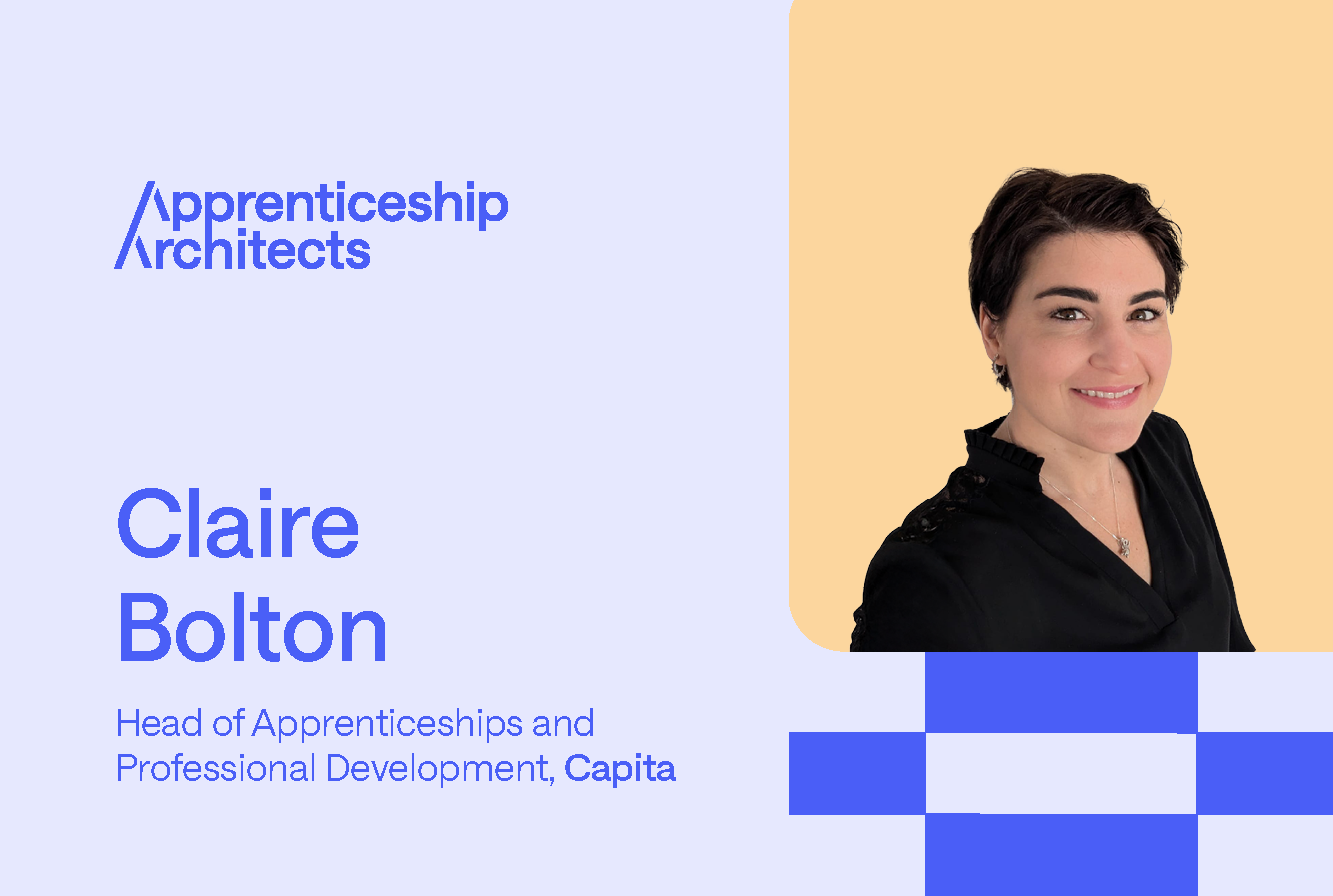
“The biggest impact is confidence” Apprenticeship Architects: Claire Bolton, Capita
Employers
Claire Williams
We spoke to Claire Bolton from Capita, about the steps for launching a new upskilling programme and how to align apprenticeships with AI adoption.
Welcome to Apprenticeship Architects, Claire. Can you tell us about your role and the apprenticeship programme you launched with Multiverse?
I'm Claire Bolton, Head of Apprenticeships and Professional Development at Capita. I work with Multiverse and other providers to promote apprenticeship programmes for Capita across the business.
I ensure programmes are of good quality and are fit for purpose, for the individuals and the organisation. I work with senior leaders at Capita to align the apprenticeships with Capita’s strategy. I’ve been working with Multiverse for some time on the AI for Business Value apprenticeship.
You’re now on your fourth intake of employees to the apprenticeship programme. Can you walk us through how it’s evolved?
At first, it was a big bang – we had so much interest across the business. It's evolved quite significantly over the four cohorts.
Initially, we started with a ‘transformation accelerator’ group. We held in-depth stakeholder interviews to understand:
- Where they sit in the business and what they’re involved in
- Who they work with and who works for them
- How could this programme add value to them?
- What are the problem statements this programme could potentially support?
We gave that information to the coaches working on the programme.
This is how you know, while building this knowledge, you're going to make a difference. And then we can use the projects they're working on, like a full cycle, and feed it back to those senior leaders.
What’s the biggest impact you’ve seen from the Multiverse apprenticeship programme?
The biggest thing is confidence. The [AI for Business Value] apprenticeship gives everybody the opportunity to start at the same level and build confidence.
For those in client-facing roles, they can go into a client meeting, take that new knowledge, and share the journey they've been on. That will be hugely powerful in our organisation to ensure our clients have confidence in us as their trusted advisor.
Can you explain the steps you took so learners knew what to expect?
In any apprenticeship at Capita, we're keen to make sure we have the right people, on the right programme, at the right time. No one wants to start a course and then drop out.
With Multiverse, we built out a comprehensive insight session. Following the first two cohorts, we took it one step further and it grew into a taster session.
It transformed from a factual session about the course, goals, and eligibility criteria into a preview of what sessions are like and how they're delivered. That way, learners get an idea of whether it would work for them. Having that exposure before they've committed has been really successful.
How do learners on AI for Business Value actually implement their new projects
We're very lucky to have Tiina Stevens, Director of Digital at Capita, who leads our AI engagement internally. She's been really involved in the programme, hosting sessions for apprentices to provide insight into her role, highlighting how they can have an impact on the business and its direction.
Tiina has introduced our AI Catalyst Lab, [which houses] all of the identified opportunities where AI could be applied as part of a solution. Apprentices have full access to align their projects to this Lab and have the opportunity to work with Tiina and her team to see it to fruition, which is really exciting.
How are you sharing success with the rest of the business?
Seeing the projects - and the impact individuals are creating - brings it to life.
This isn't just sitting in a classroom and learning the theory. They genuinely are changing the way our organisation is performing, developing and serving our clients and their customers, because they understand AI and how it can benefit them.
We share [learner] outputs in a variety of ways. We might do a session with a senior leader who previously identified the challenge. It might be that we'll have an internal community where we'll post various case studies of the projects. It varies, but it's important to complete that circle and show the successes of individuals and the impact on the business.
In National Apprenticeship Week, we had a panel session which we live-streamed across the organisation. We had six learners on the programme at the time who were able to speak about their experience.
That was incredible. Not only did it touch so many different people, it managed to get a huge audience watching virtually. It spotlighted the individuals as well as the programme overall.
We've talked about lots of positives, were there any challenges, and how did we overcome them?
One that sticks out for me – which was probably a good challenge – is we had to be careful about who we put on the programme. There was so much excitement and so much appetite. Understandably, everyone wanted to go on it. So we had to be strategic and selective as to who we could invite to join.
We did that by ensuring we had really good relationships with senior stakeholders who understood the needs of their divisions. They could work with us to identify who’s top of the list that needs to go on this immediately, who can afford to wait until the next cohort, and so on.
Without that strategic partnership with the wider business, the leaders, and their knowledge, we wouldn't have that clarity.
What’s your top advice for HR teams at the start of this journey?
I've got two. One would be to not underestimate the power of real stories. We've four cohorts in, and our first isn't far off graduating. We've got tangible impact statements, reports, projects and outcomes that we can share with our business and with our clients. It's real, it's not theory. The more we can promote those, the better.
My second bit of advice is to work with the business, layer by layer. The real success has been understanding each area of our business and how this can help individual teams, before tailoring the nominations and the offering.
We've spoken lots about the wider impact, do you have any individual success stories you want to share?
Many learners [have created] significant impact since being on the programme, but one in particular stands out from our first cohort. They had no exposure to AI and joined full of enthusiasm and excitement, like everyone does.
There was a moment when she wasn't sure if she was going to stay on the programme. And she'll tell you that she's delighted she did, because she turned that corner, and started to see the change in her thinking and doors opening internally. She's doing some brilliant work in leading AI change in her area of the business.
It’s a lovely, good news story, about achieving something that you might not have thought you could and going through all of the challenges to get there, but actually seeing the benefits afterwards.
What's your long-term vision for the AI for Business Value programme at Capita?
I’d love to create a sense of communal learning in Capita. AI is changing all the time, and it's important our colleagues are continuously developing their learning in this space.
So even once they've completed the programme, it would be lovely to create a space for them to share their learning regularly. That might be a regular spotlight ‘lunch and learn’ where we invite apprentices to share the projects they're working on.
That would be a way to spread the knowledge, excitement, and confidence across the business as well as keep momentum. We can't stand still, because we'll get left behind.

Why reskilling and flexible training are vital: Breaking down the Skills England report
Employers
Ellie Daniel
At Multiverse, we’ve been keenly following the establishment of Skills England, a new government agency sponsored by the Department for Education, which brings together partners from inside and outside government to drive improvements to England’s skills landscape, to power economic growth and opportunity.
What is Skills England’s role in assessing skills?
As the country’s authoritative voice on current and future skills needs, one of Skills England’s primary responsibilities is identifying skills gaps across the economy through comprehensive skills assessments.
The goal is to create a skills system ‘fit for the future’, and to ensure that the government’s skills strategy and policies are informed by a data-driven approach.
Introducing the Skills for Growth and Opportunity Report
Skills England published its Skills for Growth and Opportunity Report in June 2025, following a period of data analysis and engagement with employers and other stakeholders about the country’s growth and skills offer.
The report brings together a wealth of evidence including analysis of Government data and insights from 743 stakeholders, including employers.
It identifies the challenges faced by employers in developing skills pipelines and the critical importance of the skills system in delivering the Government’s missions and wider priorities, including its Industrial Strategy.
Crucially, it highlights long-standing skills shortages across the eight Industrial Strategy Growth-Driving Sectors:
- Advanced Manufacturing
- Clean Energy Industries
- Creative Industries
- Defence
- Digital and Technologies
- Financial Services
- Life Sciences
- Professional and Business Services
And in two additional ‘critical’ sectors:
- Construction - essential for achieving the government’s wider house building aims)
- Health and Adult Social Care - facing pressures as a result of demographic shifts
Skills England report: Three takeaways from Multiverse
Skills England offers an overarching perspective on themes pervasive across these sectors.
These include the escalating demand for highly qualified workers, the prevalence of gender inequality in various priority sectors, and the importance of the wider education system, including careers advice, in addressing skills challenges.
Three themes particularly caught our attention:
1) The digital and AI revolution is transforming workforce skills
According to Skills England, the unprecedented pace of technological change is a ‘major driver of changing skills needs across sectors’ with AI in particular reshaping the future of the workforce.
For example, in the creative industries, 69% of employers say their staff need urgent retraining due to new technologies. The report demonstrates that both advanced digital skills and digital literacy are in critical demand - with basic digital skills set to become the UK’s largest skills gap by 2030.
2) Reskilling is essential to combat the widening digital gap
Employers highlighted the importance of both reskilling the existing workforce alongside upskilling new entrants, with apprenticeships identified as an important tool in enabling this, particularly in relation to the adoption of AI and data science.
Despite this technological revolution, Multiverse research has shown that more than half of workers have received fewer than five hours of training on AI, and just one third (34%) of FTSE 100 companies reference AI training in their latest annual reports.
That’s why we’ve recently launched a commitment to train 15,000 new AI apprentices over the next two years.
3) Flexible apprenticeships and training options are key
Employers see the value in apprenticeships but are calling for more flexible, responsive models such as shorter, flexible courses or ‘bolt-on’ training in AI, to meet business needs as they evolve.
Multiverse has long been calling for increased flexibility in the apprenticeship system so as to widen access to learning and ensure the apprenticeship system truly serves the immediate and evolving needs of businesses.
The path forward
The Department for Education is currently developing a Post-16 Education and Skills Strategy, which will articulate its long-term vision for skills.
While we don’t expect major changes any time soon, decisions also lie ahead regarding the future of the Growth and Skills Levy, and how much increased flexibility this might offer for employers in the future.
Skills England’s assessment is a critical first step in closing the nation’s skills gaps and designing a system that will unlock economic growth. The message is clear - investing in workforce skills is instrumental to driving productivity and economic growth.
Sorry, no results found.