










We couldn’t find what you are looking for. Please try another way.
The Multiverse blog
Thank you! Your submission has been received!
Oops! Something went wrong while submitting the form.
Types of data: Definitions, examples, and how they’re used in data science
Apprentices
Team Multiverse
Learning how to analyse different kinds of information is essential for many different functional roles, regardless of where they sit in an organisation. The most common types every data professional encounters are:
- Categorical data – Describes non-numerical traits, such as gender and occupation
- Quantitative data – Numerical values like age and height
- Structured data – Information that follows a consistent format, such as phone numbers and bank account details
- Unstructured data – Less uniform data that doesn’t follow a set pattern, including photos and webpages
Data Analysts and Data Scientists rely on all four types of data to build models and make savvy decisions. Here’s an in-depth breakdown of their differences and applications — and practical guidance to help you use them in your business.
What is data?
Data refers broadly to all the pieces of information that businesses collect or produce. Practically anything can be considered data — as long as someone takes the time to observe or record it.
Most information falls into two categories:
- Qualitative data – Information that’s open to interpretation and described with language, e.g., photos and open-ended survey responses.
- Quantitative data – Measurable information that’s represented numerically, e.g., revenue, number of sales, and average customer rating.
Data has become an incredibly valuable resource for businesses in all industries. Just look at Salesforce’s iconic “Gold Rush” commercial. “If AI is the Wild West,” Matthew McConaughey drawls from under his cowboy hat, “does that make data the new gold?”
While the ad might play off a bit silly, the analogy is on point. No, most businesses aren’t selling data like freshly-mined bars of gold. But they are using this information to make faster and more accurate decisions that directly impact their bottom lines.
Take Marks & Spencer, for instance. The British retailer gathers customer feedback, demand indicators, and other data. Machine learning algorithms analyse this information and spot opportunities to develop new products. According to executive Richard Price, this artificial intelligence (AI)-driven technology has helped Marks & Spencer provide “a more compelling fashion-led experience.”
Why data types matter in data science
Classifying information is a critical part of data analysis. After all, you can’t interpret something if you don’t even know what you’re working with.
Different data types call for specialised tools. For example, numerical data like customer income fits neatly into tables and Excel spreadsheets. Theoretically, you could also add qualitative data like audio recordings to these formats. But you won’t be able to search for specific sound bites quickly — at least, not without external software. A media management platform with annotation and transcription features would work much better for these files.
The kind of information also determines the analytical techniques you use. Statistical methods, for instance, can help you uncover valuable insights in quantitative data. Suppose a sudden drop in revenue has left your sales team baffled. By analysing historical data — such as the performance of past marketing campaigns — with regression tools, you could spot factors hurting your sales.
Of course, you can’t plug qualitative data into a math formula. Just try subtracting or multiplying your customers’ favourite foods — pure nonsense. Instead, you can use strategies like content analysis and thematic analysis to spot patterns and draw conclusions.
The main types of data
Businesses rely on all sorts of information to guide decision-making. Let’s take a closer look at four popular types.
1. Categorical data
You already know that categorical — or qualitative — data is non-numerical. It uses descriptive labels to group items based on shared traits.
There are two kinds of categorical data:
- Nominal data – Information you can sort into categories, but they have no obvious order.
- Ordinal data – Data points that you can categorise and objectively rank.
Customer data can fall into either category. For example, clothing size is ordinal, because you can arrange it from “small” to “extra large.” Similarly, customer satisfaction ratings using a Likert scale — from “not at all satisfied” to “highly satisfied” — count as ordinal data.
On the other hand, customer segments are nominal because they only describe traits. You might personally care more about “new clients” than “inactive customers,” but there’s no natural order between them.
In business analytics, nominal and ordinal data helps organisations understand customer preferences. For example, Spotify learns your personal tastes by analysing nominal data like artists’ names and music genres. It also evaluates ordinal data, such as liked vs. unliked songs. Together, this information helps the streaming platform offer increasingly personalised song recommendations and playlists.
2. Quantitative data
There’s no clever wordplay going on here — quantitative data is simply anything you can quantify. If you can measure something or attach a number to it, it falls under this umbrella.
Of course, not all quantitative values are the same. This category has a few subtypes, including:
Discrete data
Discrete values are always whole numbers, and they represent things you can hypothetically count — even if it would take a very long time to do manually. For instance, you can’t have 3.75 users.
Here are a few examples of discrete data:
- Number of customers
- Number of support tickets
- Total purchases
You can easily represent discrete data with simple visualisations. If you’re analysing customer service, you could create a pie chart comparing open vs. resolved tickets.
Continuous data
Sometimes, you need to analyse complex data with decimals. That’s where continuous data comes in. It represents virtually any value and often changes over time.
This type of data gets its name because it’s measured on a continuous scale. For example, you can count minutes from 0 to infinity, but you’ll never have -3,000 minutes — unless you unlock the secrets of time travel. On the other hand, net sales revenue and temperature can have both positive and negative values. It all comes down to what you’re measuring.
Because this subtype is so flexible, it has numerous use cases in business. Predictive modelling often draws on continuous data like sales revenue to forecast future trends. You can also use these data points for regression analysis.
Interval data
Many types of data are measured on scales with consistent distances — or intervals — between each value. These interval scales can have positive or negative values, but they have no true zero. Take the hours of the day, for instance. 12:00am is an arbitrary starting point chosen by ancient humans, not the absence of time.
Other examples of interval data include dates and temperature in Celsius. You can use this type of information in data dashboards and comparisons. For example, you might compare how many days it takes to hit your sales goal based on the marketing techniques you use.
Ratio data
Of course, some types of data have equal intervals and absolute zeroes. These are known as ratio data.
Examples of ratio data include:
- Age
- Income
- Length
Ratio data comes in handy for performance measurement. An employee can’t spend negative time on a project, but they can spend zero minutes — not a great look for a performance review. However, assuming most of your team is putting in the work, absolute zero is just a useful starting point for measuring effort.
3. Structured data
Many kinds of data have a consistent, predictable format. This structured data is easy to organise in rows and columns.
Structured data includes customer names, prices, zip codes — basically, anything you can plug into a spreadsheet. Businesses use many techniques to analyse this information, such as cluster analysis and regression.
4. Unstructured data
On the other hand, unstructured data has no pre-established format, which can lead to huge variations.
An email, for example, could have one sentence or one hundred, images or no images, and all sorts of font colours. Other common types of unstructured data include multimedia — such as images and videos — and social media posts.
A spreadsheet could never capture all the nuances of this data. Instead, Data Analysts often store it in NoSQL databases or data lakes. They also use advanced analytics methods, such as natural language processing, to parse this data.
5. Semi-structured data
As you can probably guess, semi-structured data falls somewhere in between the last two categories. It has some consistent elements — such as metadata or tags — but it doesn’t fit a fixed schema. This type includes JSON and XML logs.

How Data Analysts use these types in the real world
You might assume only finance institutions and retailers use quantitative and qualitative data, but that’s not true. These types of data have many practical applications across industries.
Market researchers often use categorical data to segment customer groups. They might send exclusive discounts to VIP clients who spend over $10,000 a year, while inactive customers get limited-time offers. This approach helps businesses share the most relevant messages with each segment — instead of bombarding their entire audience with generic messages.
Similarly, marketers use discrete data to interpret A/B test results. For example, they could send out emails with different subject lines — one serious, another meme-inspired, and so on. By counting the number of clicks for each message, they can compare their performance.
Data Analysts also rely on continuous data for revenue forecasts. These models use historical data — like sales and stock market trends — to anticipate future growth. These models are extremely useful for improving business processes. If a big sales boom is on the horizon, a company might hire more staff to keep up.
Interested in trying out some of these methods yourself? Take the first step by sharpening your data classification skills. You can practise identifying data types from real-world data sets. Data.gov.uk has plenty of open databases to choose from, and you can find even more options on Github. Or join Multiverse’s Data Fellowship for hands-on learning and expert guidance.
Understanding the difference between discrete and continuous data
While experienced Data Analysts should be familiar with all data types, you don’t need to memorise everything at once. Start by learning the differences between discrete and continuous data. Here’s a quick refresher:

Distinguishing between these data types is key to choosing appropriate analysis techniques and visualisation tools. For example, you could use mode or bar charts to identify the most common value in discrete data.
Meanwhile, analysis of variance (ANOVA) allows you to compare differences between groups in continuous data sets. This might involve comparing average sales across franchises or website traffic during marketing campaigns.

Data summary and analysis techniques
You don’t need to jump right into complex calculations. There are many accessible methods to help you learn how to analyse data effectively.
Calculating summary statistics is an easy way to get started. These measures help you describe a data set’s key features. They include:
- Mean – The average of a data set. Useful for interval and ratio data.
- Median – The central value when you arrange all the numbers in order from least to greatest. Often used for ordinal data.
- Mode – The value that appears most frequently. Can measure qualitative and quantitative data.
Additionally, visualisations like bar graphs are useful for identifying patterns in categorical data. And histograms can spotlight trends in monthly sales and other numerical data.
Grow your data expertise
Understanding different data types is the first step on any data professional’s journey. This foundational knowledge will help you pick the right approaches and tools for each situation. As your calculations become more accurate and sophisticated, you can take on more responsibilities.
Are you ready to uplevel your data skills and catapult your career growth? Multiverse’s bespoke training pathways, like the Advanced Data Fellowship or Data and Insights for Business Decisions, will help you upskill without taking time off work. You’ll gain practical skills you can use to start implementing data driven initiatives in your current role — all at no cost to you.
Fill out our brief application today to learn more.

How long should a cover letter be? Overview with examples
Apprentices
Katie LoFaso
What’s the ideal cover letter length?
An effective cover letter is no more than one page — two at the absolute most.
The next logical question is, “How many paragraphs in a cover letter?” Here’s a quick breakdown:
- Paragraph count: 3 to 6
- Ideal cover letter word count: 250 to 400
Why does the length of your cover letter matter? Consider that 84% of hiring managers spend less than two minutes reading a cover letter — and 36% skim it for no more than 30 seconds. A brief letter helps you get the key points across quickly before they move on to the next application.
Why a concise cover letter works
A brief cover letter helps you clearly show your value from the very first paragraph. When hiring managers can quickly grasp your qualifications, it increases the chances that they’ll move you to the next stage. According to Jobscan research, people who include a cover letter are 1.9 times more likely to get an interview invite.
A short letter also helps you make a strong impression. It’s no secret that the UK job market has become more competitive. Tribepad reports that each job advert received an average of 48.7 applications in November 2024 — a remarkable 286% increase from November 2023. That means busy recruiters have less time to wade through applications to find standout candidates.
Brief documents also help maintain the reader’s attention. The average attention span for British adults is only 17 minutes — not long for someone reading a mountain of applications. A concise letter increases the chances that the hiring manager will read everything before they get distracted by their email or a colleague.
The purpose of a cover letter
CVs and cover letters often go hand-in-hand, but they have different functions. A CV is like a musician’s greatest hits list. It breaks down your employment history and top achievements in each role.
By contrast, a cover letter introduces your voice and career plan. It tells your story on a much more personal level — without just rehashing the CV.
For instance, your CV could mention that you built an automated system that boosted productivity by 30%. Impressive. But the cover letter lets you talk about the decisions that led to that accomplishment — and connect it directly to the role you’re applying for. In other words, it humanises your CV’s statistics by showing the how and why.
The cover letter also demonstrates how you’d fit into the company culture. Does the business value sustainability? You could discuss a previous project that positively impacted the environment. Or you might talk about your passion for climate activism.
Cover letter format breakdown
Don’t get too experimental with the layout of your cover letter. While you want the content of your application to stand out, weird formatting could seem unprofessional.
Just stick to this tried-and-true formula:
- Date and contact information: Give recruiters a way to reach you.
- Greeting: Address the hiring manager by first and last name.
- Introduction: Express your genuine enthusiasm for the role — without getting too over-the-top — and sum up why you’re the right person.
- Second and third paragraphs: This is the big pitch. Unpack your relevant experience with plenty of specific examples. As you highlight your skills, explicitly connect your expertise to the job you’re applying for.
- Closing paragraph: Restate your excitement about the role and what you hope to contribute to the company.
- Signature: Keep it professional by ending with “Sincerely” or “Respectfully.” Follow it with your signature (digital is fine) and your typed name.
Use standard formatting for your cover letter, too. Follow these rules:
- Font: 10- to 12-point Times New Roman
- Margins: 2.5 cm on all sides
- Spacing: Leave an extra space between each paragraph for easy skimming
- Alignment: Left
Writing tips to make yours stand out
The cover letter can feel like a tricky genre. You’ve got so much to say — and so little space to do it. Here are our top tips to help you write the most convincing pitch:
- Do your research. Applying to jobs is a numbers game, but don’t frantically churn out generic cover letters. Take the time to read the company website and examine the job description thoroughly. This information will help you create a truly tailored application that hits all the right points.
- Customise your language. Study the job description and subtly mirror the tone in your cover letter. If the recruiter uses a playful tone, for instance, you can loosen up your language a bit. It’s all about demonstrating your fit.
- Use lively and accessible language. Job seekers often repeat tired clichés, such as “think outside the box” and “dedicated problem solver.” Spice up your letter with lively language and clear examples. You’re not just a “team player” — you’re “a compassionate leader with a knack for mediating conflict.” It’s also best to steer clear of jargon. Any HR professional should be able to understand the letter, even if they don’t have a background in your field.
- Show your contributions. Use metrics and impact statements to demonstrate your value. “My TikTok campaign used viral skits to boost engagement by 30% over three months” sounds much better than “I make content for the company’s TikTok account.”
- Add a little personality: While the cover letter is a formal document, it shouldn’t sound boring — or worse, robotic. Don’t be afraid to let your voice shine through and show your passion for the role. Authenticity is incredibly appealing.
Real example: What makes this cover letter effective?
Studying successful cover letter examples can give you inspiration for your own. Here’s a template that human rights specialist Meredith Burke recently shared on LinkedIn:

The personal introduction immediately spotlights some of Burke’s strengths, including her passion for “creating and sustaining meaningful relationships.” The use of the word “joy” also suggests that she truly loves her work — something that a nonprofit organisation may value.
The next paragraph demonstrates the range of Burke’s expertise. Her work history involves everything from working with “under-resourced youth” to communicating with “influential corporate audiences.” Burke skillfully ties all these diverse experiences together by relating them to her passion for “effective communications.”
She also shares specific examples of projects she’s worked on. For example, she notes that she’s managed social media platforms and assisted migrant workers in Taiwan. These brief anecdotes highlight the real-world impact of her work, along with her versatile skill set. You’ll notice that Burke even links to some of the organisations she’s worked with so potential employers can learn more about them.
Burke concludes her cover letter by explaining how she’ll use her communications skills to help the employer advance their mission.
Here are a few reasons why this cover letter example works:
- It uses consistently upbeat language, such as “positively change the lives of individuals” and “meaningful change.”
- It features many practical examples that help readers imagine what Burke could contribute to their organisations.
- It shows Burke’s passion while maintaining a professional tone.
When a longer cover letter is okay
Some industries offer more leeway for the cover letter length. For instance, an academic cover letter is often two pages. People applying for senior leadership or research roles may also create longer letters.
Writing two or more pages enables you to provide more in-depth examples. An aspiring professor might spotlight a course they taught in graduate school and explain how they would build on it in their new role. A longer letter also gives you extra space to show how you’d fit in, which may win over sceptical recruiters.
But longer isn’t always better. The last thing a stressed recruiter wants to do is read a rambling or repetitive letter. Ask a trusted mentor to look over your job application and help you cut the fluff.
Common mistakes to avoid
When recruiters are faced with a metaphorical avalanche of applications, they often automatically reject candidates who make glaring errors. It’s an easy way to find high-quality applicants who pay close attention to detail.
Boost your chances of staying out of the rejection pile by avoiding these errors:
- Don’t write too much. When in doubt, aim for no more than a page.
- Don’t use vague language. Anyone can say “I work hard” or “I get results” — it means little.
- Don’t copy and paste the same letter without any customisation.
- Don’t rely on artificial intelligence. Savvy recruiters will sniff out awkward ChatGPT phrasing in seconds and may discard your application. After all, if you aren’t willing to put in the effort to write your own letter, why should a company hire you?
- Don’t just repeat your CV. The cover letter should add new depth and context.
- Don’t have a weak close, such as “thank you for your consideration.”
Final checks before you hit send
You already know that you shouldn’t use AI tools to generate your entire cover letter. But it’s perfectly acceptable — and even advisable — to use them as a pseudo writing coach. For instance, you could ask ChatGPT to proofread your cover letter or give you feedback.
Take the time to read your letter out loud, too. It’s the best way to catch awkward phrasing and spelling mistakes. And be brutally honest — if you were a recruiter, would you want to interview yourself?
Make sure your letter features your contact details and LinkedIn profile. And end with a call to action encouraging the reader to get in touch or call you with questions.
Ready to take the next step in your career?
Get one-on-one training and mentorship for each part of your professional development. Multiverse’s programmes give you advanced skills training in everything from data to AI and the confidence to grow — without the requirement to put your career on pause.
Better yet? When Multiverse partners with your employer to provide state-of-the-art, on-the-job training, you pay nothing. Apply today to learn more about our cutting-edge upskilling opportunities.

Essex Centre for Data Analytics begins AI journey with apprenticeship levy-funded training academy
News
Team Multiverse
Fully funded by the apprenticeship levy, ecda’s new academy will train 70 team members on AI-specific skills. The goal of the programme is to strengthen public sector capabilities and foster further cooperation to deliver improved services for local people.
Training will be delivered by Multiverse, an upskilling platform for AI and tech adoption. Multiverse has trained more than 20,000 apprentices in AI, data and digital skills since 2016.
Of the initial cohort, 40 team members will be enrolled onto AI for Business Value, a 13-month Level 4 apprenticeship which enables individuals to design ethical AI solutions that are grounded in the needs of the organisation. A further 30 will complete AI-Powered Productivity, a Level 3 programme, which helps teams to streamline internal workflows by using GenAI tools effectively in their daily tasks.
Nicola Mallett, Head of Profession Data, Analytics and Performance, at Essex County Council said: "We are committed to empowering our workforce with the AI skills needed to enable them to navigate the use of everyday AI to enhance productivity and identify transformative opportunities for local services. Through this apprenticeship programme, we will equip our staff with the knowledge to implement AI ethically and robustly, enabling them to work more efficiently and collaboratively, ultimately driving better outcomes for Essex communities."
Sarah Tattersall, Assistant Registrar at the University of Essex said: “Investing in AI upskilling, through the apprenticeship levy, is a great way for us to better understand the benefits AI can deliver and provide an additional way to develop our staff in cutting edge technologies. We are excited to see the impact this learning will have for the University, and how it improves the student experience over the coming months.”
Dan Fenwick, Executive Director - Corporate Services at Thurrock Council said: “We’re always looking for ways to enhance our capabilities and deliver the best outcomes for Thurrock residents. The academy will help our teams to use technology to respond to residents’ needs more efficiently and effectively.”
Multiverse combines work and learning to unlock economic opportunity for everyone. It works with more than 1,500 organisations to close critical skill gaps in the workforce in AI, data and tech, through a new kind of apprenticeship.
Gary Eimerman, Chief Learning Officer at Multiverse said: “The ecda is a brilliant example of how collaboration between public sector organisations can strengthen capabilities and deliver meaningful benefits for local communities. By developing AI skills across both the university and council teams, we’re ultimately improving the efficiency and quality of services delivered to residents and businesses alike. They're setting a great example other local authorities could follow and see similar benefits from.”
Announcing our 2025 Impact Report
News
Team Multiverse
Traditional education and training methods are struggling to keep pace. In this new world, Multiverse is committed to tackling these challenges head-on.
Our 2025 Impact Report takes a deep dive into how we are delivering learning that creates real-world impact, and helping people develop the skills they need to thrive.
We're supporting 22,000 learners to accelerate their careers and enabling over 1,500 customers to derive greater value by investing in their people to harness the potential of technology.
Impact for Customers
Multiverse provides solutions that not only address skills gaps but also deliver a tangible return on investment. We partner with clients to understand and address their specific skills needs, and develop personalised approaches to drive the adoption of technology.
We’re trusted by over a quarter of the FTSE100, half of Russell Group universities, 100 NHS trusts and 50+ local councils.
And our approach is delivering significant results:
- More than $2 billion in tracked ROI for our customers to date.
- $540 million projected ROI for learners enrolled this year.
- Productivity gains mean learners save one working month per year.
We empower businesses to unlock the full potential of their workforce. As Dan Jones, Portfolio Management and Operations, Director, Nationwide, puts it: “As we continue to invest in enhancing our technology and processes at Nationwide, it’s equally essential we place the same level
of investment in our people and their skills”
Impact for Learners
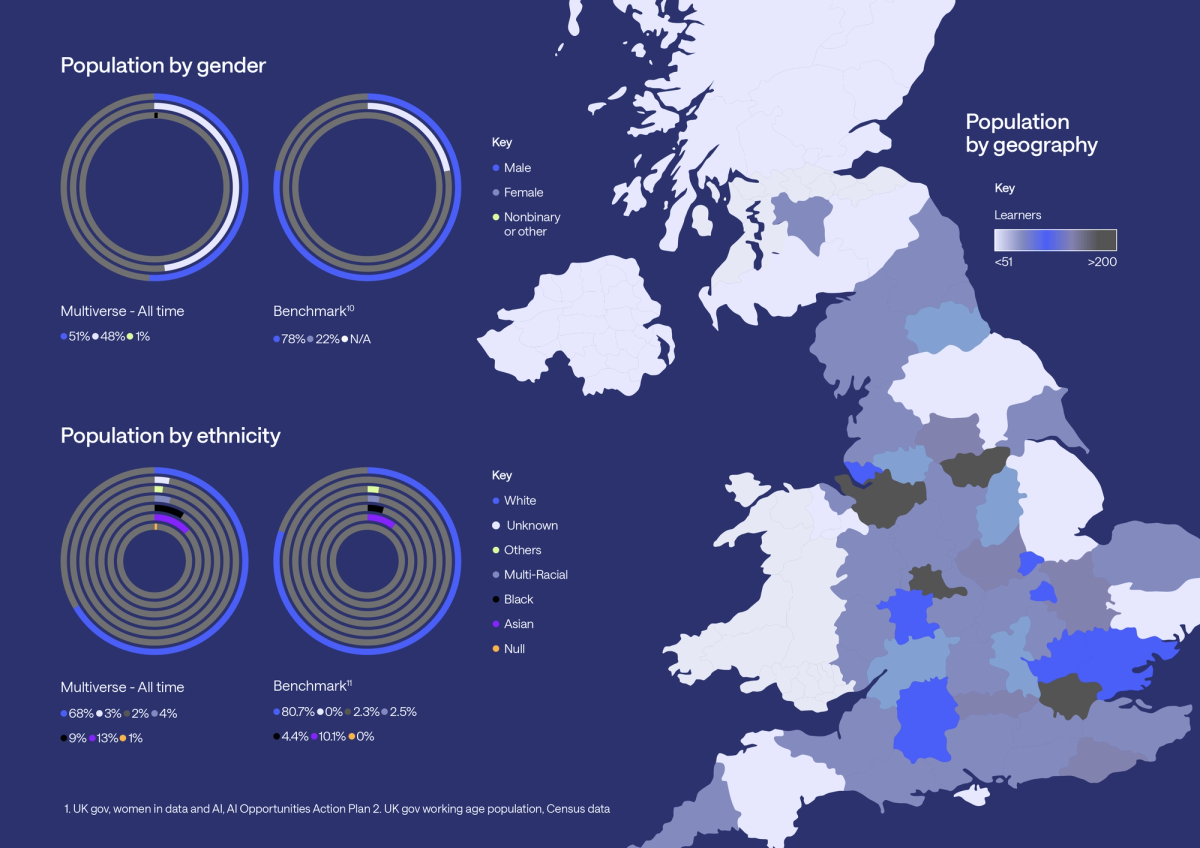
Multiverse provides pathways to acquiring valuable skills through applied learning and on-the-job experience. We recognise that traditional educational routes don't always cater to the diverse circumstances of individuals seeking to enter or advance within the workforce.
Our programmes deliver transformative outcomes for individuals:
- 1 in 2 learners (45%) received a promotion during their programme or in the 12 months after.
- 60% secured a pay rise.
- 98% achieved a pass or above in their programmes.
These outcomes highlight the potential of skills to help drive career advancement and social mobility.
As Harrison, an AI learner at Capita says: "AI has become a daily part of my workflow. Whether it’s automating tasks or improving efficiency, it’s saving me hours each week.”
Spotlight on AI
Businesses are investing in AI to the tune of $200 billion globally to drive efficiency and innovation. Employers want to meet the moment and seize the opportunity promised by productivity gains, and workers recognise the potential it has to catalyse their careers.
We want to make sure that the benefits of these skills are felt right across the population. And at the same time, we’re using AI to supercharge our own impact.
- We've launched five new AI programmes in the last 12 months.
- Our AI coach, Atlas, has received over half a million messages and has a 97% helpfulness rating.
- We are making AI skills accessible to everyone: almost a quarter of our AI learners have one or more contextual flags (23%), and our AI programs have a higher proportion of women than the sector average.

Multiverse's impact extends beyond individuals and businesses; we are also experiencing significant growth as an organisation. Our commitment to consequential learning drives us to innovate, scale our operations, and expand our reach, all while staying true to our mission of providing equitable access to economic opportunity.
Want to find out more? Read the report.

“Start with the right learner, on the right programme” Apprenticeship Architects: Gareth Kenward, Babcock
Employers
Gabriela Wasilewska
We spoke to Gareth Kenward, Head of Early Careers and Skills Development at Babcock, a leading defence company, about the steps they’ve made in data upskilling and the crucial role of line managers.
Welcome to Apprenticeship Architects, Gareth. First off, can you tell us about yourself and your role at Babcock?
I’m an early careers manager at Babcock, looking after apprentices, graduates, STEM, and external engagement at a specific site, while working closely with Multiverse on our data apprenticeship programmes.
Why did Babcock decide to launch the Data Academy?
Our large workforce relies heavily on data in day-to-day operations. Over the years, I’ve worked with the business to introduce a range of apprenticeship programmes – mainly at levels three and four, with some at level six – focused on upskilling our existing teams.
The goal is to ensure we’re making the most of our data, driving both efficiency and effectiveness. And partnering with Multiverse has been a big part of making that happen.
The programme grew quickly, which has been fantastic. We’ve got a significant number of learners enrolled, and the feedback from both apprentices and their line managers has been really positive. It’s been a real success so far, and we’re already seeing a tangible impact.
What were the key goals and business challenges you wanted to address with the programme?
Automation is revolutionising the maritime industry, enabling organisations to save considerable time and money, freeing up the workforce to focus on higher-value tasks and boosting overall productivity.
Beyond that, we also wanted the Data Academy to drive broader business efficiency and strengthen our position with clients and investors.
How did you set managers up to support apprentices from the programme’s launch?
For any apprenticeship programme to succeed, all three parties – apprentices, the business (represented by line managers), and the training provider – need to align on expectations.
For line managers, it's about helping them balance providing support for apprentices without becoming a burden or impacting their daily duties. To set them up for success, we worked with Multiverse to run dedicated sessions outlining expectations from both sides – what we needed from managers and what they could expect from Multiverse.
The sessions also helped clear up common misconceptions about apprenticeships and ensured managers were going in with their eyes open.
Feedback from these sessions was overwhelmingly positive. Apprentices felt reassured that their managers understood the significance and demands of the programme, which in turn made them more confident when asking for time to focus on their development.
More people completed the programme and brought their new skills back into the business.
What tools did you give line managers for guiding and mentoring apprentices?
On top of setting clear expectations, line managers knew where to go for additional support or resources. We built a mentorship network giving apprentices access to additional mentors – beyond their direct line managers – to give extra layers of help.
Multiverse coaches in the Data Academy – while primarily focused on apprentices – gave line managers advice and guidance on how to provide effective support.
And Multiverse’s ability to collate feedback from line managers has been incredibly useful. By establishing clear feedback loops we drilled into the challenges managers were facing to adapt the programme accordingly.
With such a large workforce, how do you strike the balance between learners hitting their goals while making a positive learning experience?
My mantra – which my team is probably tired of hearing – is that you have to start with the right learner on the right programme. And that applies at both the individual and team level.
For example, if you have five people from the same team of six in the Data Academy all at once, you’ll undoubtedly run into some operational challenges. The business’ needs always have to be balanced against the requirements of the programme.
The second part is about regular feedback and check-ins. We continuously monitor workloads to ensure they’re manageable. Proactive support is key – once a learner starts falling behind, it can be difficult to catch up.
It’s a multifaceted challenge, so it requires a layered approach.
What else have you done to stop learners from feeling overwhelmed?
Our mentoring network has been one of the most impactful. Sometimes, learners simply need help with their programme. But often, it’s guidance around how to manage their workload or balance their day job with their studies that apprentices need.
Time management is a critical challenge, so giving apprentices access to mentors outside their direct line management structure offers that additional layer of support.
We also make sure they’re aware of the broader wellbeing resources available at Babcock, including mental health first aiders, financial advice and medical support. It’s important people know they can always access help – not just for their studies but for anything affecting their ability to perform at work.
When we get feedback on learners' challenges, we work to resolve them.
Because we use a response mechanism to receive feedback, it’s an inherently reactive process. We try to act as fast as possible, as we know the sooner we do, the more likely we are to keep learners engaged and on track.
You successfully maximised Babcock’s Apprenticeship Levy spend. How do you measure and show the ROI of the Data Academy?
For us, it all comes back to impact. While we’re pleased to make full use of the Levy, it's more important that we invest in apprenticeships that deliver real business value.
We frame the Data Academy as a tool for making the company more operationally and financially successful. By tying learner success to the business, we show the value of the programme more clearly.
We also track ROI carefully, with Multiverse helping us measure the programme’s impact – particularly in terms of time savings.
For instance, if a task that previously took a week can now be completed in three days through better data handling, that’s an immediate efficiency gain. In some cases, apprentices have identified new ways to streamline processes they’re close to, saving money and improving service delivery.
We want to ensure learners complete the programme and use their new skills to help the business achieve its objectives.
You’ve been a key advocate for expanding the Data Academy. What’s your vision for the future of apprenticeships at Babcock?
We’ve scaled quickly and are now seeing real ROI, which is fantastic – but there’s still plenty of room to grow.
Data is everywhere in our business, and nearly every role interacts with data in some way.
Our goal is to identify areas where data skills will have the biggest impact, so we can achieve the quickest and most significant wins.
By expanding strategically into these areas, we can continue to demonstrate the Academy’s value across the organisation.
What’s one final piece of advice you'd give to other organisations looking to create a successful apprenticeship programme at scale?
It comes down to building strong, open partnerships. Having the right people in the room at the right time is essential – whether that’s during setup, scaling, or refinement.
Clear, honest communication makes all the difference. It allows you to celebrate what’s working and quickly adapt to what isn’t.
Finally, learn from others. Speaking to organisations already running large-scale programmes – especially those working with Multiverse – offers invaluable insights.
Sharing experiences with peers has helped us refine and strengthen our approach.
Ultimately, the key is to stay flexible and collaborative. Building a successful apprenticeship programme at scale is never a one-and-done effort, but an ongoing journey of learning and improvement.

“Secure buy-in from the top down” Apprenticeship Architects: Melissa Hope, Oxford City Council
Employers
Gabriela Wasilewska
This week, we’re speaking to Melissa Hope, Organisational Development Manager at Oxford City Council, about how their apprenticeship programme has managed to foster a new culture of collaboration across the organisation.
Welcome to Apprenticeship Architects, Melissa. First off, tell us about your role at Oxford City Council and the apprenticeship programme you launched with Multiverse.
I’m responsible for organisational learning and development (L&D) and providing support across the council. So, I work with managers and our leadership team to help deliver on our corporate strategy.
We’re currently working with Multiverse on four apprenticeships: AI for Business Value, AI-Powered Productivity, Business Transformation Fellowship and Data and Insights for Business Decisions. Across these four areas, 42 people started their apprenticeships in December last year.
What were the key goals for the programme, and how did it support the broader goals of the City Council?
We launched the apprenticeship programme to help our employees make better use of AI tools such as ChatGPT and Microsoft Copilot. Many were already experimenting with it, but didn’t fully understand how to best use the technology in their day-to-day roles.
Our goal was to reduce the time spent on repetitive, manual tasks by equipping our people with the skills to use these tools more effectively. This aligned with our broader efforts to streamline data use, improve processes and grow collaboration.
The programme also supported the rollout of our AI policy, which offers guidance on how to deal with AI and data safely, effectively, and ethically. Alongside this, we introduced a Microsoft Copilot strategy, giving all employees access to free licences.
Apprentices have been working with our ‘change agents’ – employees who drive internal innovation alongside their usual roles – to compare the free and business versions of Copilot.
They’ve created how-to guides, tested use cases, and shared findings to identify where advanced tools may drive the most impact. The collaboration has helped shape how we use AI across the council, really driving efficiency and change.
How did you structure the partnership with Multiverse in line with other L&D initiatives?
First, we integrated it into our people plan and held a ‘Let’s Talk’ session, open to everyone. These sessions focused on L&D, giving people insight into upcoming opportunities and helping them make informed decisions about which route would best suit them.
Alongside Multiverse, we also offered a range of other L&D opportunities so everyone understood the full spectrum of options available, allowing them to choose what worked best for them.
Could you tell us about the process of securing internal buy-in for the apprenticeship programme?
Before launch, we spent six to seven months building the foundation with Multiverse. We started with a data and AI skills scan across the whole organisation to identify gaps.
Multiverse then helped us present the findings alongside the business value of an upskilling programme to our corporate leadership team – showing how data-driven skills could save time and improve processes.
With leadership buy-in, we were then allocated an executive sponsor: Tom Hook, Deputy Chief Executive of city and citizen services. His support has really helped us keep on top of the programme and drive the initiative from the top-down.
Tom and I met with all the service directors individually to talk about the programme – the benefits, impact, and any concerns they might have – and this information was then disseminated down to managers.
We also ran sessions where employees could learn about the programme’s content, commitments and benefits, after which they could submit an expression of interest. We then worked with managers to confirm that the programme aligned with participants’ roles and career stages.
Your initial cohort was a big undertaking, involving 5% of the council workforce. Can you tell us about what it takes to successfully launch an apprenticeship at scale?
We needed to make sure that the programme was manageable for the organisation. So, we took a phased approach with employees given the choice to join either Cohort One or Two, depending on their schedules.
We also gave Multiverse data on the service areas and how many people worked in each, so we could make sure we had good coverage across the organisation.
Staggering the rollout kept it manageable, and we worked with directors to plan for the time commitments. Planning this way gave us a clear view of the cohorts' scope, helping us set them up for success.
What other steps did you take to ensure employees were set up for success on the programme?
To prepare participants, we ran detailed information sessions so they understood the weekly commitment: six hours, with three spent applying their skills in real work scenarios.
Once the programme was underway, we ran a quick survey to get early feedback, helping us pick up on any teething issues. Multiverse also checked in regularly, ensuring everyone knew what they needed to do and where to go for support.
And what results have you observed so far from the programme?
We’re now around three months into the programme, and while we haven’t formally measured the impact yet, we’re already hearing some fantastic feedback from colleagues.
One standout example comes from a colleague on the Data Insight for Business Decisions apprenticeship. Within 10 minutes of her first module, she’d already picked up something she could immediately apply to her role.
As she’s part of my team, I’ve been fortunate to see the impact first-hand. During a recent people team away day, she demonstrated her new Power BI skills to 22 colleagues, showing how she streamlined the reporting process for large volumes of internal data. What once took hours of manual input is now faster, clearer, and far more user-friendly.
Best of all, she quickly shared her learnings with others, spreading best practices across the council – a great example of the apprenticeships delivering value early on.
What about the general initial response from employees on the programme?
People are enjoying it – and they’re learning from day one!
There was a short adjustment period as people found the balance between the apprenticeship and their day jobs, but they seem to be coping well. The quality of the learning and the coaches have all been called out as standout strengths.
It's been especially exciting to see how the learnings are extending beyond the formal sessions. Colleagues have set up their own groups to meet, collaborate on assignments and share project ideas.
The cross-council collaboration is an example of the culture shift that’s taking shape: employees are taking new skills and using them to work together, solve problems and drive real change.
How do you plan to measure and demonstrate the ongoing impact of the apprenticeship programme?
From the outset, we worked with Multiverse to map out a clear business value plan. We identified key areas to measure, including improved productivity and time savings, as well as shared best practices.
We’ve also partnered with Multiverse’s customer service team to create a joint success plan. That’s been a really thoughtful touch – the team took the time to share their insights on the potential successes they saw for us based on what they’d learned about our organisation.
We’ve since added our own priorities to that list and are in the middle of finalising that plan. We meet regularly to review it, combining feedback from both Multiverse with our own teams’ to make sure the programme’s impact is clear and shows measurable results.
And what’s Oxford City Council’s long-term vision for the Multiverse Apprenticeship Programme?
Cohort Two is officially in motion and it’s exciting to see the growing interest from people who didn’t initially consider the programme. Managers are asking when the next cohort will start because they have team members eager to take part since seeing the impact of Cohort One.
We’re now working to map out the plan and timeline so that we have plenty of time to do it properly. That means running the same thorough process: giving people clear, detailed information so they can make informed decisions and ensuring we have the right people on the right programmes at the right time.
What was your biggest challenge in the process of launching the programme, and how did you overcome it?
Shifting the perception of apprenticeships. When we started, many still associated them with new starters or younger employees, when in reality, they’re for all ages and levels.
Luckily, I have experience in the apprenticeship field, which helped me passionately advocate for the programme. It was important to communicate that apprenticeships range from entry level to the equivalent of a master’s degree, making them a valuable tool for not only upskilling existing employees but also attracting new talent.
Information sessions helped us overcome many of these misconceptions. We had plenty of one-on-one conversations and made sure to demonstrate the value apprenticeships bring at all levels.
The other big challenge was time commitment concerns. Initially, many employees and managers assumed six hours a week would be unmanageable. But once employees settled in and it became part of their routine, they started seeing rewards in the form of time saved and increased productivity.
What’s one piece of advice you’d give to other HR leaders looking to launch an apprenticeship programme?
Don’t be scared of apprenticeships.
Many already know the value they can bring, which is great. But if you’re not sure, Multiverse will guide you every step of the way. But you have to put in the groundwork upfront – there’s no point rushing the process.
So, take your time, speak with the right people across your organisation and secure buy-in from the top down.
The learning opportunity: Making data and AI skills attainable for the NHS
Employers
Rhys Westall
Meaning, there’s a missed opportunity for trusts to streamline operations and transform care. Only one in five NHS organisations are considered “digitally mature”. And despite lots of progress in the last decade, there are still areas of the NHS relying on paper and non-digital processes.
It makes embracing new technologies, such as AI, feel like an unattainable goal – one that goes beyond moving the health service from analogue to digital.
As we enter this new era for the NHS, data and digital skills across the workforce will be fundamental to improving patient care, streamlining processes, and making cost savings.
The case for upskilling in the NHS
Why should a consultant anaesthetist care about data skills? You might not immediately think it’s important.
But when we show how understanding patient data supports positive patient outcomes, the story changes.
Data and AI skills can support better decision-making, automate routine tasks and even enable innovation from within teams – outcomes that are relevant for roles across each trust.
Being data-driven moves the health service away from a reliance on “gut feeling” when making decisions. So, the information NHS staff work with becomes more meaningful – with the opportunity to save millions in costs.
With more than 1,500 learners across 95 NHS trusts and arm’s-length bodies, Multiverse’s digital, data and AI training programmes have so far unlocked £10m in savings over six months. And that’s just the tip of the iceberg.
Building on a skills foundation to boost productivity
Data and AI skills have to be embedded into every layer of trusts in order to deliver the lasting impact the health service needs.
Looking at skills holistically will improve data maturity and, in turn, AI readiness.
Assessing the levels of data maturity in the workforce will help NHS trust leaders understand their current skill gaps and opportunities for growth. Tailored learning programmes can then align with the goals and objectives of the transformation strategy.
Aligning skills requirements with strategic workforce planning processes creates a solid foundation – making skill gaps easier to spot and solve.
Importantly, providing upskilling through the levy, combined with applied learning, means people can learn on the job – making a stronger link between the training and how it impacts their day-to-day. After all, what’s the point of learning new skills if they can’t be applied directly into your role?
North London Foundation Trust (NLFT), for example, needed to reset its company culture around technology. To make this happen, the trust provided an upskilling programme, delivered by Multiverse, to improve data literacy across its workforce and improve productivity.
One learner used the analytical skills gained in the Digital Academy to pinpoint bottlenecks in one department’s discharge process. By employing data visualisation techniques using Power BI, he could effectively illustrate the issues, reducing the number of active patients awaiting assessments from 25 to one within nine months.
Engaging staff for a future-fit NHS
Improving the data and AI skills of NHS staff can create opportunities across the service. From improving patient outcomes to automating routine tasks, freeing up time and even enabling innovation from the inside.
The results from our digital, data and AI programmes show what’s possible. We see NHS workers saving on average seven hours a week – just from improving their data skills.
Today, the NHS can take advantage of the levy – a strategic funding pot for trusts to deliver applied learning that upskills the workforce at scale and at no extra commercial cost.
Levy-funded training is an ideal way to harness the talents of NHS workers to effect positive change – helping every employee gain the skills and confidence to support the digital evolution of the NHS.
Multiverse is empowering every NHS employee to unlock innovation and improve patient care through our applied learning programmes. Discover more
Article originally featured in HSJ Online
Implementing AI in the public sector: Four tips to enhance adoption
Employers
Gabriela Wasilewska
The AI Opportunities Action Plan highlights the potential the technology has to enhance efficiency, improve service delivery and support better decision-making.
The big question is: what does it mean for public services?
Howard Lewis, the managing director of Modern Workplace at Microsoft, shares some thoughts on how to take advantage of AI in local government and strengthen public sector services. Here’s a snapshot of what he has to say.
Applying AI in the public sector
In practice, implementing AI in the public sector could look like:
- Predictive insights to notify when potholes could need maintenance, social care services that might require urgent intervention, and where emergency services could need to be deployed based on data trends.
- Automating back-office processes to free up staff time for higher value or community-facing work.
- Improving citizen engagement with AI-powered chatbots that handle common questions, reducing response times and improving accessibility.
But the challenge is implementation. AI is only as effective as the strategy and the people behind it. And that's why we're seeing a shift from exploring AI to developing real-life use cases which benefit the public.
An AI-ready culture comes from the top
Successful AI adoption starts with strong leadership. Whether it’s breaking down silos or driving data strategies, public sector leaders need to be champions of change – creating a culture of collaboration and innovation.
"Encouraging the right culture comes from the top-down – no matter what you’re looking to achieve. When implementing AI, business leaders need to be active, visible and demonstrate consistent participation."
Howard Lewis, Managing director of Modern Workplace at Microsoft
To make this possible, building a coalition with executive peers and the wider management community will help to engage the rest of the organisation – enabling a culture that’s ready for change.
Establish ethical frameworks for AI usage
There are several pillars of an AI ethics framework, including fairness, accountability, transparency, reliability and safety, inclusivity, and privacy and security.
Yet, a framework alone won’t do the job – you also need strong internal communications.
“Communication is key. You have to demonstrate the importance of the framework, why shortcuts shouldn't be taken, and the impact on fair, secure and accurate AI usage,” Howard explains. “Never has this been more necessary than in the public sector, where employees work with sometimes confidential and sensitive data.”
Having an ethical framework for how you will use AI can also help reduce data constraints. That means no waiting to sort your data quality to get started. Instead, your data strategy works alongside the implementation of AI – all shaped by your ethical framework.
“Starting with small-scale pilots helps to get the ball rolling and see those early wins, but it also means cleaning up your data in manageable chunks so it’s ready to use for specific applications,” Howard shares.
Empower your people
Today, the topic of AI adoption coincides with concerns about how the technology could be used to replace workers.
“Establishing clearly how AI will be applied can help to assuage worries. But, you can empower your workforce too if you’re able to show how their involvement is critical,” Howard explains. “We call this: keeping humans in the loop. And it’s a vital part of ensuring compliance is maintained too.”
The key to getting this right, Howard says, is upskilling and reskilling employees on AI. By ensuring staff can understand and apply the technology, you can create an environment where people feel empowered.
“Having the right skills in your workforce means employees can start to think of creative, responsible ways to leverage AI to improve legacy processes and deliver real, long-term impact.”
Howard Lewis, Managing director of Modern Workplace at Microsoft
When people feel empowered to use AI – with the appropriate guardrails in place – public services will benefit from more available time for human contact and support.
Collaborate with partners to develop best practice
“Whether it’s demonstrating real-world use cases or how to address your specific AI applications, technology partners can help you identify and prioritise high-impact areas for implementation,” Howard mentions.
By partnering with trusted AI advisors, the public sector can focus on driving the most meaningful change. “There’s a feedback loop to partnerships that means you can benefit from the technology now and as it evolves to better meet their needs,” Howard concludes
At Multiverse, we’re partnering with Microsoft to equip 1 million people with the skills needed to thrive in an AI-enabled economy by 2025. By collaborating, we can work together to share expertise and create opportunities to prioritise best practice.
Get started today
It’s important to remember the public sector is only two years into working with AI on a large scale.
While there could be a tendency to feel left behind or out of the loop, public services adoption is just getting started. As long as those in the sector take initial steps to begin AI implementation today, no one will be left behind.
See how Essex County Council and the NHS are embarking on their digital transformation journey with incremental changes.
Morgan Sindall Infrastructure builds out data academy as upskilling initiative saves 7,200+ hours annually
News
Team Multiverse
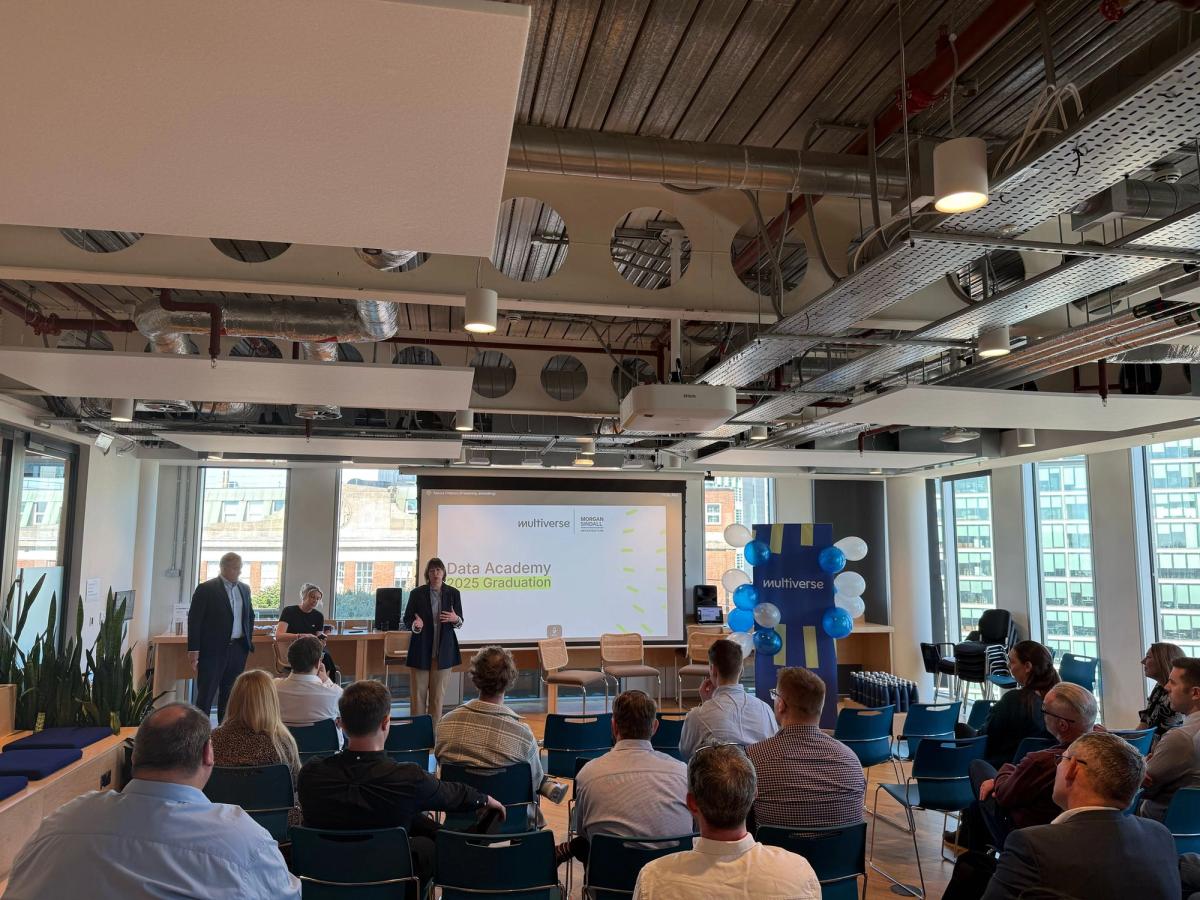
Morgan Sindall Infrastructure today announces that it will build out its data academy with Multiverse, following the success of its graduating apprenticeship cohort.
In a move that will continue to boost business potential through data-driven decision making, the upskilling initiative marks Morgan Sindall Infrastructure’s continued commitment to investing in its people. The forthcoming launch will bring the total number of employees who have enrolled on digital and data programmes with Multiverse to 80.
Impact across the business has been substantial since the inception of the academy. The most recent cohort saw a 14% increase in individual efficiency during the programme – equating to more than 7,200 hours saved per year. Apprentices have used improved data skills to drive tangible business outcomes, from mitigating weather-related project delays, to reducing workplace safety incidents, to increasing visibility of potential quality issues. Following their completion of the programme, 86% of the graduating cohort achieved a distinction.
One apprentice who drove significant impact on programme is James Macdonald, who developed skills in Python, SQL and PowerBI. He said: “I’ve already benefited from learning how to conduct hypothesis tests and build regression models in Python. I’ve been able to apply this in my work on our carbon calculation tool, to predict the carbon footprint of forthcoming projects, which will be really valuable. And elsewhere I’ve already seen value in data skills reducing time spent gathering information for reporting dashboards.”
Multiverse’s 2024 Skills Intelligence Report revealed that in construction, 29% of employees’ time working with data is spent unproductively. Morgan Sindall Infrastructure’s continued commitment to upskilling, however, will enable its teams to automate processes and tasks, leading to a significant boost in efficiency and output.
Sarah Reid, Managing Director - Water & Highways at Morgan Sindall Infrastructure said: “The Digital and Data Academy is part of our ongoing commitment to developing and protecting our people, ensuring they have the right tools and knowledge to thrive in a fast-paced industry. Having the skills to harness data effectively will not only improve efficiency across the business but also create opportunities for personal and professional growth.”
Multiverse combines work and learning to unlock economic opportunity for everyone. It works with more than 1,500 organisations to close critical skill gaps in the workforce in AI, data and technology.
Gary Eimerman, Chief Learning officer at Multiverse said: “Data is transforming the future of the construction industry. By taking a forward-thinking approach to close the data skills gap, Morgan Sindall Infrastructure will deliver measurable benefits for both its business and its people.”
Average Software Engineer Salary in the UK: How Much Can You Make?
Apprentices
Team Multiverse
Whether you’re merely considering an engineering career or looking to understand how your current salary stacks up, this blog will guide you through everything you need to know — from basic Software Engineer salary expectations, to job outlook, skills and training.
Software Engineer Salary in the UK
According to Glassdoor, the average Software Engineer salary in the UK is around £46,000. The figure is above the median gross pay for all full-time employees of £37,430 (ONS).
Many factors influence a Software Engineer’s salary, including experience level, skills, location and role. And the data reported varies by sources. But here’s what you may earn as a Software Engineer in the UK:
- Lower-end salary: £42,000
- Average base salary: £52,500
- 90th percentile salary: £160,000
Data sources: Indeed, Talent and Levels.fyi.
Highest-Paying Cities for Software Engineers in the UK
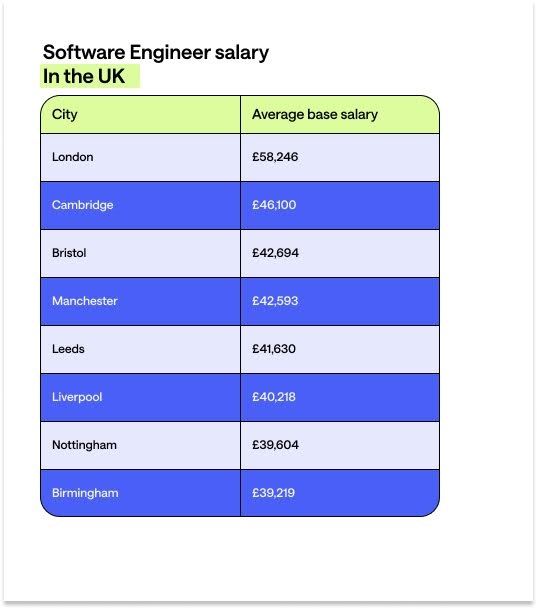
Where you live in the UK impacts how much you earn as a Software Engineer. In 2025, London companies pay Software Engineers around £58,000 on average before bonuses and other incentives, while Liverpool companies pay around £40,000, according to Glassdoor salary data. The eight highest-paying cities for Software Engineers in the UK are:
- London
- Cambridge
- Bristol
- Manchester
- Leeds
- Liverpool
- Nottingham
- Birmingham
Here’s that data broken down by city, updated for 2025.
Software Engineer Salary by Job Title
Software engineering is a broad industry with many well-paying roles to choose from. Here are some common software engineering job titles and what you can earn in each. (Unless otherwise noted, all salary data is from Talent.)
Front-End Developer
Front-End Developers focus on building the front-end elements of websites or applications that people interact with and see. They learn programming languages like HTML, CSS and JavaScript.
Front End Developers also fix code errors and debug applications. As a Front-End Developer, you must understand user design and experience principles.
Front End Developer salaries in the UK, according to Glassdoor salary data:
1. Low-level salary: £32,000
2. Average base salary: £41,000
3. High-paying salary: £53,000+
Web Developer
Web Developers are similar to Front-End Developers, but they focus solely on websites. As a Web Developer, you’ll either build websites from scratch or manage existing websites. You may also be responsible for improving website loading speed, technical search engine optimisation (SEO), and other performance indicators.
Web Developer salaries in the UK:
1. Low-level salary: £26,000
2. Median salary: £33,000
3. Top-paying salary: £43,000+
Back-End Developer
Back-End Developers work on the back-end; i.e., all the elements that make an application run but users don’t see. As a Back-End Developer, you’ll likely use programming languages like Python, PHP and Ruby. Back-End Developers also work closely with Front-End and Web Developers to unite server-side (back-end) and front-end efforts.
Back-End Developer salaries in the UK:
1. Low-level salary: £53,000
2. Median base salary: £64,000
3. Top-paying salary: £78,000+
Full-Stack Developer
Full-Stack Developers work on front and back-end development. They tend to be generalists but have a few years of experience in both areas. Because their skills are so versatile, there’s a high demand for Full-Stack Developers.
Full-Stack Developer salaries in the UK:
1. Low-level salary: £41,000
2. Median base salary: £53,000
3. Top-paying salary: £70,000+
Cyber Security Engineer
Cyber Security Engineers focus on protecting a company’s networks, systems and data. They identify any potential security threats and create solutions to secure them. As a Cyber Security Engineer, you’ll be responsible for data security. Example tasks include installing firewalls, testing systems for vulnerabilities and analysing risk.
Cyber Security Engineer salaries in the UK:
1. Low-level salary: £34,000
2. Median base salary: £45,000
3. Top-paying salary: £61,000+
Data Engineer
Data Engineers combine data analytics with software engineering. As a Data Engineer, you’re responsible for designing and creating data systems. More specifically, your work will help companies collect, store and understand large amounts of raw data. You’ll also work to make data more accessible to other team members like Data Scientists and Business Analysts who interpret the data you provide.
Data Engineer salaries in the UK:
1. Low-level salary: £38,000
2. Median base salary: £48,000
3. Top-paying salary: £61,000
What Does a Software Engineer Do?
As a Software Engineer, you can develop software, websites or other applications. Software engineering is a broad discipline and can lead to many different career paths. Here are some of the basic skills and responsibilities to help you understand what you’ll do as a Software Engineer.
Software Engineer responsibilities:
Analyse complex information
Software Engineers dissect intricate data and systems to understand their functionalities and limitations. This level of analysis is important for identifying potential issues, optimising performance, and developing new features.
Translate client and user needs into practical business solutions
Bridging the gap between user expectations and technological capabilities, Software Engineers convert client requirements and user feedback into actionable development plans.
Write, test and rewrite code to improve existing programmes
Continuous improvement is a cornerstone of software development. Engineers rigorously write and test code to enhance its functionality, efficiency, and security. This process can involve tasks like debugging, refactoring, and sometimes overhauling large sections of code.
Find and fix bugs
Identifying and resolving software bugs is another Software Engineer responsibility. Engineers use a variety of debugging tools and techniques to diagnose problems, ensuring applications run smoothly and efficiently.
Collaborate with other programmers, Technical Writers, clients and colleagues across departments
Engineers work alongside programmers, Technical Writers, and other stakeholders, sharing knowledge and insights to guide the software’s development, documentation, and deployment.
Source new technologies that solve business problems
Software Engineers research and integrate emerging technologies that can offer competitive advantages. This can involve evaluating new tools, languages, and frameworks, that can improve product offerings and drive innovation.
Keep up with training needs and best practices
The tech landscape is ever-evolving. So continuous learning is essential for Software Engineers. They must stay informed of the latest industry trends, best practices, and technological advancements.
To become a Software Engineer, you should be interested in developing these skills in your career:
1. Technical skills: You’ve built a software application in JavaScript, for example.
2. Coding skills: You know different programming languages like JavaScript, SQL and CSS.
3. Commercial mindset: You understand the Software Development Life Cycle and how to meet business needs.
4. Communication: You communicate technical concepts to non-technical people.
5. Problem-solving: You ‘troubleshoot’ tech problems and fix bugs.
6. Analysis: You analyse technical information while understanding user and client requirements.
7. Commitment to training: You want to become a master in your field by continuously learning and improving.
Aside from demonstrating relevant skills (or a commitment to learning them), employers may require specific qualifications:
- At least a grade of 4/C GCSE (or equivalent) in Maths and English
- A Levels in relevant subjects like Computing
- A Software Engineering Level 4 apprenticeship standard or the willingness to work towards one
Are Software Engineers in Demand?
It’s unknown exactly how many Software Engineers currently work in the UK, but the total is likely comparable to other leaders in Europe, such as Germany. The problem for employers? The demand for Software Engineers doesn’t equal the supply. Add to that the fact that nearly 20% of engineers in the UK are likely to retire by 2026, and it’s clear that the role is in demand.
A quick search for “Software Engineer” jobs on LinkedIn also highlights the demand, with more 18,000 UK job openings on the platform as of February 2025.
Typical Software Engineer career progression
Freshly minted programming professionals often start their careers as Junior Software Developers. As they gain experience and specialisations, many progress into Data Engineering or other domains or become mid and senior-level SWEs.
To make the leap to mid-senior level, Software Engineers often require training and skill development in areas ranging from cyber security to AI. They also need to understand how to innovate, increase productivity, and connect the impact of specific projects to larger organizational goals.
If you’re looking to take the next step in your career as a Software Engineer, Multiverse’s Advanced Software Engineering programme could be right for you. Our programme focuses on applied impact and measured learnings, helping teams unlock enhanced productivity. The best part? You upskill on the job, meaning you don’t have to pause your career while learning — and employers cover the costs of the programme once they partner with Multiverse.
If you want to take the next step in your engineering career, create a profile with us today in just minutes. Our team can then double-check your eligibility and discuss apprenticeship options.
Sorry, no results found.