










We couldn’t find what you are looking for. Please try another way.
The Multiverse blog
Thank you! Your submission has been received!
Oops! Something went wrong while submitting the form.
From chaos to competence: 4 lessons on AI adoption challenges
Employers
Gabriela Wasilewska
The reality is that AI is here to stay. But with mounting questions around risk, governance and making a return on investment (ROI), how can leaders move from chaos to competence with AI? And how can they overcome AI adoption challenges?
We spoke to Rudy Lai, CEO at Tactic, and Jason Smith, AI Strategy Lead at Publicis Media, to tackle these questions and to share guidance on how best to get started.
Lesson 1: Prioritise people and processes
What’s their best advice for starting AI transformation?
“The technology is the least of your worries,” says Jason. “People and process are two of the most difficult things to get right.”
Jason recommends assessing the ‘day in the life’ of your workers to understand how generative AI (GenAI) can help, while also encouraging people to be hands-on with the technology. He adds:
<block-starlight>“Because GenAI has democratised access to AI and machine learning, people need to roll their sleeves up, try things, and get grace to make mistakes.”</block-starlight>
“Everybody understands that AI is the next big thing, the next business opportunity, the next tool to create impact,” says Rudy, agreeing on the need to focus on people and processes.
He argues many businesses struggle to find the right place to start, and suggests a three-tiered approach when thinking about AI adoption:
- Tier one: empowering employees with GenAI tools such as Microsoft Copilot, helping people be more productive.
- Tier two: transforming your product or services with AI features.
- Tier three: using AI to create entirely new business models.
As you move through each tier, you’ll shift from internally focused AI use cases to external ones. How far you’ve progressed depends on a range of factors, including your level of data skills maturity.
However, Rudy argues: “No matter how you slice and dice the use cases of AI in your organisation, you always need to go back to the business impact.”
Upskilling should be treated as a priority – giving your people the foundational data skills to unleash the potential of AI.
Lesson 2: Identify champions to support AI implementation
When asked which teams are most receptive to AI, Rudy notes that it depends on task suitability, digital maturity, and staff readiness:
“One of the first signs of a department being AI-ready is you can imagine putting the work they do into a large language model (LLM) and automating it.”
He adds that “well-defined problems” such as repeating tasks and processes are good candidates for automation. And not to forget: teams with an existing strong data culture will be better targets for initial AI adoption.
AI champions – people who are curious, proactive, and willing to experiment with new tools – is one way to encourage adoption.
So what else makes a great AI champion?
“[They have] the right mindset, a willingness to give it a go,” says Jason. AI optimism goes a long way – and these people may already be building rough and ready prototypes to show what can be achieved – even if these prototypes aren’t perfect.
After getting AI champions on a consistent skill level, they can act as mentors to others around them – as well as being focal points for spotting new use cases.
“Those use cases are when you can start to get some traction with the help of these champions, who can then hopefully bring other team members along,” he adds.
One initial step you can take to identify your AI champions is reviewing your skills inventory – helping you spot AI capability and strengths that may already exist in your workforce.
Lesson 3: Watch out for ‘shadow AI’ to manage risk and AI governance
Significant risks are emerging from unmanaged AI use – also known as ‘shadow AI’.
Without proper AI tool oversight, risks can include data leakage, compliance issues, and misinformation. It’s a challenge that adds to the barriers to AI adoption.
Given the availability of free-to-access tools, as well as new players entering the market such as DeepSeek, businesses can run into difficulty when they have no rules or protections in place around tool use.
“There's not a huge amount of visibility on how and what people are using, and it’s fairly challenging to detect,” says Rudy.
“People can be almost too excited about what AI can do, and being too reliant on what AI is producing without verification.”
As well as the need to have solid AI governance frameworks in place, Jason argues responsible AI usage should also be considered, with people asking the questions:
“Should I do this? Is it ethically correct? That's much more difficult to get right, but you have to factor in both [governance and responsible use]. It's important to recognise what might be the unintended consequences of deployment and adoption,” he says.
So how can these risks be contained?
Creating a ‘sandbox’ environment where your people can experiment with AI tools safely is one way to protect leaders from risk, data security and compliance challenges.
For it to work, Jason suggests: “It’s a combination of leadership setting the tone and the policies. Make sure agreements are in place so you can use the tools in the sandbox. And then training so that people are aware of the risks.”
Lesson 4: ‘Find the baseline’ to measure the ROI of AI
As AI projects shift from proof-of-concepts to full adoption, showing the ROI of AI is a recurring theme for leaders making a business case for AI.
And while there is no one-size-fits-all approach or a ‘magic measurement tool’ to share all the answers, the panel recommends going back to basics on measurement.
Rudy advises against using vanity metrics, and instead for people to look at the 'business as usual' KPIs they're already tracking.
“Vanity metrics don't deliver real business impacts because you have shifted the focus from what you need – such as time efficiency, cost efficiency, or more revenue.”
It’s a sentiment echoed by Jason, who says how you measure can vary between use cases. He recommends establishing ‘baselines’ that you measure in the business:
“If you've got that in place it's going to make it much easier for you to measure your return on investment.”
What next with your AI adoption challenges?
With agentic AI influencing trends in 2025, you are likely looking closely at how to overcome your AI adoption challenges.
Rudy and Jason share three principles to help get you started:
- Start with clear business goals, not just AI hype
- Empower internal AI champions to drive change
- Balance innovation with governance to scale AI safely
From chaos to competence: 4 lessons on AI adoption challenges
Employers
Team Multiverse
The reality is that AI is here to stay. But with mounting questions around risk, governance and making a return on investment (ROI), how can leaders move from chaos to competence with AI? And how can they overcome AI adoption challenges?
We spoke to Rudy Lai, CEO at Tactic, and Jason Smith, AI Strategy Lead at Publicis Media, to tackle these questions and to share guidance on how best to get started.
Lesson 1: Prioritize people and processes
What’s their best advice for starting AI transformation?
“The technology is the least of your worries,” says Jason. “People and process are two of the most difficult things to get right.”
Jason recommends assessing the ‘day in the life’ of your workers to understand how generative AI (GenAI) can help, while also encouraging people to be hands-on with the technology.
“Because GenAI has democratized access to AI and machine learning, people need to roll their sleeves up, try things, and get grace to make mistakes,” he adds.
“Everybody understands that AI is the next big thing, the next business opportunity, the next tool to create impact,” says Rudy, agreeing on the need to focus on people and processes.
He argues many businesses struggle to find the right place to start, and suggests a three-tiered approach when thinking about AI adoption:
- Tier one: empowering employees with GenAI tools such as Microsoft Copilot, helping people be more productive.
- Tier two: transforming your product or services with AI features.
- Tier three: using AI to create entirely new business models.
As you move through each tier, you’ll shift from internally focused AI use cases to external ones. How far you’ve progressed depends on a range of factors, including your level of data skills maturity.
However, Rudy argues: “No matter how you slice and dice the use cases of AI in your organization, you always need to go back to the business impact.”
Upskilling should be treated as a priority – giving your people the foundational data skills to unleash the potential of AI.
Lesson 2: Identify champions to support AI implementation
When asked which teams are most receptive to AI, Rudy notes that it depends on task suitability, digital maturity, and staff readiness:
“One of the first signs of a department being AI-ready is you can imagine putting the work they do into a large language model (LLM) and automating it.”
He adds that “well-defined problems” such as repeating tasks and processes are good candidates for automation. And not to forget: teams with an existing strong data culture will be better targets for initial AI adoption.
AI champions – people who are curious, proactive, and willing to experiment with new tools – is one way to encourage adoption.
So what else makes a great AI champion?
“[They have] the right mindset, a willingness to give it a go,” says Jason. AI optimism goes a long way – and these people may already be building rough and ready prototypes to show what can be achieved – even if these prototypes aren’t perfect.
After getting AI champions on a consistent skill level, they can act as mentors to others around them – as well as being focal points for spotting new use cases.
“Those use cases are when you can start to get some traction with the help of these champions, who can then hopefully bring other team members along,” he adds.
One initial step you can take to identify your AI champions is reviewing your skills inventory – helping you spot AI capability and strengths that may already exist in your workforce.
Lesson 3: Watch out for ‘shadow AI’ to manage risk and AI governance
Significant risks are emerging from unmanaged AI use – also known as ‘shadow AI’.
Without proper AI tool oversight, risks can include data leakage, compliance issues, and misinformation. It’s a challenge that adds to the barriers to AI adoption.
Given the availability of free-to-access tools, as well as new players entering the market such as DeepSeek, businesses can run into difficulty when they have no rules or protections in place around tool use.
“There's not a huge amount of visibility on how and what people are using, and it’s fairly challenging to detect,” says Rudy.
“People can be almost too excited about what AI can do, and being too reliant on what AI is producing without verification.”
As well as the need to have solid AI governance frameworks in place, Jason argues responsible AI usage should also be considered, with people asking the questions:
“Should I do this? Is it ethically correct? That's much more difficult to get right, but you have to factor in both [governance and responsible use]. It's important to recognize what might be the unintended consequences of deployment and adoption,” he says.
So how can these risks be contained?
Creating a ‘sandbox’ environment where your people can experiment with AI tools safely is one way to protect leaders from risk, data security and compliance challenges.
For it to work, Jason suggests: “It’s a combination of leadership setting the tone and the policies. Make sure agreements are in place so you can use the tools in the sandbox. And then training so that people are aware of the risks.”
Lesson 4: ‘Find the baseline’ to measure the ROI of AI
As AI projects shift from proof-of-concepts to full adoption, showing the ROI of AI is a recurring theme for leaders making a business case for AI.
And while there is no one-size-fits-all approach or a ‘magic measurement tool’ to share all the answers, the panel recommends going back to basics on measurement.
Rudy advises against using vanity metrics, and instead for people to look at the 'business as usual' KPIs they're already tracking.
“Vanity metrics don't deliver real business impacts because you have shifted the focus from what you need – such as time efficiency, cost efficiency, or more revenue.”
It’s a sentiment echoed by Jason, who says how you measure can vary between use cases. He recommends establishing ‘baselines’ that you measure in the business:
“If you've got that in place it's going to make it much easier for you to measure your return on investment.”
What next with your AI adoption challenges?
With agentic AI influencing trends in 2025, you are likely looking closely at how to overcome your AI adoption challenges.
Rudy and Jason share three principles to help get you started:
- Start with clear business goals, not just AI hype
- Empower internal AI champions to drive change
- Balance innovation with governance to scale AI safely
Understanding AI ethics: What every professional needs to know
Apprentices
Team Multiverse
In January 2025, for example, the book-tracking app Fable drew controversy when its AI generator produced insensitive annual summaries for readers. Meanwhile, in December 2024, Italy ordered OpenAI to pay a €15 million penalty for data privacy violations.
These real-world examples reflect broader concerns about the ethical implications of AI in the workforce. According to Multiverse’s The ROI of AI report, 36% of workers believe their organization lacks responsible and ethical AI practices. Despite this, 93% feel confident they have used this technology ethically. But without the proper training, many people fail to recognize how AI can be misused.
This article explores key AI principles and emerging ethical dilemmas. We’ll also share practical strategies for upskillers who want to learn how to follow AI ethical frameworks in the workplace.
What is AI ethics?
As Dr. David Leslie of the Alan Turing Institute explains, “AI ethics is a set of values, principles, and techniques that employ widely accepted standards of right and wrong to guide moral conduct in the development and use of AI technologies.”
Many organizations have created AI codes of ethics to help developers and other professionals use this technology responsibly. These guidelines outline AI ethical principles and may include industry-specific standards.
For example, the Market Research Society released an AI ethics guide urging practitioners to “prioritize and safeguard participants’ privacy and data rights” when using AI in research projects. Similarly, the Institute and Faculty of Actuaries and the Royal Statistical Society co-published a guide to ethical data science that requires members to “maintai[n] human oversight of automated solutions,” including AI systems.
While these principles might seem abstract at first, they can help professionals recognize and address ethical concerns. Here are a few scenarios that workers may encounter:
- A Human Resources Specialist notices that AI-powered resume screening software consistently filters out women.
- A Data Scientist is asked to analyze confidential customer data without obtaining consent.
- A marketer uses a text-to-image generator to create visual content for social media, but the images misrepresent the products.
An AI ethics code empowers professionals to make moral decisions that prioritize human interests and minimize risks.
Key principles of AI ethics
There’s no universal framework for AI ethics. But a few foundational tenets appear consistently in guidelines from professional organizations and government agencies.
Transparency and accountability are two central ethical principles for AI. According to the Ada Lovelace Institute, businesses should practice transparency by creating clear data-sharing agreements and publishing spending data. Impact assessments and audits also promote accountability.
Fairness is another key part of AI ethical guidelines. AI systems should be designed to avoid discrimination against any communities or individuals. For example, the Microsoft Responsible AI Standard requires AI developers to “minimize the potential for stereotyping, demeaning, or erasing identified demographic groups, including marginalized groups.” This process involves ongoing bias checks and collaborating with members of diverse demographic groups to understand how AI tools impact them.
Additionally, respect for human dignity and autonomy are core AI moral principles. For instance, the Council of Europe requires member states to “ensure that activities within the lifecycle of artificial intelligence systems are fully consistent with human rights, democracy, and the rule of law.”
Privacy and data protection are two more guiding principles for AI development and usage. The UK General Data Protection Regulation requires businesses to only collect personal data for specified and legitimate purposes. Companies must also keep this information secure and delete it when they no longer need it.

Ethical challenges in AI
While artificial intelligence offers many benefits, it also has several troubling ethical implications. You may encounter these common challenges while designing or using AI tools.
Algorithmic bias
Without careful oversight, algorithmic systems can unintentionally reinforce unconscious biases. This often occurs when businesses train AI models with incomplete or unrepresentative data sets, leading to selection bias. Additionally, AI systems can cause harm by treating certain groups differently.
For example, a 2024 lawsuit against SafeRent alleged that the platform used a biased algorithm to score rental applicants. The algorithm didn’t factor in housing benefits and weighed credit information too heavily, leading to discrimination against low-income applicants and people of color.
Lack of transparency
Many companies have developed “black box” AI systems that don’t explain how they operate. For example, when you use ChatGPT, you see your inputs and outputs, but what happens in between is a mystery.
This secrecy raises troubling questions about the possibility of incorrect answers and hidden bias. After all, you can’t say for certain that a result is correct and fair if you can’t check the math yourself. As a result, many users mistrust AI technologies.
Major AI platforms also frequently withhold information about how they train their AI models. In 2024, book authors filed a lawsuit against NVIDIA, claiming the company’s AI training data “comes from copyrighted works” that were copied “without consent, without credit, and without compensation.” By refusing to disclose their source materials, AI companies risk violating intellectual property rights and angering human creators.
Tech dominance
When you think about companies developing AI systems, you probably picture tech giants like Amazon and Meta. These mega-corporations have significantly influenced the AI industry, raising concerns about monopolies. Sarah Cardwell, the CEO of the UK’s Competition and Markets Authority, observes that the dominance of a few companies “could shape [AI] markets in a way that harms competition and reduces choice and quality for businesses and consumers.”
Practical steps for professionals to adhere to AI ethical frameworks
Practicing AI ethics involves more than basic steps like not uploading customer data to ChatGPT. It requires a deeper understanding of how these systems work and their ethical considerations.
Stay educated on AI principles
Artificial technologies are evolving at lightning speed, with new applications and tools emerging monthly. Following industry-recognized AI ethics guidelines allows you to stay up-to-date and adapt to new challenges.
Online courses allow you to learn AI guiding principles at your own pace. For example, Multiverse’s AI Jumpstart module provides a foundation for core AI concepts like prompt engineering and machine learning. You’ll also learn to analyze AI outputs for ethical considerations like implicit bias. This flexible training will help you future-proof your career while expanding your technical skills.
Trustworthy resources from industry leaders are another invaluable source of AI training. Professional associations often create AI ethics codes and host educational workshops about new tools. Additionally, a mentor can offer one-on-one guidance when you face ethical issues, such as over-reliance on AI within your organization or using AI tools to create manipulative advertising.

Promote transparency in your work
When it comes to the ethical use of AI, transparency is non-negotiable. Always document your AI workflows clearly so others can review and understand your processes. This might involve making your AI code open-source or explaining how you used Midjourney to design a magazine ad.
This transparency should also extend to your data. Make sure to use diverse data sets that are ethically sourced and labeled. The data should also be free from undisclosed biases, such as the underrepresentation of people from certain age groups or geographic areas.
Invest in continuous skill development
As more businesses embrace artificial intelligence tools, upskilling is key to advancing your career while gaining a deeper understanding of AI ethics.
According to the Multiverse Skills Intelligence Report, 90% of employees want to improve their data skills. Multiverse’s AI for Business Value apprenticeship is an excellent opportunity to strengthen these skills. You'll learn how to use structured data to drive business value while mitigating AI risks.
There are also many informal opportunities to expand your knowledge of AI ethics. Participating in discussions and industry events can empower you to share your perspectives and learn from peers with similar ethical values. For instance, you could join the r/AIethics subreddit or attend events organized by the Institute for AI in Ethics.
Become an ethical AI leader
For centuries, science fiction stories like Frankenstein and Jurassic Park have explored the ethics of technology. With the emergence of AI, these moral dilemmas have become much more pressing and real.
Staying informed and continuously upskilling will enable you to navigate these changes responsibly. Multiverse’s free apprenticeship programs can help you gain practical experience while learning ethical AI practices. Take the next step by applying today.

The best Excel formulas to speed up your work
Apprentices
Katie LoFaso
This lack of knowledge reveals a significant skills gap. The Multiverse Skills Intelligence Report 2024 found that 57% of employees have no or only basic Excel skills, despite its widespread use. As Euan Blair, CEO of Multiverse, observes, “Workers are wasting hundreds of hours a year because they lack the skills to handle data effectively.”
The good news? Mastering Excel formulas can boost your productivity, helping you build and manage spreadsheets faster while reducing errors. In this guide, we’ll explore the most useful Excel formulas, grouped by function.
What is an Excel formula?
An Excel formula is a set of instructions entered into a cell to perform calculations or actions on your spreadsheet data.
Formulas are incredibly useful shortcuts that let you automate complex or repetitive tasks. For example, manually adding 1,000 financial transactions might take hours, especially if you double-check your work. With the SUM function, you can calculate the total accurately in a few seconds.
The anatomy of an Excel formula
Every Microsoft Excel formula begins with an equal sign. This symbol signals to the platform that you’re entering a formula instead of plain text.
A formula’s anatomy may also include some or all of these components:
- Functions like AVERAGE and MAX tell Excel which calculation or action to perform with your data.
- Operators are mathematical symbols, such as a plus or minus sign. They’re used for basic calculations or to compare values in a formula.
- References identify the specific cells in the spreadsheet that the formula should use. For example, you might multiply A1 * B1.
- Parentheses specify which part of the formula to calculate first. These symbols are essential for complex formulas, especially when you need to change the normal order of operations.
Let’s say you have a spreadsheet with customer demographic data, and you want to calculate the average income. If this data is listed in column B, your formula would look like this:
=AVERAGE(B2:B120)
If we analyse this formula’s anatomy, AVERAGE is the function, and B2 and B120 are the references.
Excel applications in the workplace
There’s a reason why Excel is so popular: It’s one of the most versatile tools in the modern workplace.
Data analysis is one of the most common Excel applications. Professionals use this platform to analyse a wide range of numerical and qualitative data. Depending on your role, you might use Excel functions to identify sales trends or measure employee productivity. The software can also transform the results into data visualizations like charts and graphs, making it easy to share findings with colleagues or clients.
Additionally, Excel formulas can help you make more strategic decisions. For instance, the IF function allows you to test two scenarios: one with a TRUE result and the other with a FALSE result. This what-if analysis allows you to explore the potential outcomes of different scenarios, such as decreasing your budget or adjusting pricing.
Excel formulas can also save time in the workplace, leading to significant productivity increases. According to the Multiverse Skills Intelligence Report, employees waste an average of 4.34 hours weekly — or a staggering 25 work days per year — completing data tasks inefficiently. With the right formulas, you can speed up these tasks and use the time you save on more critical activities.
Basic Excel formulas to know
You might assume that you need to become a Data Scientist to use Excel functions, but that’s not the case. With just a day or two of practice, you can learn these basic formulas and quickly upskill.
Arithmetic formulas
Excel users often need to perform calculations with numerical values. Instead of reaching for a calculator, you can use these simple Excel functions to get results quickly.

Use the SUM formula to add the values of cells. Source: Microsoft Support.
The SUM formula is =SUM(A1:A10). It adds the values in a given range of cells. Use it to quickly tally up numerical data, such as sales and inventory quantities.
The AVERAGE formula is =AVERAGE(A1:A10). As the name suggests, it adds up all the values in a range and calculates the average. For example, you could use it to find the average purchase amount or the average competitor pricing.
To calculate the number of numeric entries, use the COUNT function, which is =COUNT(A1:A10). This formula is handy when you need to count specific data points, such as the number of financial transactions or returns.
Text formulas
If you spend a lot of time working with text in Excel, you know how tedious it can be to edit individual cells. With text formulas, you can manage qualitative data as efficiently as numeric values.
The CONCATENATE function is =CONCAT(A1,B1). It lets you combine text from two or more cells into a single string. Say, for instance, you entered customer street addresses and cities into separate cells. With this function, you can easily combine them for faster shipping or improved data analysis.
You can remove extra spaces from text with the TRIM function, which is =TRIM(A1). This formula is helpful when you accidentally add double spaces before, between, or after words.
Excel formulas also allow you to quickly change the case of text. The UPPER formula is =UPPER(A1), which converts the entire cell to uppercase. For the opposite effect, use the LOWER formula, which is =LOWER(A1).
Date formulas
There are many reasons why you might need to add the current date to a spreadsheet. Maybe you’re working on a financial analysis with time-sensitive data or counting down the days until a deadline. Use one of these formulas to add the date:
- =TODAY() - Inserts the current date
- =NOW() - Adds the current date and time
These are dynamic formulas, which means they’ll update every time you open or refresh the spreadsheet. That way, you don’t need to change this information manually.
Advanced Excel formulas for efficiency
Once you’ve mastered basic Excel formulas, you can learn how to perform complex calculations. These advanced formulas can drastically improve your productivity and strengthen your data analysis skills.
Lookup and reference formulas
Businesses often create vast Excel spreadsheets with hundreds or even thousands of columns and rows. Manually locating specific data points in this sea of information can be frustrating and overwhelming. Lookup functions solve this issue by allowing you to quickly find data.
The VLOOKUP function searches for values in a table by column. To calculate it, enter =VLOOKUP(value you’re searching for, table, col_index, [range_lookup]). For example, you might use this formula to find a customer’s name based on their phone number or locate an employee’s salary by their ID number.
The INDEX function returns the value of a given location in a range of cells. Its formula is =INDEX(array, row_number, col_numb). Use it to retrieve data from a specific place in a table. If you sort products by the number of sales, for instance, you might look up the price of an item from the bottom of the list.
Before using the INDEX function, you must identify the data’s exact data. Enter the MATCH function, which is =MATCH(lookup_value, lookup_array, [match_type]). It finds the location of an item — such as an employee or product — within a range. Together, INDEX and MATCH are two of the most important Excel formulas because they let you pinpoint any data in complex spreadsheets.
Conditional formulas
A conditional formula lets you analyse data that meets specific criteria. These Excel functions return different results based on whether the condition is true or false.
You can perform logic tests with the IF formula, which is =IF(condition, value_if_true, value_if_false). Say, for instance, you offer an exclusive discount to customers who spend over $500 in a year. If you place a client’s total spend in column B2, your formula will look like this: =IF(B2 > 500, “Discount”, “No Discount”).
Similarly, SUMIF adds cells if they meet certain criteria. Calculate it with =SUMIF(range, criteria, [sum_range]). Suppose you want to calculate the total earnings for Sales Representatives who have met a $200,000 revenue target and earned a $10,000 commission.
If you store their annual revenue in A2 to A13 and the commission amount in the B column for people who meet the target, your formula would be: =SUMIF(A2:A13, “>200000”, B2:B13). This formula will only calculate the total earnings for Representatives who earn over $200,000 in revenue.
Data analysis formulas
Advanced Excel formulas let you perform complex data analysis with the click of a button. Here are a few functions often used to gain business insights from datasets:
- =MAX(A1:A10) calculates the maximum value in a range
- =MIN(A1:A10) returns the minimum value
- =COUNTIF(range, criteria) only counts cells that meet the defined criteria
For example, you could use the MAX and MIN functions to identify the marketing campaigns with the highest and lowest returns on investment.
Best practices for using Excel formulas
Using formulas in Excel can seem intimidating, especially if you’re unfamiliar with this platform. But don’t worry. Our Excel tips will help you create formulas that boost your productivity and lighten your to-do list.
Start with the basics
Whether you’re using basic or advanced Excel formulas, you must format them properly to get results. Set yourself up for success with these best practices:
- Always begin formulas with an equal sign
- Consider using Formula Autocomplete to improve accuracy
- Turn on conditional formatting to spot patterns in your data set faster
- Use the formula bar to double-check syntax for errors
Use cell references
A spreadsheet can change drastically over time as you add or delete data. Using cell references instead of hardcoded numbers allows your formulas to adapt to these changes automatically.
Say, for instance, your annual membership is in column A, and you add a $30 fee. Instead of writing =A2 +30, you could add the fee in column B and write =A2 + B2. That way, the sum will automatically update if you change the membership or fee in the future.
You can also create named ranges to improve readability and accuracy. For example, instead of referring to a column as “=Sheet1!$B$2:$B$12”, you could simplify it by naming the selected range “Earnings.” This easy step can help you interpret spreadsheets faster and with more confidence.
Validate your work
While Excel formulas can perform sophisticated calculations, they’re only accurate if you set them up correctly. You can improve precision with Excel’s built-in tools, such as error checking and formula auditing. Testing formulas on small data sets can also help you catch and fix any issues before scaling them to larger ones.
Real-world applications for professionals
Professionals can use Excel formulas in many different roles. For instance, Business Data Analysts can apply SUMIF and VLOOKUP to track budgets and identify specific expenses. Similarly, Operations Managers can monitor project timelines and transportation schedules with date functions like TODAY() and DATEDIF.
Excel formulas also allow marketers to analyse campaign performance. This might involve using the AVERAGE function to measure engagement levels or COUNTIF to identify email campaigns that achieve specific open rates.
Become an Excel whiz
Whether you use Excel every day or only occasionally, learning formulas can open new opportunities for career growth. These functions empower you to manage and analyse data more efficiently, helping you work smarter and make educated decisions.
Sharpen your skills by experimenting with both basic and advanced Excel formulas. As you gain confidence, you can explore more powerful data tools, such as Microsoft Power BI or artificial intelligence-powered analytics software.
While it’s completely possible to learn Excel formulas on your own, a structured program can help you gain more sophisticated data science skills. Multiverse’s free Data and Insights for Business Decisions apprenticeship is the perfect opportunity to level up your skills and master new tools. You’ll learn how to analyse data with AI, predictive analytics, and other advanced methods.
Are you ready to expand your technical skills and advance your career? Apply today, and the Multiverse team will get in touch to discuss the next steps.
Why the functional skills apprenticeships reforms are good news for employers
Employers
Ellie Daniel
The power is now in the hands of employers and learners to decide if achieving a level 2 English and Maths qualification should form part of their apprenticeship course – after the UK Government announced a change in the rules.
Employers have consistently told us that functional skills apprenticeship requirements act as a blocker to apprenticeship take-up – so removing this bureaucratic barrier is great news for both employers and apprentices.
Let’s explore what’s been announced and what it means for apprenticeship programmes.
What functional skills apprenticeship rules has the Government changed?
The government is relaxing the functional skills rules for adult apprentices (people aged 19 and over) with immediate effect.
Previously, learners who didn’t pass Maths and English at GCSE had to achieve a functional skills qualification to complete their course.
Now, businesses and apprentices have the power to choose whether functional skills qualifications should be an exit requirement on their courses or not. Apprentices will still have the opportunity to develop English and Maths skills relevant to their chosen apprenticeship standard as part of their programme.
Announced during National Apprenticeship Week, the Government says the changes will mean up to 10,000 more apprentices will qualify from training every year. It’s hoped this will boost the number of skilled people entering high-demand sectors.
The changes will apply to apprentices who are currently on programme (provided they were over 19 at the time of starting their course) as well as apprentices who have not yet started. Many of those that have previously withdrawn due to functional skills requirements, will also be able to re-enroll.
Apprentices aged 16-18 will still have to complete a functional skills qualification as a part of their course.
The Multiverse take on functional skills in apprenticeships
At Multiverse, we’ve consistently campaigned for the reform of functional skills and welcome the changes made by the Government. We believe they will make for a fairer and more inclusive apprenticeship system, improving access to skills at every age and every career stage.
For example, employers may already be satisfied with the Maths and English abilities of their employees, based on performance in their role – even if they don’t have formal qualifications, achieved through a written test. For some apprentices, the previous rules meant digging out evidence of old qualifications in order to finish their course – which might not always have been possible.
The changes will also improve access to apprenticeships for those from disadvantaged backgrounds.
Department for Education data suggests 38% of non-disadvantaged pupils without a Level 2 in English and maths by age 16 will achieve it by age 19, the proportion is only 24% for people from a disadvantaged background.
The change means employers can shift attention to tackling the skills gaps they want to address, and learners can focus on developing and deploying their skills.
Speaking in response to the Government’s announcement, Multiverse CEO and founder Euan Blair said the reforms will widen and expand access to apprenticeships:
“For years this requirement has created an artificial barrier between apprenticeships and those who could benefit from them, including young people from disadvantaged backgrounds and older workers whose roles are at risk of job displacement, while often diluting the quality and purpose of an apprenticeship.
“Apprenticeships are about giving as many people as possible the ability to improve their career prospects and contribute meaningfully to their employers: this move helps to underline that focus.”
What business leaders are saying about functional skills changes
Multiverse helps more than 1,500 leading companies upskill their workforces with our apprenticeship programmes – and we’ve trained more than 20,000 professional apprentices.
For a long time, employers have said the old rules acted as a hurdle to apprenticeship uptake. We know many of the organisations we work with are welcoming the news, including the John Lewis Partnership (JLP):
“We welcome the relaxation in functional skills requirements. It’s an important step towards the reform needed to help more people access apprenticeships. Gaining GCSE Maths and English qualifications can be a significant barrier to starting or completing one and we believe it will help more disadvantaged people, including those who leave the care system or those with learning disabilities, make a career for themselves.”
Jo Rackham
Executive Director of People, JLP
What other changes have the Government announced?
The Government also confirmed plans to cut the legal minimum length of apprenticeships from 12 to eight months, as part of the Growth and Skills levy reform. The change in the minimum length of an apprenticeship is expected to be introduced in August 2025.
Three Trailblazer areas will pioneer the approach first:
- Green energy
- Healthcare
- Film and TV production sectors
Multiverse is in conversation with policymakers on what this approach could look like for critical data and AI programmes.
What steps should employers take next?
If you need support navigating the changes to functional skills requirements, our expert team is on hand to help.
What is a database? Comprehensive overview for data pros and beginners
Apprentices
Team Multiverse
When you use Google Maps to drive to work, the platform relies on its geospatial database to suggest the best route. Once you’re at your desk checking your inbox, the email server retrieves your messages from a vast database. And if you need to backup a file, you’ll probably store it in a cloud database like Google Drive or Dropbox.
These are just a few ways professionals interact with databases, often without even realising it. These tools power virtually every technology used by businesses, from attendance trackers to web applications.
So what is a database, exactly? In this article, we’ll explore the different types of databases and their applications in the business world.
What is a database?
A database is an electronic system used to store and manage an organised collection of data. Businesses use databases to securely store various kinds of data, such as:
- Customer contact information
- Employee performance data
- Financial transactions
- Health records
- Images
- Product inventories
- Videos
Software developers have created many types of database management systems (DBMS) to handle different kinds of information. One of the most popular systems is MySQL, which organises data in rows and columns. By contrast, MongoDB can store unstructured data, such as images and audio files, that doesn’t fit neatly into tables.
No matter which DBMS you use, you can query — or search — it to quickly retrieve data. For example, if you have a database with 2,000 photos, you might use dates or keywords to locate the images you need. That way, you don’t have to spend time sifting through them all manually.
Of course, databases aren’t just convenient storage tools. They’re also the foundation of business data analytics. These digital repositories allow you to retrieve data to analyse with statistical methods and other tools. The insights you gain can lead to more educated business decision-making.
Suppose you want to analyse customer data to learn more about your client base. With a well-organised database, you can easily retrieve demographic data for each customer. Platforms like Microsoft Power BI and Tableau allow you to analyse this data and find patterns. For instance, if you notice that your audience is mostly Millennial women, you could launch a marketing campaign to appeal to this group and boost revenue.
Types of databases
The type of data you’re storing will help determine which kind of database to use. Here are a few common kinds of repositories that you may already interact with in your day-to-day activities.
Relational databases
Companies often gather data points that are related to each other. For example, you might collect your customers’ names and email addresses or employee IDs and salary information.
If you store all this information separately in a database, it would be like a vast soup of data, leading to absolute chaos. You’d have no way of knowing who the contact information belongs to, making it impossible to personalise your email marketing. And if you have a large team, you’d never be able to match salaries to the right employees.
That’s where relational databases come in. They store data neatly in tables with columns and rows. Every row contains a single record — such as a product or customer — while columns represent predefined categories. This format lets you easily identify and understand the connections between data points.
Here’s a visualisation of a simple relational database for employee data:

Database administrators and other professionals use Structured Query Language (SQL) to build and manage relational databases. This programming language uses schemas — or pre-determined rules — to organise data points into tables. It also lets you retrieve specific data, such as a list of Project Managers or employees earning less than £40,000.
While SQL allows you to build a relational database model from scratch, you can also use pre-built systems like MySQL, PostgreSQL, and Microsoft SQL Server (MSSQL). They all use tables to organise data but have different features and limitations. For example, MySQL is a completely free open-source tool, while MSSQL requires you to pay for a licence to access all the features.
NoSQL databases
NoSQL may seem like the opposite of SQL, but it actually stands for “not only SQL.” These database management systems are perfect for handling unstructured or distributed data.
Structure is one of the biggest differences between SQL and NoSQL databases. While SQL databases use predefined tables, NoSQL databases have flexible schemas, allowing them to manage non-relational or unstructured data with ease. For example, in a document database, you might store blog posts and their metadata in JSON format. This approach lets you organise posts with various types of content effectively.
NoSQL databases are also easier to scale than SQL systems, making them a popular choice for managing big or complex datasets. This can include sensor readings from the Internet of Things devices, social media posts, and other data sources that can’t fit into tables.
Like SQL, NoSQL has many established systems with different data models. For instance, Cassandra stores information in columns, while MongoDB uses a document-based format.
Other types of databases
While SQL and NoSQL are the most popular DBMS, they’re far from the only options.
Graph database systems like Neo4j organise data with nodes and relationships. These intricate networks can help you uncover connections between items that might otherwise get overlooked. For example, you could use a graph database to analyse the relationships between customers and products and offer personalised recommendations.
On the other hand, an object oriented database stores data as objects, consisting of properties and methods, or actions you can perform with the objects. In a grocery store database, for instance, a “product” object could have the properties “name” and “expiration date.” Each object could also have methods like “updateInventory” or “checkExpiration.” Popular object oriented databases include db4o and Objectivity.
Meanwhile, hierarchical databases use tree-like structures with parent-child relationships to organise related data points. A grocery store could create parent records for different departments, with child records representing individual products. One of the most well-known hierarchical databases is IBM’s Information Management System.
Components of a database
Even the smallest databases can have surprisingly complex structures. Every database system includes these key components:
Hardware
All databases depend on physical systems for data storage. This hardware includes computers, hard drives, and other equipment.
For cloud databases, this hardware is typically stored and managed off-site by the service provider. The most secure databases have multiple physical locations to reduce the risk of data loss from natural disasters and other catastrophes. Amazon alone has built over 100 data centers to contain its physical equipment.
Software
DBMS tools like Oracle Database and MySQL bridge the gap between hardware and users. Database software allows you to control and access your data, even if you’re thousands of miles away from the physical computer system.
Data
Databases contain raw information, known as data, and organise it into a usable format. There are many types of data, from audio files to text and transaction records.
Most databases also include metadata, or “data about data.” It provides additional information about the dataset’s properties, such as the author and creation date of files.
Access language
Like most software, databases don’t “speak” English. Instead, you need to use a programming language to write commands in a format that a database can understand. For example, you could use SQL to query or delete data from a relational database.
Procedures
A database management system has specific rules and processes to help you manage and operate it. These procedures often include guidelines for setting up the database and creating backups.
Database management systems (DBMS)
A database management system is software used to create, manage, and maintain databases. This technology lets you modify the logical structure — like by merging or separating records — without having to rewrite the entire database.
A DBMS also includes access controls to restrict what users can view or modify, improving data security. Plus, it has built-in features for data backup and recovery, giving you extra peace of mind.
Applications of databases in business
You may assume that only tech professionals use databases, but that’s not true. This technology supports countless business functions in every industry.
Marketing and sales professionals often rely on customer relationship management (CRM) systems like Salesforce. These platforms let users store and manage contact information and other customer data.
Similarly, databases allow banks to process financial transactions almost instantly. If a customer swipes their debit card to pay for a meal, the bank's database checks their account balance and verifies they've entered the right PIN number. Based on this data, the database will approve or deny the transaction.
Supply chain management is another common application for databases. Companies can use a DBMS to track their inventory in real time, reducing the risk of over- or understocking products.
Finally, businesses in all industries can use databases for data analysis. A bank might analyse financial records to detect fraud, while marketers can gain insights about customer behavior and preferences.
Common database challenges
While databases have become increasingly critical to business operations, they’re not always easy to manage. Here are a few common database challenges that you may encounter.
Data security
Databases often store sensitive data like credit card numbers and addresses. This valuable information can make them a prime target for cyber criminals — especially in industries that collect vast amounts of personal or financial data.
In 2024, for instance, hackers breached the Ministry of Defence’s payroll system and stole the bank details of UK military personnel. That same year, cyber criminals launched a ransomware attack on a medical diagnostics service, disrupting operations at several London hospitals.While cyber attacks on databases are a serious threat, you can use many strategies to protect sensitive information. For example, you should always encrypt data when you’re transferring it between databases. Access controls like multi-factor authentication and biometric readers can also reduce the risk of data breaches.
Scalability
An organisation’s data needs can drastically change over time. For example, the amount of demographic data you collect may increase exponentially as you reach new audiences. That’s why it’s critical to choose a database system that can scale with your business.
Performance optimisation
Huge databases may handle hundreds or thousands of requests per minute, especially if they’re central to your operations. This high traffic can cause frustrating performance issues like bottlenecks and delayed queries.
Fortunately, there are many ways to speed up your database and keep it in top shape. This often involves using query caching to reduce the strain on the database and rewriting sluggish queries.
Backup and recovery
Even the most vigilant businesses can experience devastating database failures. For instance, a flash flood could wipe out your hardware, or a hacker might corrupt your software with malware. If you’re not prepared, these disasters could lead to catastrophic data loss.
Regular backups are key to protecting your valuable data. Choose database software that automatically backs up your information to secure locations. You could also use a distributed database to replicate your data across multiple servers in different locations. That way, you can recover quickly if one server fails.
If the worst case scenario happens, don’t panic. Database software often has built-in recovery tools to help you restore some or all of your lost information.
Become a database management expert
As businesses increasingly rely on data for every operation, databases have become an essential tool in every industry. However, many people don’t know how to use this technology effectively. According to the Multiverse Intelligence Report 2024, 42% of employees struggle to structure, prepare, and manipulate data.
Upskilling can help you expand your database knowledge and prepare to take on more data-oriented tasks. Get started with a Multiverse’s data analytics apprenticeship. You’ll gain hands-on experience as you learn how to develop data infrastructure and use data tools. The best part? You can keep working in your current role as you learn.
Ready to take the next step on your professional journey? Apply for a Multiverse data apprenticeship today.
What is machine learning?
Apprentices
Team Multiverse
To create the systems, ML professionals must first develop, train, and evaluate them. To do this, they leverage large amounts of data and statistical algorithms. If successful, the computer system can mimic how humans learn and perform specific tasks.
An organisation may invest in machine learning for multiple reasons. Fraud prevention and offering personalised customer recommendations are two everyday use cases. Automating specific tasks that would otherwise take serious time and resources is another.
For example, a Machine Learning Engineer might use machine learning to organise large amounts of data for them before they analyse it. Because they don't need to organise the data manually, it's much quicker for a specialist to gain insights.
You may have heard people use the terms machine learning and AI interchangeably. While these fields are similar in many ways — they're not the same.
Think of it this way: Machine learning is how a computer system learns and creates its "intelligence." On the other hand, AI is what a computer system uses to put that "intelligence" into action. Let's return to our data analysis scenario. Machine learning is how a computer learns to organise data. The computer uses AI to organise data with little to no human input.
Now you know what machine learning is, here's why it matters to your career. Whether you have or don't have machine learning skills, one thing remains the same: ML will fundamentally change how we work.
You only need to look at the industry's market growth to see the future of work — though it's arguably already here. By 2030, experts predict the market volume for machine learning will likely reach £371.50bn.
What do businesses use machine learning for?
Around 514 UK companies used "machine learning" to describe themselves and their offering(s) in early 2023. Of those 514, computer software companies made up the most considerable portion at 37%.
Aside from the growing number of self-described "machine learning" companies, organisations of all sizes and across industries use ML techniques in everyday operations. A business may use machine learning to implement an AI program. For example, a company could build a custom GPT, meaning they've either knowingly or unknowingly used ML.
Companies also use ML in the following ways:
- Fraud prevention: A business can use machine learning to find fraudulent behaviour across business operations. That could mean finding and removing instances of phishing across company email or phones.
- Personalised recommendations: Research by SurveyMonkey reveals that nearly half of customers "are interested in getting personalised deals." As a result, businesses that want to improve customer experiences are using ML to help them meet this demand. In this context, machine learning can help build systems that suggest products — or even offer tailored discounts — using past customer purchases and website interactions.
- Segmenting customers and app users: Machine learning algorithms can organise large volumes of data into different categories much quicker than a human could. That's why many companies deploy these algorithms to uncover different audience segments for them. A company like Spotify could use ML in this way to serve relevant ads to different user segments.
What are the two approaches to machine learning?
Supervised and unsupervised learning are the two main approaches (or categories) within machine learning. Machine Learning Engineers use both methods to train models. However, supervised and unsupervised learning train them differently. Let's take a closer look at each.
Supervised
As a Machine Learning Engineer, you'd use a supervised approach to train a predictive model using a labelled dataset. That means for every input, there's a related output. You may pick this approach if you want the model to compare input data to the actual outputs. It can then make more accurate predictions based on the data.
Use case: You can use supervised learning to categorise and label data. So, for fraud prevention, you might use this approach to train a model that marks company emails as "spam" or "not spam."
Unsupervised
As a Machine Learning Engineer, you'd use an unsupervised approach to train a model using an unlabelled dataset. You may pick this approach to uncover patterns or relationships within the data without using predefined outcomes or providing guidance.
Use case: Unsupervised learning can cluster data into naturally occurring categories. You might use this approach to uncover existing patterns or relationships within the data to help segment customers and app users into groups.
How do machine learning algorithms work?
Let's break down how machine learning algorithms work:
- Forward pass: A Forward Pass is the calculation process used by an ML algorithm to produce an output or prediction based on input data. Input data can be anything from images to text or numbers — it all depends on the problem you're trying to solve.
- Loss function: A loss function calculates the difference between the predicted values of a model and the actual values in the training data. The loss function aims to help a model adjust its parameters during training to improve accuracy and reduce error.
- Model optimisation process: The model optimisation process gradually adjusts and improves the model's internal parameters. An ML algorithm will base these gradual adjustments on the calculated loss. The model optimisation process aims to reduce this loss, improving the model's accuracy and effectiveness over time. The algorithm repeats the process until it optimises the model sufficiently.
What do Machine Learning Engineers do?
Machine Learning Engineers of all experience levels work with complex data sets. With that in mind, tasks include finding, organising and analysing large volumes of data from different sources. ML professionals will also use programming languages to build, evaluate and improve machine learning models.
Aside from perfecting models, Machine Learning Engineers develop, train, and deploy machine learning algorithms. ML specialists, their colleagues and computer systems can then use the algorithms to complete tasks, make predictions or solve business challenges.
Machine Learning Engineers usually sit within the broader data science team. As such, a data science colleague may ask them to help build and perfect AI systems that use machine learning. Because of this, they need to communicate and collaborate with Data Scientists and other colleagues who develop and use these systems.
Senior Machine Learning Engineers usually take on tasks requiring more advanced mathematical and programming techniques. So, they build more complex machine learning models and algorithms than their junior colleagues, for example. They may also be responsible for writing technical documentation that sets the standard for the rest of the team. Senior Machine Learning Engineers may also lead development projects.
In Junior, Mid-Level, and Senior Machine Learning Engineer roles, these professionals must stay ahead of the latest AI technologies, techniques, and tools.
How much do Machine Learning Engineers make?
Indeed ranked "Machine Learning Engineer" in the top 10 for in-demand jobs of 2025 in the UK. But what can Machine Learning Engineers in the UK expect to make? On average, these professionals typically earn around £68,000 per year (also according to Indeed).
That said, what you make as a Machine Learning Engineer can change depending on your experience level. Your location may also affect how much you make as a Machine Learning Engineer.
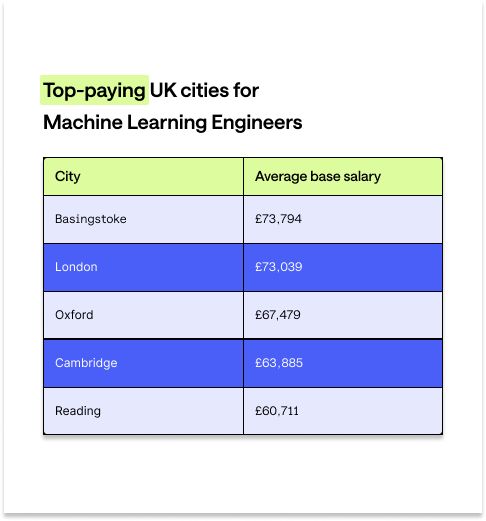
According to Indeed, the five highest-paying cities for Machine Learning Engineers in the UK are:
- Basingstoke
- London
- Oxford
- Cambridge
- Reading
Here’s a breakdown of the UK's top-paying cities for Machine Learning Engineers.
Machine Learning Engineer Job Requirements
Depending on the role, Machine Learning Engineers might need specific qualifications — a degree (or equivalent) qualification in computer science or statistics, for example. Still, many positions offer on-the-job training and development so that you can work towards a relevant qualification in the role.
A typical Machine Learning Engineer may have a background in programming, computer science, data science or another related field. Without this work experience, entry-level professionals should demonstrate a commitment to learning relevant skills.
To become a Machine Learning Engineer, you should have or be willing to develop the following skills:
- Mathematical understanding: Statistics, linear algebra and probability are critical in machine learning.
- Programming languages: You can use programming languages like Python, SQL (Structured Query Language) and Java for statistical analysis.
- Machine learning fundamentals: You can train accurate models using machine learning approaches and algorithms.
- Data analysis basics: You understand how to gather, clean, and organise raw data. You also have data visualisation skills.
- Business acumen: You know and use the entire machine learning process to meet business needs. You also use AI to drive business value and enhance your daily workflows.
Developing machine learning and AI skills in 2024
University can help you develop machine learning and AI skills. If you follow this path, you must choose a relevant degree or postgraduate qualification. Something like data science, computer science, or engineering would work. But this route is expensive — tuition fees alone cost up to £9,250 yearly.
Online learning through platforms like Coursera is another way to learn ML skills. This avenue offers flexibility around your existing commitments. But you may have to complete the work in your spare time. Plus, many online learning platforms don't provide accredited and industry-recognised qualifications. As such, you might stand out less in a competitive job market.
A professional apprenticeship with Multiverse, on the other hand, offers you the best of both worlds. You'll achieve an industry-recognised qualification. Then, depending on the programme, you can earn a degree equivalent. You'll also experience flexibility: learning in-demand skills through on-the-job training that fits around your work schedule.
These programmes can help you achieve your upskilling career goals, too. If you're already in a relevant role — say working as a Data Analyst — you can hone the skills needed to advance into machine learning. To top it off, apprenticeships are tuition-free. Not only will you save money, you'll make money by earning a salary as you learn.
Get paid to future-proof your career with Multiverse
Experts predict the market volume of the machine learning industry will grow from £126.30bn to £371.50bn by 2030. Those numbers suggest you could access more career opportunities — if you have the skills to meet future industry demand.
That said, specialists with machine learning skills are already in demand and well-compensated compared to most other professions. Long story short? There's never been a better time to future-proof your career by honing machine learning and AI skills.
A Multiverse apprenticeship programme is a tuition-free way for you to get started. As a Multiverse apprentice, you'll automatically gain access to the AI Jumpstart module — regardless of your programme.
The module caters to everyone. So, no matter where you are in your career, you'll learn foundational and future skills to stay ahead of the ever-changing digital landscape. And what's more, you'll get paid to do so.
Start or advance your machine learning career by completing our fast and simple application.
Skanska UK is building for the future with digital Academy
News
Team Multiverse
Together, Skanska UK and Multiverse have already trained over 50 employees through specialist learning opportunities enhancing skills. This latest addition will further enhance skills across the organisation and contribute to delivering Skanska UK’s digital transformation strategy.
Sally Scott, Director of Talent and Capability at, Skanska UK: “Through this partnership we are equipping our people with the knowledge and skills to ensure our projects deliver on time and to cost and quality expectations, making faster, data informed decisions. Our Data apprenticeships are now joined by a new AI apprenticeship, enabling more colleagues the opportunity to upskill.”
The training is being delivered by Multiverse, a tech company that identifies, closes and prevents skills gaps, through personalised, on-the-job learning. Multiverse has trained more than 20,000 apprentices in AI, data and digital skills since 2016.
The expanded Academy offers programmes such as the Level 3 apprenticeship ‘Data & Insights for Business Decisions’, covering core technical skills including cleaning, formatting and preparing data. The Level 4 ‘Data Fellowship’ lays the foundation for apprentices to become high-performing analysts and data science professionals.
Skanska UK is also leading the way on developing skills in AI in the construction sector, launching a first cohort onto Multiverse’s ‘AI for Business Value’ programme. AI will be taught as an tool to understand opportunities for ensuring profitability and predicting performance, while reducing manual processes to free up time for skilled workers.
According to the Multiverse Skills Intelligence Report, the UK construction industry currently contends with nearly a third of employees' time working with data being spent unproductively. Through upskilling, Skanska UK will help deliver more effective outcomes for customers and in turn help it compete in an increasingly data-driven construction sector.
Tom Gould, Operational Efficiency Director, at Skanska UK said: “From enhancing project timelines to optimising resource allocation, we recognise the transformative role data has in construction. Working together with Multiverse we are expanding learning opportunities for our people, ensuring we continue to deliver efficient and cost-effective solutions to clients and remain on the leading-edge of an evolving industry.”
Gary Eimerman, Chief Learning Officer at Multiverse, said: “It’s fantastic to see the value that Skanska has gained from our long-running partnership. In expanding the Data Academy to more employees, and exploring the opportunities afforded by AI, Skanska is seizing the opportunity to build for the next era of construction. In this new era, digital skills will be a catalyst for improved operations throughout the industry, from project development to sustainability and beyond.”

Continuous learning at every age and every career stage: Gen Z just as anxious as their parents about getting overtaken by younger, more tech-savvy workers
News
Team Multiverse
In this environment, a single shot of learning early on in life is clearly no longer sufficient.
Instead, we need to embrace a model of lifelong learning, where opportunities for growth and development are available to people of every age and at every stage of their career. That’s why at Multiverse, we deliver programmes that enable everyone to benefit from continuous, applied learning.
In the lead up to National Apprenticeship Week, we commissioned new polling with Public First to understand more about how people perceive their career journeys, from early career starters to more experienced workers - and found some surprises along the way…
Gen Z are just as worried as their parents about the threat of more tech-skilled workers
The rapid pace of technological change, particularly in the field of AI, has led to a widespread feeling of anxiety about being "left behind". And you might expect that this would be significantly more common among older generations.
But no: this concern isn't limited to older workers. It spans across ages and career stages.
Gen Z are similarly likely to think that they’re being overtaken by tech-savvy younger workers as those their parents’ age, with nearly a third of 18-24s expressing agreement compared with a third of the 45-54s.

This tech anxiety is also more pronounced in those who have taken extended leave from the workplace. Women who took extended leave are more likely than average to say they think they are perceived as not tech-savvy (37% vs 34%), and that they’re being overtaken at work by younger, more tech-skilled workers (38% vs 33%).
Career progression slows as you grow — but should it?
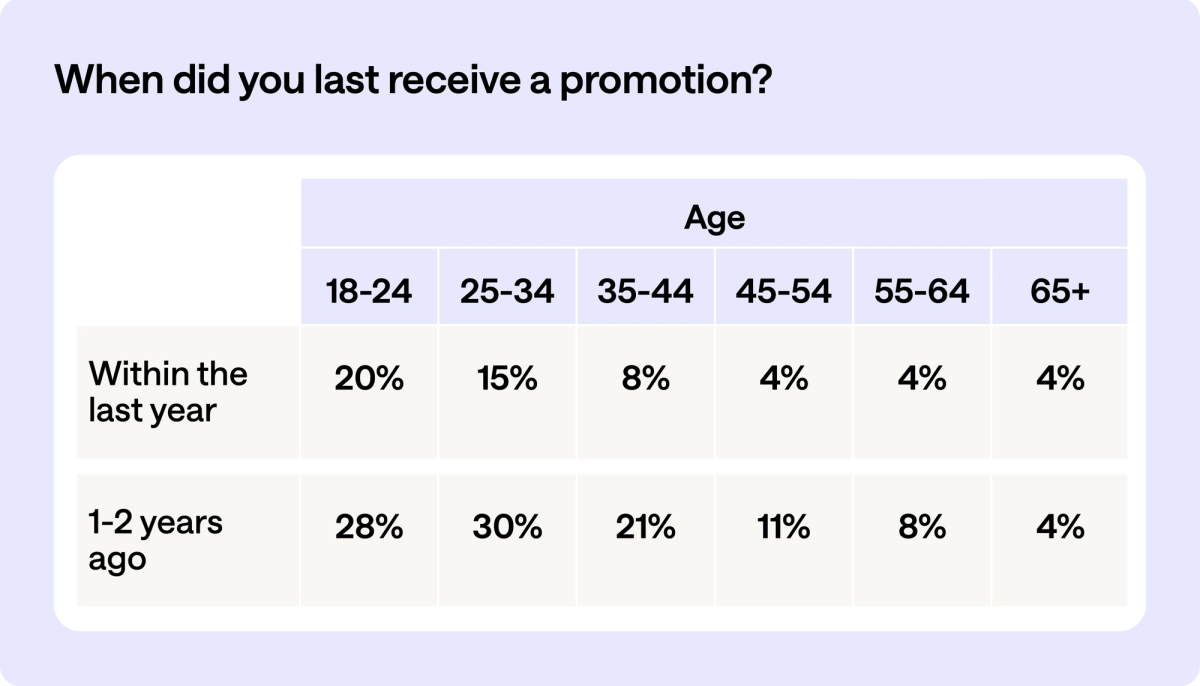
Our research found that those in the first decade of their career (18-24-year-olds) have seen much greater recent progression than those approaching the last decade of their career (55-64s).
Nearly half (47%) of career starters told us they have been promoted within the last two years, compared with just 12% of the 55-64s.
This career plateau needn’t be the case. Particularly with the UK government’s ambitions for growth and boosted productivity, there is no reason why more experienced workers shouldn’t also be enabled to seize the skills opportunity alongside their early career counterparts. After all, AI wasn’t around when most older workers began their careers.
In their working lives they’ve been witness to the death of the fax machine, the rising tide of email, the advent of the internet and the move to mobile. And they’ve tackled them all. Who says there’s such a thing as too old for AI?!
With this stark data, it’s perhaps unsurprising that more than two in five workers aged 55-64 (42%) express negative feelings towards their current pay level, and the availability and frequency of payrises (49%) and promotions (44%). Reskilling could be a solution: not just for individuals. Imagine the national economic upside if those in the last decade of their careers were promoted with the same frequency of those in their first.
More experienced workers recognise the need to reskill in tech
Despite feeling like they are not a priority for training and development (two in five agreed), older workers are more keen to develop their digital and AI skills than younger cohorts.
While some people might have the perception that older generations are tech-resistant, this data demonstrates loud and clear the fact that age doesn’t correlate to willingness to learn new skills.
Women who took an extended period of leave from work are also more likely than average to say that they need training at work to become capable of using new tech (45% vs 37%). They also express the desire to gain improved digital and AI skills from training.
These differences in priorities highlight the need for tailored approaches to skills development, ensuring that everyone, regardless of age or career stage, has access to the training they need to succeed. This was one of the core principles included in our Skills Mission report - we know from polling we commissioned last year that 9 in 10 workers support the right to reskill.
Taking learning out of the classroom and into the workplace
The evidence is clear: learning shouldn't be a one-time event. By prioritising continuous learning, we can help to ensure that there is equitable access to economic opportunity for all.
This helps employers - because it offers them a more skilled and engaged workforce, who they’re more likely to be able to retain.
And it helps learners - because it empowers them with the tools they need to succeed in a world brimming with change.
You’re never too old to try something new. You’re never too young to recognise the substantial effects of technological change.
Methodology
Public First online survey commissioned by Multiverse for the period 17 to 21 January 2025 with 2011 participants. All results are weighted by interlocking age and gender, region, and social grade to nationally representative proportions.

“Augmenting humans with AI requires a huge mindset shift” | In conversation with… Lisa Pinfield, Capita
Employers
Claire Williams
Capita launched its Data and AI Academy last year, designed to equip employees with new skills to use AI responsibly and drive business outcomes.
Lisa told us about her vision for AI skills at scale, the value of internal storytelling, and her lessons for leaders embarking on multi-year transformation journeys.
First things first. Can you tell us a little about your experience, your role at Capita, and your career journey to your current role?
I’ve been with Capita for 19 years and have a broad remit, looking after all things performance and development, culture, responsible business, and our early careers and apprenticeship offer.
I fell into learning from recruitment, and developed a fond love of lifelong learning as a result. When I left school, I went straight into an apprenticeship with a car manufacturer, and then joined Capita in a recruitment role, where I was lucky enough to study my CIPD part-time to get my HR qualifications.
Recently I’ve done my Master's in Leadership as well, funded through the Apprenticeship Levy, which was a fantastic opportunity to go back and study. So I’m a huge advocate for all things apprenticeships!
How is Capita approaching the opportunity of AI?
AI is fundamental to Capita’s ‘Unlocking Value Together’ strategy. We’re helping to reduce operational costs for our customers and enable them to provide higher-quality work to their employees, by removing repetitive and mundane tasks.
We’ve been partnering with several local authorities on proof of concepts to test out new AI tools. For example, we're helping advisors in our contact centres with a more human-centred and empathetic approach to how we deal with customer enquiries. AI allows us to listen to live conversations and seamlessly stitch together the council services in the background. It equips advisors to answer many enquiries much faster. It’s reduced our average call handling times for clients by 20%, which has a brilliant impact on our customer service and CNPS.
A separate trial for the British Army uses AI to streamline and process medical records, reducing processing times for applicants by 30%.
We're also drawing on the expertise of the highest calibre AI engineers and partnering with technology hyperscalers, including the likes of Microsoft ServiceNow, Salesforce and AWS, to develop efficient, ethical, impactful solutions, which now underpin our operations.
How is AI transforming the skills teams need at Capita?
We’re having to think about skills in a completely different way. As part of our workforce planning strategy and the work of my team, we’re looking at how we augment humans with the AI capability we’re bringing in – it’s a huge shift in mindset.
I’m really thinking about the skills the organisation needs in the future. The reality is that AI is transforming how teams operate, automating more repetitive tasks, and simplifying workflows.
It’s allowing us to focus on different skills, and for us, we’re prioritising data literacy. The AI we’re using is only as good as the data that we’ve got. We’re therefore trying to enable teams to interpret that data as fluently as possible. It doesn’t mean we’re training everybody to be data scientists, by any means, but it’s giving anyone the fundamental skills to ask the right questions, and critically analyse AI-generated insights to make better informed decisions.
We’re also looking at the behavioural skills that go alongside that, creating curiosity and an adaptive learning mindset. For instance, we need higher levels of emotional intelligence than before to help with critical thinking and problem-solving.
One way Capita is taking action has been launching the Data and AI Academy. Can you tell us how that idea came about and the goals of the programme?
The Data and AI Academy has been fundamental to us shifting the dial. The need came from a multitude of different skills we were looking to develop, particularly around technical proficiency.
For our employees, it’s about understanding the benefits of AI, the basics around data science and machine learning, as well as AI literacy. Ethical considerations and the responsible use of AI are also massively important.
We can’t underestimate AI's impact on frontline colleagues, so we’re focussing on adaptability: giving individuals the skills to be curious and continue to learn. We want our employees to make that human judgement and be creative for the parts that AI can’t replicate.
Data management and analysis is another area. We want to ensure everyone understands data governance, security practices, and the data lifecycle.
We’re proud of the programme we’ve built in partnership with Multiverse. We’ve got 86 learners on the AI for Business Value apprenticeship, and that's had a significant impact on our business.
I’m also incredibly proud of the materials we’ve built together for colleagues who sit out of the Levy-funded options. It’s important we’re developing AI literacy right across the business.
What made you decide to work with Multiverse?
The reason we chose Multiverse was their ability to demonstrate thought leadership in the AI space. We felt that out of all of the providers that we have worked with, or we went through a procurement exercise with, Multiverse was able to demonstrate the link to the actual business benefit.
Multiverse took the time to understand the transformation and change journey that Capita is on, and build something that was appropriate and meaningful to our employees.
The flexibility that Multiverse has given us on content and delivery styles for different audiences, from lower levels to leadership, has been fantastic, and we've seen a huge impact from that.
The biggest thing is true partnership. It's listening, it's understanding each other and building something that's successful together.
What’s the biggest success you’ve seen from the AI Academy? And what are you proudest of so far?
I’m proud we’ve got people talking about AI and the impact it can have while dispelling some of the myths.
It’s been lovely to do some internal storytelling around people's success on the programme. We often do things like fireside chats where individuals share their proof of concepts. One apprentice recently shared the impact of manual processing changes they’d made within back-office operations. Hearing somebody bring it to life and talk with such fluency around their AI solutions was fantastic.
I’m also hugely proud of our Microsoft 365 Copilot rollout, which is happening across the business. Using the AI for Business Value programme, we’re integrating our internal learning alongside how we’re developing Copilot's impact on our business.
How are employees responding to AI-driven changes in workforce development and skills programmes?
The business has undergone a huge transformation, and naturally, there has been a lot of scepticism about AI replacing human interaction. What this programme has done is demonstrate the advantages that you can have with AI. Our employees are now much more curious – the programme has made them keen to be involved and learn more.
Where there was maybe a fear of job displacement or reluctance to change previously, we’re finding that people are embracing AI.
Learners on the apprenticeship sharing their stories and successes has been fantastic – it’s bringing more people to the table and making them want to be part of the journey. We’re now seeing the knock-on effects where we’ve got people breaking down the door to be part of the next cohorts – it's exactly the success we wanted to get.
Let’s talk strategy. How does workforce transformation in AI support Capita’s broader strategic goals?
A big part of my role at the moment is leading our cultural transformation globally, and emphasising AI's ethical and responsible use across the business. It’s part of our Better Company pillar, which ladders up to our Unlocking Value Together strategy.
We have to align our cultural transformation with AI, so we can drive operational efficiencies, improve governance, and create better skills development to support our tech-enabled culture and future.
We're also refreshing our values at the moment, which I’m leading. It’s been fantastic hearing people so energised in focus groups about the opportunity that AI and data presents, and the opportunity to think about their roles in a different way – less transactional, and more creative and problem solving work.
What’s the biggest hurdle you’ve had so far on that journey, and how have you overcome it?
Navigating budget constraints. We've had to be as creative as ever to help individuals through that change journey, but also to give them the skills they need for the future.
So we've been repurposing a lot of our content – and challenging the art of the possible, utilising AI ourselves internally to create better materials and content.
Without our partners investing time to understand some of those challenges and be on that journey with us, it wouldn't have been such a success. So we’re grateful for the support Multiverse has given us.
Do you have a piece of advice that you’d share with other leaders looking to embark on a similar journey?
Don’t underestimate the change journey. For us, it’s a multi-year strategy – and not something that will happen overnight. We’re introducing AI and continuous improvement initiatives to change employees’ perceptions and drive teams to work together differently over time. But, it’s required strong leadership in that process.
We’re investing lots of time with our senior leadership team to help develop their skills. We want our leaders to become real advocates for changing workforce planning and viewing career pathways differently.
To build a truly augmented workforce, you must make sure all members of the organisation – at all career levels – are equipped with the right skills and tech. It's simple things. Make sure they've got the right equipment, they've got the right tools, but then to allow them to trial things and have a safer space to fail.
And finally, collaborate in strong partnerships. That’s the biggest element for me that’s been successful.
When you look at the year ahead, what are the trends shaping your role, and what are you doing to prepare?
I’m super excited about 2025. It will be keeping up with the rapid pace of change now – things are moving and accelerating faster than ever before. We’re using our budget as creatively as possible to upskill people to get ahead of that change.
Our business is hugely ambitious for its transformation with AI, and what we’re doing for our clients and customers. I can’t let our people down in giving them the skills to deliver what we’re expecting.
I’m also thinking about AI-driven learning experiences. We should practise what we preach and focus on social and collaborative learning to help individuals accelerate their growth. So we will be focused on upskilling and reskilling.
We all talk about the future of work, but do we understand what the future of work looks like in enough detail? We’re putting a lot of focus into that.
A practical challenge for me is ensuring that our remote workforce are still feeling part of that change journey, and adapting to our generational workforce and the differences that brings, as well.
One principle we have at Multiverse is that learning should be available for everyone at every age, and every stage. How is Capita considering this across the generational workforce?
Having five generations in the workplace is hugely exciting, but it brings lots of differences and lots of change. Multiverse has challenged our thinking around making sure that we have learning available to all different generations. Some Capita employees have been with us for a long time, and their roles are changing.
I’m sure that in some organisations those skills would be written off. Instead, it’s about looking early enough to ensure we are reskilling and upskilling. Individuals have got so much capability to do different things. We just need to make sure that we're challenging them in the right way, and giving them accessible, digestible content that’s relevant to their role.
I don’t think any inward learning team can do this on their own. Having truly great partnerships where you understand each other, you trust each other, and you can bring in the experts to fill gaps for you works wonders.
National Apprenticeship Week is coming up. How do you perceive the importance of apprenticeships at Capita?
On a personal level, apprenticeships have really supported me. They helped me at the start of my career, and I've now got a Master's funded through the Levy too.
Apprenticeships give fantastic opportunities to school leavers, but they are also an incredible mechanism for upskilling and reskilling. That's where we’ve tried to dispel myths at Capita – we’ve had over 700 learners go through apprenticeship programmes in the last couple of years. It's fantastic to see skills development in management, leadership, data and AI, where we're seeing huge impact and change.
The Levy allows us to partner and think about things in a slightly different way, using it as a mechanism to upskill our workforce. I’d encourage other organisations to think a little bit more outside the box about how you can use some of the apprenticeship standards that are out there to add business value.
So I will always continue to advocate for apprenticeships. It's hugely exciting to see how they develop and change individuals.
And finally, let’s end on a fun one… in an ideal world, what’s the one dream task you’d like AI to do for you?
I’d love it to manage my teenagers’ emotions for me! But joking aside, for me it would be to create a continuous learning culture of growth and curiosity. I’d love it if AI had a magic way to consistently embed that spirit of constant learning and growth into individuals and across the business.
It’s maturing and it's learning at such a rapid rate. Who knows what AI will do in the future?
Sorry, no results found.