







.jpg)
We couldn’t find what you are looking for. Please try another way.
The Multiverse blog
Thank you! Your submission has been received!
Oops! Something went wrong while submitting the form.
Making the business case for apprenticeships
Employers
Claire Williams
Businesses are struggling to meet increasing demand for digital and data skills, and with emerging technologies like Artificial Intelligence (AI) opening up limitless growth opportunities, the pressure to keep up has reached its peak.
But how can leaders create opportunities for workers at all stages to upskill and reskill? By combining real-world training with durable and industry-relevant technical skills, apprenticeships can help close the gap between the skills businesses need and those taught in the classroom - propelling careers forward in the process.
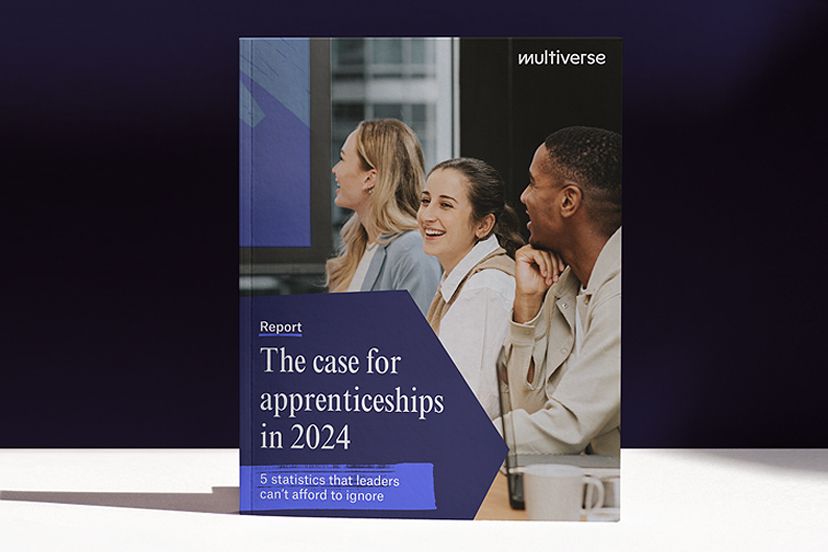
In our new report, we reveal the trends driving the business case for apprenticeships in 2024, based on our original research with hundreds of leaders across the globe. Download the report for full access, or read on for key insights.

Rethinking the way we train our workforce
In all our research, one message is clear: we need a new approach to deliver the skills most needed in future.
Multiverse data shows that the majority of business leaders are concerned about traditional education’s ability to deliver the digital, data, and tech skills in top demand. And with almost 50% of workers saying they’ve received no training in the last five years, the existing workforce isn’t being upskilled to fill the gaps.
That’s where apprenticeships can offer a solution – 70% of business leaders believe on-the-job learning is the best way to develop in-demand skills.
Building tomorrow’s skills, today
According to our research, over two-thirds of business leaders believe their business will need different workforce skills to remain competitive by 2030. They also believe AI will improve productivity and customer experience, and create more informed business strategies.
But a lack of AI skills in the workforce is already being felt. Leaders named AI as their most significant skills gap today, with employees lacking the training and knowledge needed to effectively harness new tools in the flow of work.
To leverage AI now and in the future, businesses can’t afford to leave knowledge in the hands of a few specialists. New methods for building emerging skills at scale are required. And the sooner, the better.
Over 70% of business leaders say they are investing in upskilling and reskilling as part of their future strategy, and 83% say they are moving quickly to implement AI skills training.
By tailoring learning directly to today’s business needs, apprenticeships offer a scalable way to upskill and reskill employees in emerging digital, tech and data skills.
Skills gaps create a clear impact on the bottom line
Our research shows 8.5% of annual revenue is lost as a result of digital and data skill gaps. But just as a lack of skills can hold a business back, new capabilities can propel it forward.
Upskilling and reskilling apprenticeships can help leaders close critical skills gaps while empowering employees in every function to improve speed and efficiency, leading to increased capacity and reduced time per task.
In our report, we reveal how Multiverse apprentices have used their skills to drive business impact worth millions, by identifying revenue generating and cost saving opportunities.
People of all ages need new skills and opportunities
When it comes to career progression opportunities, too many workers are being held back by a lack of skills.
Our research, conducted in partnership with the Burning Glass Institute, shows that in America, three quarters of the workforce (76.2%) are underemployed, facing blockers to upward career advancement, or otherwise in need of reskilling or upskilling opportunities.
By breaking the expensive barrier between education and employment, apprenticeships can help all individuals to gain new skills and access life-changing growth trajectories – whether they’re aiming to restart their career, change direction in their current company, or even enter the workforce for the first time. That’s why Multiverse apprenticeships are open to employees of all ages.
Transforming skills at scale through apprenticeships
In the future of work, businesses can’t rely on one shot of learning at the start of a career.
Apprenticeships can help leaders ensure that employees have the skills required to thrive as technology develops, build new talent pipelines from a broader range of backgrounds, and boost career longevity for their employees – all while contributing toward a more resilient economy.
Reach out to our team to learn more, or download our full report to explore our findings.
Launching on-demand coaching, powered by AI
News
Team Multiverse
Artificial Intelligence is creating new ways to add value to our learners and customers, and better routes through which to do it.
First, we’re equipping people with the skills they need to thrive in an AI age. We’ve already trained thousands of individuals in advanced AI skills via our data programmes, and last summer we rolled out AI training to every one of our apprentices.
And secondly, we see AI as a solution to some of the biggest challenges that education has faced to date. World-class training has been held back by scarcity: but the strength of AI is its ability to turn scarcity into abundance.
It’s why we’re investing heavily in our technology, to develop the tools that will unlock outstanding training to hundreds of thousands of learners.
This month, we’re launching one such tool: on-demand coaching, powered by AI.
The story so far
Expert, human coaches have always supported our apprentices, and will continue to do so. But we wanted to create something that could build on that support. To be there for apprentices whenever they have questions, with no delays. We know that, for example, our apprentices have a lot of questions as they approach crunch moments, projects and assessments - and those questions don’t always come during working hours.
So, during one of our regular hackathons, our tech team built a first iteration of an always-on, AI-powered assistant coach. It was immediately clear that this could benefit apprentices as a first port of call: to help them understand course material, overcome challenges, or brainstorm ideas.
Cem Gurkan, Product Manager, said: “As the world of work becomes more flexible and we push for more inclusive workplaces: not every assignment is done from 9-5 any more. The rapid acceleration in AI technology can make it possible for us to be there for apprentices whenever they need us.”
Enter: Multiverse Atlas.
Introducing Multiverse Atlas
Multiverse Atlas is built on a commercially available Large Language Model (LLM), and has been carefully prompted to support our apprentices.
It’s designed to encourage a socratic method of coaching, aiding apprentices to delve into topics themselves and find solutions, rather than simply giving answers like an off-the-shelf chatbot might. Atlas can give career advice, answer questions on topics related to our programmes, and quiz apprentices on topics - helping them to study.
Clare Dodd, VP Global Delivery, said: “Our coaches are industry experts that go through a rigorous coaching academy that covers our coaching philosophy: how we teach apprentices to ensure they are empowered to do their best work, retaining and applying their skills and knowledge. Atlas enables coaches to do what they do best, whilst also providing assistance in the moment an apprentice needs it most.
“For Atlas to do that successfully, the learning team worked closely with the tech team to test and iterate Atlas’ style of responding to apprentices - guiding them to find answers, and referring them to their human coach when they need additional support.”
The prompt that powers Atlas went through more than 100 iterations over a three month building process, and it continues to evolve with the close input from our coaches.
Atlas tailors its responses to the apprentice it is speaking to: it knows who they are, the industry they work in, the sort of job they do and the apprenticeship programme they are studying. At the core of what we do is the belief that people learn better when content is personalised to them, and AI enables that at scale.
In our beta tests, more than 10,000 questions have been asked and apprentices found 90% of Atlas’ responses to be helpful. For when Atlas doesn’t have the answer, apprentices can speak directly to their coach from the same on-demand chat application. Coaches can also see Atlas’ responses and can clarify or correct. On-demand coaching ultimately enables apprentices to connect directly with support, no matter where they are.
Atlas in action
The future of AI at Multiverse
This is just the beginning. Multiverse Atlas, and our on-demand coaching, will keep evolving.
As you read this, Atlas is being trained on all of our courses: so it will soon know our programmes like Software Engineering or the Data Fellowship back to front, to guide apprentices through their work. We’re continuing to personalise Atlas to each learner, so it can provide advanced contextual support based on where they are in their programme. We want to build the ultimate assistant coach that journeys with apprentices and provides them helpful, tailored assistance as they learn.
Peppa Wise, VP GTM, said: “When we’ve asked business leaders, they’ve told us that they don’t have the skills they need to reap the productivity gains AI could bring. Through our module - AI Jumpstart - we're offering training to all of our apprentices in these technologies, to start to close that skills gap. And AI tools themselves will enable us to make that training even better, and reach even more people: so more businesses can see the benefits that AI will bring.”
And Atlas is just one part of how we’re thinking about AI. Looking to the future, we’ll launch more ways to ensure our apprentices are power-users of AI tools, and experts in machine learning: while building the tools that will enable world-class, personalised, applied learning at scale.

Nuffield Health invests in data development enabling staff to improve health and performance outcomes
Employers
Team Multiverse
By prioritising the skills development of their employees, Nuffield Health aims to improve the use of data and digital skills across the organisation, delivering better outcomes for patients and beneficiaries across its services. Employees will benefit from new skills, enabling them to make faster data-informed decisions, whilst becoming more self-efficient when working with data.
The programmes will cover a range of skills including analytics, AI, and predictive modelling. Training will be delivered by Multiverse, a tech company that has trained more than 10,000 learners in digital skills. Staff will enrol on one of two Multiverse programmes; the 13-month Data Literacy apprenticeship introduces apprentices to the use of data and covers the core technical skills required to transform data into insights, as well as softer skills like building narratives and presenting findings.
The 15-month programme Data Fellowship covers more advanced data analytics and modelling, giving learners the skills to clean, analyse and model data; the ability to visualise and tell data stories to non-specialists; and the confidence to lead conversations around machine learning.
Professor Ben Kelly, Director of Data at Nuffield Health, said: “It’s vital that we are data-driven in everything that we do in order to deliver the best outcomes for all who use our services. Our use of data has helped to identify the need for our free-to-access initiatives, as well as establishing and evolving how these are delivered by analysing the outcomes. We have ambitious plans for the future, and offering our people the opportunity to enhance their skillset will, in turn, help us to develop our data analysis, bolstering the health outcomes for all the services we provide. High-quality training is the way to unlock the use of data across Nuffield Health, and our partnership with Multiverse ensures that training is grounded in real-world application.”
Ben Davies, Organisational Development Director at Nuffield Health, said: “We want to see more of our people with these in-demand skills. Whether they are working from our head office, on the gym floor in one of our fitness and wellbeing centres, or working on the ward in one of our 37 hospitals; everyone at Nuffield Health will see the benefit of enhanced data skills and this benefit will positively impact all who use our services. The use of data will help us deliver on our purpose to build a healthier nation, but it will also greatly enhance the long-term career prospects of individuals who do the course by providing them with the most in-demand skills and valuable qualifications that are essential in this modern world.”
Peppa Wise, VP GTM at Multiverse, said: “Nuffield Health has recognised that data skills cannot be concentrated in a single data team or silo, they need to be spread across an organisation. Through this programme, team members across Nuffield Health will be able to use data to do their jobs better, and deliver better outcomes for their patients and beneficiaries.“
Celebrating Women in Tech at Multiverse
Life at Multiverse
Team Multiverse
At Multiverse, we are working hard to create the change we want to see in the world. We’re proud that 55% of our UK team identify as women, and this increases to 64% of our Global Leadership Team (director level and above). In our Tech team 36% identify as women - while this is higher than the UK Tech industry, we know we need to do more. This blog post aims to celebrate the contributions and perspectives of four exceptional women helping to shape Tech at Multiverse.

Aishwarya's journey, from rural India to being a Senior Software Engineer at Multiverse, is a testament to her passion for problem-solving and the transformative power of technology."In the rural parts of India where I grew up, problem-solving and mathematics were my escapes, and my journey started when my father gifted me a laptop during my childhood. This sparked my curiosity and passion for technology," Aishwarya says.
Aishwarya believes that the tech industry's most rewarding aspect is its profound societal impact, especially in her role at Multiverse, where she works on projects aiming to bridge the tech skills gap. "Witnessing the transformation of people's lives, especially those who couldn't afford traditional education, is incredibly fulfilling,” she explains.
Looking ahead, Aishwarya imagines exciting possibilities for the future of the tech industry, where technology is used as a tool to address real-world challenges and contribute to positive societal changes.
Her advice for anyone interested in pursuing a career in tech? "Embrace curiosity and continuous learning," she advises, "Engage in real-world projects, network with industry professionals, and find your passion within the realm of technology."

For Mireia, her passion for mathematics led her naturally to a career in data science and she particularly enjoys using “mathematical models in real-world scenarios.”
Among the most rewarding aspects of her career, Mireia highlights the sense of achievement in seeing a project through to completion. She’s also excited by ’ the rapid advancements unfolding in the AI space, and how this will likely change the look of everyone’s lives and work going forward.
When asked what advice she would give to somebody considering a career in data science, Mireia keeps it straightforward: "Always continue learning." This aligns with the Multiverse value of ‘development is at our core’, which we know is crucial to a successful and fulfilling career.

"I’ve always been interested in dissecting details and spotting patterns," Ellena says, "The process of researching, spotting trends, and deciding what story to tell via aggregated information is surprisingly similar to creating a robust essay or report."
Her passion for data analytics fuels her current role at Multiverse, where she utilizes her talents to facilitate productive discussions and bring actionable outcomes for our customers.
As for the future, Ellena is most excited by the emerging potential of AI to increase productivity, enhance the understanding of customer sentiment, and help to make informed decisions using big data.
"If you're considering a career in data and analytics," Ellena advises, "make sure to research, talk to people in the industry, understand what you enjoy (whether it's the research aspect, cleaning data, storytelling, or all of it), take learning courses, and build a network. It’s useful for learning, demonstrating interest, and problem solving!"

Sara has found the perfect sweet spot between her knack for creativity and a more practical, functional role in the product design world.
"The challenging, shifting landscape of the tech world thrills me," Sara affirms, "The creativity that comes with coding and working with a team to turn ideas into reality seems like the perfect compromise between working in industry and being an artist."
When asked about the most rewarding part of her work, Sara speaks highly of her colleagues. "Working with incredibly talented people who challenge me every day and make me strive to be better".For Sara, one of the most exciting things about the tech industry is its constant dynamism; the industry is always on the move, continually advancing, which means there’s always something new to learn and adapt to.
Sara's advice to young women considering a career in tech is unequivocal: "Be brave and bold. There’s a space in the tech industry for us, too."
These inspiring stories underscore that the tech industry is a dynamic field populated by passionate, bold, and brilliant individuals. The contributions of women in tech enrich the industry and influence a more balanced, inclusive future.
If you’re looking to join our growing Tech team, check out our live roles.
North London Mental Health Partnership launches a Digital Academy
Employers
Team Multiverse
The training, which will be delivered by the tech company Multiverse, aims to enhance the Partnership's digital capabilities, making it more data-driven, and ultimately improve patient outcomes and services.
The initiative is part of NLMHP's strategy to upskill its workforce with an emphasis on intelligent use of data to drive improvements and efficiencies.
Sarah Wilkins, Chief Digital Information Officer at NLHMP says ‘‘being part of this initiative means understanding of our data and insights will be embedded through the organisation, enabling us to enhance our services and improve patient and service user outcomes. Not only will it drive operational efficiency, but it will also serve as a stepping stone in our commitment to professional development for our staff."
Multiverse has worked with more than 10,000 apprentices in areas such as data analytics and software engineering.
This is only just the start of the journey, NLMHP will enrol another 50 employees onto the Academy in March to embed cultural change across the Partnership.
Peppa Wise, Vice President Go To Market at Multiverse, said, " The nature of healthcare is changing. Tech and data have the potential to help all of us lead healthier lives.
“Through this partnership, NLMHP is not only investing in its operational efficiency to better support patients and service users, but it is also nurturing its workforce with cutting-edge data skills. This step will enhance patient services and outcomes, reflecting the growing embrace of a data-driven approach across the NHS."
Wigan named best place to be an apprentice, new analysis finds
News
Team Multiverse
Multiverse’s ‘Best Places to be an Apprentice’ ranks areas using criteria from government and ONS data including the number of apprentices per business, growth in the number of new apprentices, the area's employment rate, and how affordable renting is across the towns and cities.

The analysis found that Wigan, Stoke-on-Trent, and Newcastle-under-Lyme are the top three areas to be an apprentice in England.
All three topped the list by scoring consistently highly in every category, particularly for the high number of apprentices per business.
The affordability of properties for apprentices to rent means that nine of the top 20 places are in the North of England, whilst London does not feature at all. Three areas are in the North East, three in the North West, and three in Yorkshire and the Humber. This compares to just four in the South East and one in the South West.
The analysis shows that the opportunity for apprentices stretches beyond big cities. Towns dominate cities in the ranking, with only five of the top 20 places being cities: Stoke, Plymouth, Hull, Southampton, and Sunderland.
Euan Blair, CEO at Multiverse, said: "Apprenticeships are an incredible vehicle for social mobility across the UK - and at Multiverse we’re proud to have apprentices in every corner of the country. Access to our apprenticeships has been unlocked by the use of tech to scale our offering nationwide and has allowed us to reach often overlooked areas.
"The spread of opportunities supports our belief in the ability for apprenticeships to be the tool that enables equitable access to economic opportunity, for everyone.”
Creating career comebacks at Citi through data skills
Employers
Team Multiverse
For employers aiming to encourage talent back to the workforce, or transition employees into new roles, upskilling and reskilling initiatives offer a vital solution.
We explore how Citi, the global bank, is opening new pathways for individuals to return to work, start a career, or change roles within the financial services industry – while supercharging their development through the power of data skills.
About Citi’s Reactivate Your Career Program
Designed for those returning to work after a career break lasting more than two years, Citi’s program offers job opportunities across a wide range of roles, including operations and technology.
Participants benefit from a tailored professional development package and complete a qualification to enhance their skillsets. Since 2020, Citi has partnered with Multiverse to provide data skills training to participants.
“We believe it’s vital to have a workforce that reflects a diverse range of backgrounds, perspectives, and experiences,” says Jacqui Lloyd, Head of Apprenticeships and DEI Execution at Citi. “Through the Reactivate Your Career program, we’re committed to helping people return to careers they love or carve out a new path in the dynamic financial services industry.
“Apprenticeships are an important tool we leverage to develop future leaders and build critical skills for Citi. In our ongoing partnership with Multiverse, we’ve created career-accelerating opportunities for workers at all stages. We’ve seen first-hand how empowering our colleagues with data skills delivers impactful results and tangible advantages across the business."
Transformative opportunities with data upskilling
Whether they’ve taken time out for family or personal obligations, or simply to reassess their career path, the program is helping a wide range of individuals navigate their way into different roles in financial services.
At the same time they receive further training in high-demand data skills, helping them to transform data into insights and make informed business decisions.
Srilakshmi’s story
Srilakshmi joined Citi’s program in a project management role and completed a data qualification with Multiverse. She found the benefits went far beyond finding her footing back in the professional world.
“When I had my second child, I decided to take a break to prioritise my family. After three years, it felt like it was the right time to get back to work,” she said.
“What stood out to me about [Reactivate Your Career] is that it's not only about getting back to work, it's also about upskilling. Not only am I back at work, I'm also learning something new through the data program. The best part about the apprenticeship is taking those concepts and applying them to your work.”
Driving business impact with data literacy
Participants are leveraging their new skills to drive change in teams across Citi, making strides by streamlining processes, enhancing efficiencies, and crafting data visualisations. 100% of line managers said participants had created business impact for Citi using their new data skills.
Saloni’s story
Saloni is an IT project manager at Citi. Having completed a Multiverse data literacy apprenticeship during the program, she now uses her enhanced Tableau skills to create time-saving algorithms, automating monthly processes that used to be manually done.
“The skills taught on this course have backed up the incredible on-the-job training and work I’ve done in my role at Citi,” she said.
The result? She’s achieved an impressive efficiency boost of 80% when working with data and has been praised by her internal stakeholders.
“Through the Multiverse course, Saloni has also acquired a very good understanding of handling data which positions her to lead related projects within our stream,” said her line manager.
Empower your teams with the skills of the future
Find out more about opportunities at Citi at jobs.citi.com.
We’re opening apprenticeships to people of all ages
News
Team Multiverse
We’re opening our entry-level apprenticeships to people of any age for the first time: enabling people in their 30s, 40s and 50s to restart their career, change direction, or even enter the workforce for the first time.
More than 50% of our apprentices are currently over the age of 30 on upskilling and reskilling programmes, and we know the benefit apprenticeships can have for those of any age.
That’s why, now, all of our apprenticeships are open to anyone: whether you’re entering the workforce for the first time, reskilling into a new career or industry, or uplevelling your skills.
Euan Blair, CEO of Multiverse, said: “There’s long been a belief that apprenticeships are only for young people. This isn't true: apprenticeships can support a broad range of people at multiple stages in their lives to control the trajectory of their careers.
“Our mission is to provide equitable access to economic opportunity for everyone. Supporting people of any age to access apprenticeships is another step towards delivering this.”
In December, our research found that more than 5m UK workers over the age of 50 are considering retiring early, creating a large risk to an already strained workforce: many of whom are concerned about not having the modern skills employers are currently looking for.
Blair said: “The changing tech landscape proves that people of all ages need new skills, and the opportunity to reimagine what their career can be. Whether someone is 16 or 60, we want to use apprenticeships to support them to build meaningful, sustainable, and well paid careers."
Minister for Skills, Apprenticeships and Higher Education Robert Halfon said: “Apprenticeships are for everyone, at all ages and stages of their career. So, it is brilliant news that Multiverse is removing all age restrictions from their apprenticeships, enabling more people to retrain and upskill later in life. Multiverse understands the wealth of benefits apprentices bring to businesses across the country.
“Apprenticeships are crucial to giving people from all backgrounds the chance to gain the skills they need to unlock their potential while addressing skills gaps and helping to grow our economy. That’s why we’re increasing investment in apprenticeships to 2.7 billion available by 2024/25, extending the skills ladder of opportunity to all.”
Cheshire West and Chester Council achieves success with Data Skills Academy
Employers
Team Multiverse
Over 70 members of staff have enrolled on the programme to date, with a fourth cohort about to launch in March. Training is delivered through professional apprenticeships by tech start-up Multiverse and funded through the Government’s Apprenticeship levy.
Employees are enrolled on one of three data apprenticeships, including up to degree-level.
- The 13-month Data Literacy programme covers the core technical skills required to transform data into insights, as well as softer skills like building narratives and presenting findings.
- The 15-month Data Fellowship course will give apprentices the skills to clean, analyse and model data, and tell data stories to non-specialists.
- The degree-level Advanced Data Fellowship will empower apprentices to develop their skills in data analysis and data science, studying areas like statistical testing, data ethics, predictive modelling and data security.
Research by the UK Government has found that almost a quarter of employees use advanced data skills in their work, yet a shortage of skills in this area is estimated to cost UK businesses £2bn a year.
New data skills are unlocking valuable insights about the needs of residents and communities, enabling the Council to deliver focused digital and transformation programmes. Services are benefiting from a saving in staff time on data management tasks and the Council is seeing wider impact from the creation of the new, Council-wide Data Hive network, supported from the central data hub.
Simon Riley, the Council’s Chief Operating Officer said: “A key focus for us across the Council is to use data and insight to inform strategic decision making. Accurate and up to date data has never been more important for us and accessing the right tools, technology and trained staff to make the most of that data is essential.”
Multiverse delivers world-class training in a wide range of qualifications in tech, data, and engineering. Apprentices benefit from one-to-one coaching with an industry expert and are supported by a thriving community with events, socials, mentoring and leadership programmes.
Peppa Wise, Vice President of Go to Market at Multiverse, said: "Working efficiently with data is absolutely vital for all organisations - and for local authorities it's essential for delivering high quality services to residents. Cheshire West and Chester Council is expanding its skills in this space through its Data Academy. Apprentices benefit from Multiverse’s intensive coaching and applied learning, to develop rich skills in the most high-demand areas that will serve them for their career."
.jpg)
Hays and Multiverse launch apprenticeship academy to tackle national digital skills challenges
Employers
Team Multiverse
The launch comes as difficulty in accessing talent continues to be a key concern for employers - with 95% of tech employers experiencing skills shortages in 2023, according to data from the Hays UK Salary Guide. Hays is working with Multiverse to co-deliver the ‘Data Analysis and Business Transformation Academy’ which empowers undiscovered talent with skills such as data analytics, communication, machine learning and project management, through level 4 apprenticeships.
Those who successfully join the academy are paid during the initial training period, which is front-loaded into a 10–12-week intensive bootcamp at the start of the apprenticeship.
Upon completing the bootcamp, individuals will work at Hays' partner organisations for the remainder of their apprenticeship, gaining accelerated experience within a variety of different markets whilst delivering impact and transformation for the organisations they are deployed with. Each apprentice taking part in the academy will also have the opportunity to go on to gain further qualifications and secure a £10,000 bonus upon successfully completing the 2-year programme.
The first cohort of individuals have already enrolled in the academy in January, with a further 25 enrolling in March.
Harry Gooding, Director of Skills and Learning at Hays, said: "This new academy is a game-changer in the talent world and offers the chance for businesses to access much needed skills from individuals who can create real value from day one.
For the individuals, it’s an opportunity to access world-class training, regardless of qualifications – enabling high potential people from all backgrounds to thrive at the most exciting companies.”
Peppa Wise, VP GTM at Multiverse, said: "Our mission is to provide equitable access to economic opportunity for everyone - and this new academy from Hays will enable people to access world-class training and unlock great careers, regardless their educational background or career history."
The academy fits as part of Hays’ Skills and Learning offering which provides an alternative route for individuals to access tech careers, widening access to high skilled roles for undiscovered talent from disadvantaged backgrounds.
The training is delivered collaboratively by Hays and Multiverse. Multiverse is a tech company focused on high-quality education and training through a unique professional apprenticeship model. Multiverse delivers apprenticeships in areas such as software engineering and data analytics.
Sorry, no results found.