








We couldn’t find what you are looking for. Please try another way.
The Multiverse blog
Thank you! Your submission has been received!
Oops! Something went wrong while submitting the form.
8 time management tips for busy professionals in the AI age
Apprentices
Team Multiverse
If all those responsibilities make you feel overwhelmed, you’re not alone. Nine out of ten UK employees say they’ve experienced high or extreme pressure in the last year.
You probably can’t cut your to-do list in half — at least, not if you want to advance your career. But you can get more done with less stress with these time management tips.
Spotting the signs of poor time management
Sometimes, it’s hard to recognise that your time management skills are lacking. Sure, you might be crossing things off your list and meeting most of your deadlines. But that doesn’t necessarily mean you’re being productive — or finding a healthy work-life balance.
You probably need help managing your time if:
- You’re always scrambling to hit deadlines at the last minute.
- Most days, you add more to your agenda than you finish.
- Important tasks at home keep getting overlooked, until you realise you haven’t vacuumed in weeks.
- You constantly stay late at the office or spend half your Saturday working to get everything done.
- Sometimes, you don’t even know what to start working on.
- You rarely have time to upskill, so you feel like you’re falling behind your colleagues.
Look out for sneaky time wasters, too. You might spend hours reading emails or trudging to boring meetings. Or maybe you’re multitasking all the time, like typing out a memo while you nod along in a Zoom meeting. These nonproductive activities may make it seem like you’re doing a lot, but they’re actually making you less efficient.
8 ways to take back control of your schedule
You can’t pick and choose all your tasks, but you can control how you handle them. Get ahead with these simple time management strategies.
1. Set clear goals and priorities
Creating goals is the foundation of effective time management. They help you prioritise tasks and say no to things that won’t help you move your career forward.
Use the SMART framework to set professional and personal goals that are:
- Specific - Imagine what you want to achieve in detail.
- Measurable - Make sure you can easily track your progress.
- Achievable - Pick something you can realistically accomplish with your current resources.
- Relevant - Your objectives should fit your long-term career plan.
- Time-based - Set deadlines and milestones.
Let’s say you’re a Software Developer with a mile-long debugging backlog. You could aim to clear out half of it in two months by fixing at least five bug reports a week.
Once you’ve got your big goals, don’t just stick them at the top of your to-do list. That’s too intimidating. Instead, break them down into bite-sized tasks that you can chip away at. Want to clear out hundreds of unread emails in your inbox? Schedule two blocks a day to answer and delete messages, and set time limits so you don’t get lost reading months-old emails.
As you work on your goals, the Eisenhower Matrix can help you spot high-priority activities. It sorts tasks into four quadrants:

For example, reading random e-newsletters goes in the “delete it” category, so use the unsubscribe button liberally. A time-sensitive client email, on the other hand, needs an immediate response.
2. Build a realistic weekly schedule
A digital calendar can significantly improve time management at work and in your personal life. Choose a mobile-friendly platform like Google Calendar so it’s always accessible.
Before you open your calendar, write down all your upcoming tasks and sort them by priority, like this:
- High: Client presentation on Friday, report due Monday morning
- Moderate: Daily standup meetings, study sessions for learning data analysis skills, walking the dog every evening
- Low: Checking email, putting away laundry
Estimate how much time you’ll need for each item, and be honest with yourself. If that detailed report usually takes four hours, don’t say you can do it in three, or you’ll just feel stressed.
Use this list to start mapping out your weekly schedule. Create colour-coded time blocks for similar tasks — like meetings and presentation prep time — so you can see what’s coming up at a glance. Schedule at least a few hours a week for deep focus, too, so you can work on creative tasks without interruption.
And don’t forget to pencil in plenty of breaks and buffer time. Sure, you could rush to six back-to-back meetings, but you’ll probably feel too drained to work on anything else. Regular breaks reduce stress and improve your overall well-being.

3. Tackle challenging tasks first
You’ve got limited energy, no matter how much coffee you chug. Start your day by “eating the frog” — a.k.a starting with the hardest or most urgent tasks on your list. This helps you build momentum and frees up time later for routine tasks.
The Pomodoro technique can help you maintain focus for those big tasks. It breaks work into 25-minute intervals, followed by five-minute breaks. After you complete four pomodoros, take a longer 30-minute break. This strategy lets you accomplish tasks faster without burning out.
Whenever possible, avoid packing your schedule with too many difficult tasks. Quality over quantity is key to protecting your mental health and productivity.
4. Minimise distractions
While most time management tips focus on doing more, you should also cut down on tasks that sap your attention. Social media and texting are two of the biggest culprits. Turn off notifications during focus time and use app blockers to stop yourself from scrolling on TikTok for “just five minutes.”
A tidy workspace can also help you concentrate. Get rid of clutter, such as random bobbleheads and knick-knacks, and create quiet zones free from unnecessary tech.
5. Use the right tools
Many professionals use time management tools to stay organised. Here are just a few options:
- Toggl Track to record your time and see where it’s going
- Digital calendar apps to schedule tasks and set reminders
- Forest to encourage you to put your phone away and focus
- Todoist to track and manage tasks
Experiment with a few programmes to see what works best, but don’t feel like they’re mandatory. If old-fashioned sticky notes and written calendars boost your productivity, stick with that.
6. Organise notes and tasks in one place
Nothing wastes time like searching for a scrap of paper on a messy desk — or worse, trying to remember something that your boss told you three weeks ago.
Save time by jotting everything down in a digital note-taking app like Notion or Google Keep. Keeping everything together decreases stress by making sure you always have clear, up-to-date information.
7. Avoid procrastination with small wins
Nothing kills motivation like slogging through an ocean of tasks. Give yourself something to celebrate by setting micro-goals. A major white paper might take days to complete, but treat yourself to a fancy coffee after drafting each section. Little victories will help you stay motivated and recognise your progress.
Don’t let perfectionism paralyse you, either. Just start, and tell yourself you can always fix it later.
The two-minute rule also stops little tasks from piling up. If something takes less than a couple of minutes, do it right away, even when you don’t feel like it.
8. Review and adjust your system
Mastering time management won’t happen overnight, especially if you’re a chronic procrastinator or easily distracted.
Start small by choosing just two or three of these practical strategies to increase productivity. At the end of each week, spend 10 minutes reviewing your progress and analysing how you’re spending time.
Not making progress? Try new time management apps or switch up how you prioritise tasks. You could even use AI to automate basic tasks like sending appointment reminders to clients.
Above all, flexibility is key. Your personal life may get busy, or you might decide to focus more on upskilling. Adapting your time management system will keep everything moving smoothly.

Apply these skills in your Multiverse journey
Time management skills can benefit all professionals, but they’re especially critical for apprentices. Techniques like time blocking and the Pomodoro method will help you balance work, training, and projects.
Multiverse’s free Project Management and Transformative Leadership apprenticeships allow you to apply and build these valuable skills. You’ll learn how to delegate tasks and identify areas for improvement in your organisation. These hands-on programmes also help you future-proof your career with in-demand AI and leadership skills.
Complete our quick application to learn more about how a Multiverse apprenticeship can improve your time management.


Learning scientists identify 13 human skills gaps that could threaten AI adoption, as companies race to integrate the technology
News
Team Multiverse
As companies invest millions into artificial intelligence, reports from sources such as MIT are beginning to suggest that over-reliance on generative AI can reduce critical thinking. This resulting human skills deficit could itself threaten the effective adoption of AI if not properly addressed, according to findings published today by learning scientists at upskilling platform Multiverse.
The researchers found that creativity, analytical reasoning and systems thinking are among the 13 human skillsets required for the workforce to successfully adopt AI. These sit alongside technical skills such as prompt engineering, AI model evaluation and AI process modelling, and hold the keys to effectively bringing together people and technology to drive value.
The findings were uncovered through qualitative and observational research with AI power-users, alongside expertise derived from upskilling thousands of workers in the use of the technology. The resulting skills framework will support workers and organisations looking to improve their AI maturity – their ability to deliver meaningful impact with AI.
Accenture predicts that AI could contribute £736 billion to UK GDP by 2038, but also notes that leading companies are nearly twice as likely to prioritise ‘soft skills’. A substantial gap between AI’s potential and the human skills required to use it effectively could therefore represent a major risk to UK productivity and growth.
“Leaders are spending millions on AI tools, but their investment focus isn't going to succeed. They think it's a technology problem when it's really a human and technology problem. Without a deliberate focus on capabilities like analytical reasoning and creativity, as well as culture and behaviours, AI projects will never deliver up to their potential," said Gary Eimerman, Chief Learning Officer at Multiverse. "This framework provides a new model for talent development in the age of AI, which must include human skills as well as technical skills in order to drive tangible business results.”
Focusing on the requirements for effective collaboration between humans and AI, 13 human skills have been identified as critical to support technical AI adoption. These form part of Multiverse’s broader skills taxonomy, a hierarchical system mapping the skills required for success in the digital era.

The most essential human skills identified for meaningful AI adoption are:
Cognitive skills: Mental abilities used for learning, reasoning, problem-solving, and decision-making.
- Analytical reasoning: Breaking down complex information for AI to more effectively deliver its instructions; recognising tasks that AI is not suitable for.
- Creativity: Pushing the boundaries of AI use and experimenting with new approaches to drive innovation.
- Systems thinking: Identifying patterns in AI performance to predict how AI will respond to a task.
Responsible AI skills: Applying ethical principles to ensure the responsible use of AI, considering its impact on individuals and society.
- AI ethics: Spotting bias and recognising how it affects AI outcomes; using AI outputs in an ethically sound way to inform business recommendations.
- Cultural sensitivity: Identifying when AI outputs lack sufficient geographic or cultural awareness.
Self-management skills: Recognising thoughts, values, feelings, and behaviours, and how they impact the ability to achieve objectives when using AI.
- Curiosity: Examining the broader context and requirements of a task to augment AI outputs.
- Self-regulated learning: Reflecting on the success of a chosen AI approach; partnering with AI to self-assess its outputs.
- Detail orientation: Fact checking AI for hallucinations and errors; using one’s own domain expertise to ensure accuracy.
- Adaptability: Iterating and refining one’s approach to interacting with AI based on the quality of outputs.
- Determination: Patience and willingness to continue trialling new approaches with AI, even during unsuccessful AI interactions.
Communication skills: Strong interpersonal skills which support the optimisation of AI outputs.
- Empathy: Treating AI as an extension of one’s own mind and thoughts; anthropomorphising AI to create more thoughtful, receptive, and intentional dialogue.
- Tailoring communication: Discerning whether AI output has the desired tone for a particular audience or situation, and refining prompts if it is not.
- Exchanging feedback: Using AI to proactively seek feedback on work.
These key skillsets, alongside the broader skills taxonomy, underpin the proprietary skills assessment tools embedded in the Multiverse platform. These tools help organisations better understand the current capabilities of their staff ahead of embarking on upskilling initiatives.
“We need to start looking beyond technical skills and think about the human skills that the workforce must hone to get the best out of AI,” said Imogen Stanley, Senior Learning Scientist at Multiverse, who led the development of the skills taxonomy. “What we found during our first principles research phase was that skills like ethical oversight, output verification, and creative experimentation are the real differentiators of power AI users. By developing these specific skills, employees can move from being passive users of AI to active drivers of innovation and value.”
Multiverse is the upskilling platform for AI and tech adoption, which delivers personalised, on-the-job learning. Multiverse has trained more than 20,000 apprentices in AI, data and digital skills since 2016.
Over 1,500 companies work with Multiverse to deliver impactful learning that’s transforming the workforce at scale. Programmes are targeted at people of any age or career stage.
Beyond critical thinking: 13 durable skills driving AI adoption
Learning Science
Team Multiverse
The need for AI durable skills research
Recent research by Gerlich (2025) found a significant negative correlation between frequent AI tool usage and critical thinking abilities. This was particularly evident in younger participants, who showed higher dependence on AI tools and scored lower on critical thinking assessments compared to older participants. The study attributes this decline to ‘cognitive offloading’, the delegation of thinking tasks to machines, which appears to undermine our capacity for independent analysis.
However, Multiverse recognises that as the world of work evolves, so too will our conceptualisation of intelligence and the skills required for effective AI interaction. Beyond just critical thinking, there exists a whole new set of durable skills that individuals must master to harness AI’s potential.
Our research approach
Our research aimed to investigate the specific durable (soft) and cognitive skills that enable successful AI adoption and integration in the workplace.
We had 3 research questions:
- What specific durable and cognitive skills are essential for successful and effective AI use in the workplace, and why?
- How is task performance using AI affected when the relevant durable and cognitive skills are not present?
- Do durable and cognitive skills for successful AI use vary between experience with AI levels?
We used the following definitions of durable and cognitive skills:
Durable (soft) skills refer to personal attributes and social abilities like communication, adaptability, and ethical awareness that enable effective human interaction and collaboration, representing uniquely human competencies that cannot be algorithmically replaced (Amann & Stachowicz-Stanusch, 2020; Kumar, 2023).
Cognitive skills refer to the mental abilities and processes fundamental to acquiring knowledge and understanding, including analysing, applying, creating, and reasoning, which are essential for learning, decision-making, and critical evaluation of AI outputs (Zhai et al., 2024; Gerlich, 2025).
To ensure the authentic representation of these human skills, we employed a Grounded Theory approach. This is a data led, iterative process that builds theoretical frameworks directly from data, rather than testing pre-existing hypotheses. This allowed us to observe human behaviour in an AI environment, extract and pinpoint core skills from this raw data.
We conducted this observational research using Think Aloud Protocol Analysis (TAP; Ericsson & Simon, 1993), a research method which gathers verbal reports as data. The participants, 20 of Multiverse’s AI users ranging from beginner to expert level, verbalised their thoughts and decisions as they carried out daily tasks using AI. This was paired with follow-up interviews to understand participants’ perceptions of the way they interacted with AI.
Our findings
After collecting our initial data, we conducted thematic analysis which highlighted a set of 13 skills with examples of how each skill optimises AI use in the workplace.
These address research question 1, ‘what specific durable and cognitive skills are essential for successful and effective AI use in the workplace, and why?’, and research question 2, ‘how is task performance using AI affected when the relevant durable and cognitive skills are not present?’
Below, you can see an example skill that was evidenced in our research, ‘Tailoring Communication’. As alluded to above, this example shows how grounded theory research was used to identify specific skills. We analysed the raw data and grouped themes together, undergoing a process of iteration and refinement which eventually led to our final skillset of 13.
1. Tailoring communication: Discerning whether AI output has the desired tone for a particular audience or situation, and refining prompts if it is not.
This skill was observed as participants reviewed AI outputs to ensure a match with their desired tone, to sound like the human user, or to be appropriate for a particular audience. In the TAP analysis, a participant talked about understanding their environment in relation to AI’s outputs:
"The key here is marrying the output of your AI tool to the human world that you live in at work, which is like generally what is the expectation and the culture surrounding what your output should be."
Participant 9
Intermediate/Advanced AI user
Another participant reflected on the key soft and cognitive skills they employed in their AI interactions:
"I like to think about how I would explain this process to a normal person who isn’t a robot. And then that explanation becomes my prompt."
Participant 16
Expert AI user
We also captured evidence addressing research question 2, as participants reflected on the consequences of not tailoring their communication when using AI:
"The consequence would have been additional questions or confusion created by not being very clear and speaking in a voice that was appropriate for the audience that you're working with."
Participant 7
Expert AI user
Whilst this participant candidly explains:
"If I would solely trust and let Chat-GPT guide me in my communications I would truly fail."
Participant 1
Intermediate AI user
A note on critical thinking...
Interestingly, the evidence we captured for cognitive skills when using AI echoes established research demonstrating that when people anticipate future access to information, they exhibit lower rates of information recall but enhanced recall for information location and access methods (Sparrow, Liu & Wegner, 2011). This suggests that memory storage is being relocated rather than diminished, prompting us to reconsider which cognitive abilities are most valuable when working alongside AI systems. Our research supports this phenomenon, suggesting that the challenge lies not in cognitive decline as Gerlich’s research concluded, but in determining which skills to prioritise in an AI-augmented work environment.
Addressing research question 1, the full set of our 13 critical skills for AI adoption is listed below, along with their groupings:
Cognitive skills - Mental abilities used for learning, reasoning, problem-solving, and decision-making.
1. Analytical reasoning: Breaking down complex information for AI to more effectively deliver its instructions; recognising tasks that AI is or is not suitable for.
2. Creativity: Pushing the boundaries of AI use and experimenting with new approaches to drive innovation.
3. Systems thinking: Identifying patterns in AI performance to predict how AI will respond to a task.
Responsible AI use skills - Applying ethical principles to ensure the responsible use of AI, considering its impact on individuals and society.
4. AI ethics: Spotting bias and recognising how it affects AI outcomes; using AI outputs in an ethically sound way to inform business recommendations.
5. Cultural sensitivity: Identifying when AI outputs lack sufficient geographic or cultural awareness.
Self-management skills - Recognising our thoughts, values, feelings, and behaviours, and how they impact our ability to achieve our objectives when using AI.
6. Curiosity: Examining the broader context and requirements of a task to augment AI outputs.
7. Self-regulated learning: Reflecting on the success of a chosen AI approach; partnering with AI to self-assess its outputs.
8. Detail orientation: Fact checking AI for hallucinations and errors; using one’s own domain expertise to ensure accuracy.
9. Adaptability: Iterating and refining one’s approach to interacting with AI based on the quality of outputs.
10. Determination: Patience and willingness to continue trialling new approaches with AI, even during unsuccessful AI interactions.
AI communication skills - Strong interpersonal skills which support the optimisation of AI outputs.
11. Empathetic interaction: Treating AI as an extension of one’s own mind and thoughts; anthropomorphising AI to create more thoughtful, receptive, and intentional dialogue.
12. Tailoring communication: Discerning whether AI output has the desired tone for a particular audience or situation, and refining prompts if it is not.
13. Exchanging feedback: Using AI to proactively seek feedback on work.
Finally, addressing research question 3, our research also revealed that participants at four different AI experience levels exhibited distinct characteristics.
- Basic users tended to focus on task completion with simple prompts and limited evaluation.
- Intermediate users balanced quality and efficiency with growing AI awareness.
- Advanced users optimised AI for strategic tasks, used more complex prompts, and exhibited metacognition i.e. reflected on their own strengths and limitations in the AI interaction.
- Expert users integrated AI into sophisticated workflows, whilst maintaining extensive knowledge of AI’s constraints.
Interestingly, we found that female participants consistently underestimated their AI competency in self-assessments, requiring upward adjustments to a higher experience rating based on observed performance - highlighting important implications for how AI confidence is perceived across demographics.
What’s the impact of these findings?
In addition to answering our research questions, we have addressed a critical gap in the literature by conducting bottom up, grounded theory based research. Almost every piece of research or articles written about durable (soft) skills relies on pre-existing definitions of durable and cognitive skills. Our inductive research, on the other hand, observes how these skills naturally emerge and manifest in real workplace contexts - allowing us to discover authentic skill categories which reflect how humans behave in relation to AI.
Multiverse has already recognised the importance of these soft skills and successfully mapped them onto our existing learning programmes. For example, in our AI for Business Value programme, the technical requirement to ‘model business processes using relevant techniques, standards, notation and software tools’, directly connects with the durable skill of ‘Creative Thinking: being confident enough in one’s own AI abilities to push the boundaries of AI use’, demonstrating how durable skills are essential for mastering technical skills.
Additionally, being able to identify these skills allows us to progress towards being able to assess them and measure them, helping employee’s develop deeper and more sustainable AI capabilities beyond more basic AI awareness and technical skills.
And for leaders?
There are several key takeaways for leaders from this research:
Make strategic AI investments: Rather than pursuing blanket AI adoption that can reach billions in expenditure, leaders should evaluate tools based on their specific use cases and longevity, and whether they will unlock your company’s potential or hinder progress. Consider reframing your company’s skill development priorities towards transferrable soft and cognitive skills which in turn enhance any technical competency.
Crucially, focus on investing in learning as much as the tools themselves - creating the time, space and resources for deep and lasting AI adoption is as critical an investment as purchasing the technologies.
Map existing training: If your organisation has existing AI that requires technical training but you aren’t seeing progress in AI adoption, consider mapping that training against our newly identified durable skills. This approach may increase adoption and learning of your already-invested AI technologies. Leaders can also identify where relevant AI durable skills naturally align with technical competencies and integrate them, rather than treating them as separate initiatives.
Normalise cognitive offloading: Help your teams understand that relying on AI for certain tasks isn’t cognitive laziness, but strategic resource allocation that exercises an entirely new set of cognitive capabilities. Leaders can model and encourage when it is appropriate to use AI, while still valuing uniquely human contributions.

References:
- Amann, W., & Stachowicz-Stanusch, A. (2020). Soft skills and their role in employability. Management International Review, 60(4), 485-510.
- BBC. (2025). Government redirects apprenticeship funding towards foundational skills. BBC News.
- Clevry. (2025). Hiring Intelligence Report 2025: Soft skills as top hiring priorities. Clevry Research.
- Ericsson, K. A., & Simon, H. A. (1993). Protocol analysis: Verbal reports as data (Rev. ed.). MIT Press.
- Gerlich, R. N. (2025). AI overreliance and critical thinking decline: Evidence from workplace studies. Journal of Cognitive Technology, 12(3), 45-62.
- Global Skills Agenda. (2025). Core skills for the future workforce: Resilience, creativity, and analytical thinking. World Economic Forum.
- Goldman Sachs Research. (2023). The potentially large effects of artificial intelligence on economic growth. Goldman Sachs Economics Research.
- Kumar, S. (2023). Soft skills in the age of AI: Redefining human value in automated workplaces. Human Resource Management Review, 33(2), 178-195.
- Leça, B. P., & de Souza Santos, M. (2025). Cognitive skills development in AI-enhanced learning environments. Educational Technology Research, 41(1), 23-38.
- Nadeem, A. (2024). The irreplaceable human: Soft skills as competitive advantage in AI integration. Business Strategy Review, 35(4), 112-128.
- Sparrow, B., Liu, J., & Wegner, D. M. (2011). Google effects on memory: Cognitive consequences of having information at our fingertips. Science, 333(6043), 776-778.
- University of Oxford. (2025). AI skills wage premium study: Technical competencies in the modern workplace. Oxford Internet Institute.
- World Economic Forum. (2025). Future of Jobs Report 2025: Skills disruption and workforce transformation. WEF Publications.
- Zhai, X., Chu, X., Chai, C. S., Jong, M. S. Y., Istenic, A., Spector, M., ... & Li, Y. (2024). A review of artificial intelligence (AI) in education from 2000 to 2020. Educational Technology Research and Development, 72(1), 1-45.
The Royal Institution of Chartered Surveyors embraces AI and data with new training academy
News
Team Multiverse
The Royal Institution of Chartered Surveyors (RICS) has partnered with Multiverse to launch a Transformation Academy for staff. A suite of tailored data and AI courses will enable teams to harness data and insights to improve decision-making, enhance operational efficiency, and drive a culture of innovation to improve service for its members.
The academy will provide upskilling opportunities that will support RICS’ mission to modernise its workforce and elevate built and natural environment industry standards. With a focus on both foundational and advanced AI and data skills, the training will enable staff to implement new ways of working and optimise processes.
This will in turn enhance the experiences provided to members from faster, more responsive support to more relevant insights and services. It will also enable RICS to streamline internal reporting and processes, and make smarter, data-informed decisions that strengthen its role as a trusted voice in the built and natural environment.
According to Multiverse’s Skills Intelligence Report 2025, the construction industry loses 26 days of productivity every year, with 33.9% of employees’ time working in data spent ineffectively. RICS is enhancing its workforce capabilities by enrolling teams across three specialised cohorts, each aligned to deliver hands-on experience to ensure AI and data training can be applied to role-specific day-to-day activities.
The Data Cohort will focus on building a strong foundation through the Level 3 Data Insights, Level 4 Data Fellowship, and Level 5 Applied Data Engineering courses. Practical tools like Microsoft PowerBI will be introduced to apply insights in real time.
The Transformation and Project Management Cohort will take the Level 4 Business Transformation and AI for Business Value courses. Meanwhile, the AI Cohort will learn how to apply AI-driven tools to deliver measurable improvements via Multiverse’s Level 3 AI-Powered Productivity and Level 4 AI for Business Value.
Robyn Mckenna, Chief Product Development Officer at RICS, said: “At RICS, we’re committed to equipping our people with the skills and tools they need to thrive in a rapidly evolving landscape. The launch of the Transformation Academy in partnership with Multiverse is a critical step in embedding data and AI capability across our organisation. It will not only improve how we operate internally but also how we serve our members; with faster insights, smarter decision-making, and a stronger foundation for innovation. This is about future-proofing both our workforce and the profession we support.”
Gary Eimerman, Chief Learning Officer at Multiverse, said: "RICS is a world-renowned organisation with a 150-year foundation of supporting a sustainable and insight-led chartered surveyor community. The launch of our training programme underlines this commitment, supporting teams with the digital tools and skills they need to make data-driven decisions, enhance client service and streamline manual processes.”
Multiverse is the upskilling platform for AI and tech adoption, which delivers personalised, on-the-job learning. Multiverse has trained more than 20,000 apprentices in AI, data and digital skills since 2016.
Over 1,500 companies work with Multiverse to deliver a new kind of learning that’s transforming the workforce at scale. Programmes are targeted at people of any age or career stage.
What is project management, and how is it evolving in the age of AI?
Apprentices
Katie LoFaso
Project management itself is all about bringing people and resources together to get complex tasks done efficiently. Today, businesses are using AI to simplify everything from setting budgets to troubleshooting equipment shortages. Learning how to work with these tools can help you lead projects more successfully and open up new career pathways as employers look for tech-savvy Project Managers.
What is project management?
Project management focuses on planning tasks and leading teams to reach shared goals. It requires strong communication skills, problem-solving abilities, and other soft skills.
Even relatively simple projects often involve many steps, including:
- Creating a realistic project budget and timeline
- Managing resources, such as construction equipment or financial software
- Delegating tasks to specific team members based on their strengths and availability
- Assessing risks and planning how to avoid them
- Documenting project progress at every step
Project Managers handle these nitty-gritty details so their teams can focus on more specialised tasks. For example, a tech firm might bring in a dedicated Project Manager to plan a mobile app project, while Software Developers concentrate on the actual programming. This division of labour keeps projects moving forward smoothly, without distractions or too many people making decisions.
Organisations in all industries rely on Project Managers to plan and oversee initiatives. In the UK, these professionals contribute an estimated £186.8 billion to the economy. They help companies make strategic decisions — such as how much to invest in a marketing campaign — and use resources efficiently.
The five phases of the project management process
Project management professionals work on a wide range of initiatives, even within the same industry. One person might manage the construction of a multi-million-pound hospital, while another oversees software development for medical professionals.
While these undertakings can have very different scopes, they typically follow the same project life cycle. Here are the five stages:
- Initiation
You probably wouldn’t backpack across Europe without a map and a budget — that’s a fast-track to disaster, or at least a stressful trip. Managing projects requires the same kind of thoughtful pre-planning.
During this phase, professionals set project objectives and map out the big-picture steps to achieve them. They also evaluate the project’s feasibility. For instance, a client may want to revamp their entire onboarding process but only have the budget for a new handbook. Figuring out these limitations early helps prevent disappointment and overspending later on.
Initiation also involves:
- Weighing the potential project’s pros and cons
- Identifying project team members
- Defining the project scope
- Establishing the project deliverables or outcomes
Project Managers often organise all this information in a project charter. This document helps stakeholders understand exactly what’s involved in the undertaking and the estimated project costs. That way, they can make an educated decision about whether to move forward — or go back to the drawing board.
- Planning
In the planning phase, Project Managers develop a detailed roadmap for the initiative. This outline should include:
- A scope statement that defines exactly what the project will involve (and what it won’t)
- A step-by-step plan for completing the project
- A realistic timeline with milestones and deadlines
- A detailed budget that factors in every cost, from labour to office supplies
- A breakdown of which project team members will handle each task
- A communication plan, such as weekly meetings or email updates
- A risk management plan that addresses potential hazards (supply chain shortages, cyber attacks, etc.)
Planning is one of the most time-consuming steps in the project management process, but it’s well worth it. It helps build a strong foundation for the project and prevents serious issues down the line.
For instance, you might realise that a project requires a custom piece of equipment that takes months to order. By spotting this early, you can adjust your schedule and avoid frustrating delays.
Planning also prevents the all-too-common problem of scope creep. Clients often ask for more deliverables, or overachieving team members may take on extra tasks without thinking twice. With a strong plan, you can set boundaries and deliver (only) what you promised.
- Execution
Once you’ve finished your plan, you’re ready to put your project team to work. This is the core part of the initiative, where everyone comes together to start creating the deliverables.
Every complex project involves a healthy amount of delegation. Consider your project team members’ strengths and interests when assigning tasks. An aspiring leader, for instance, might be eager to plan client meetings. Meanwhile, a Business Analyst may focus on gathering and analysing financial data.
As a Project Manager, you should communicate frequently with all your stakeholders. This might involve a daily standup with the project team, regular status updates, and quarterly reports. By keeping everyone in the loop, you’ll reduce confusion and costly errors.
Tracking is key, too. Obviously, you don’t want to micromanage your project team — that’s bad for morale. But checking their progress and setting smaller milestones will help ensure that everyone stays on track. That way, you can offer support as needed.
4. Monitoring and control
Controlling a project may sound harsh, but you’re not turning into Big Brother. This phase simply involves tracking a project’s progress and addressing any roadblocks as a team.
Start by setting key performance indicators (KPIs) to measure project success. If you’re managing a social media campaign, you might track these metrics:
- Engagement rate (comments, likes, etc.)
- Follower count
- Number of impressions
On the other hand, a software development project might focus on cycle time and code quality.
This kind of project monitoring will help you understand your performance and adjust your plan if necessary. For example, consistently poor code quality might mean that it’s time to bring in a more experienced Software Developer.
You should also closely monitor the budget throughout your project. An extra resource here, a little overtime there — these costs can add up quickly. Track all expenses carefully to keep your spending in check.
And don’t forget about the timeline. Even the most experienced Project Managers can’t avoid every delay, such as a natural disaster or a flu outbreak in the office. Be flexible and ready to shuffle around resources or deadlines to keep making progress.
5. Closure
The project isn’t over when you finish your last deliverable. You still need to hand everything over to the client and reflect on what you learned.
Share your project documentation with your client and other stakeholders. This paperwork helps them understand how to manage it moving forward. You may also need to provide hands-on training to set them up for success. Nursing staff, for instance, might need a workshop to learn how to use a new healthcare database.
Evaluate the project's success, too. Here are a few questions to consider:
- Overall, which parts of this project went well?
- How could I improve future projects?
- What obstacles did the team face, and how did we overcome them?
- Were there any unnecessary steps or resources?
Schedule a debriefing meeting to discuss these topics with your team and talk about your insights. This step will help you celebrate a successful completion and make your next project plan even better.
Types of project management
There’s no one-size-fits-all project management methodology. It depends on your goals, the industry you’re in, and your team’s strengths. Here are four popular frameworks.
Waterfall
When a river flows down a waterfall, it moves in one direction. Sure, the water might splash up a bit when it hits the bottom, but it never turns around and flies back to the top.
The Waterfall methodology works the same way. The project moves through each phase — from initiation to closure — one step at a time, without ever reversing or repeating phases.
This one-way approach requires a lot of upfront planning to get everything right the first time. But when done well, Waterfall can significantly boost efficiency and productivity. Plus, team members may feel more satisfied when they’re not constantly redoing their work.
Of course, it’s not easy to change a waterfall’s direction. This sequential method works best for simple and predictable projects that don’t require much flexibility.
Agile
Agile project management uses an iterative approach to help teams constantly improve their work. Instead of waiting for feedback at the end, they work on tasks in small bursts, get input, and make adjustments as needed.
Software Developers created the Agile method to keep up with their clients' rapidly changing demands. It’s a much more flexible approach than the waterfall method, allowing teams to make changes on the fly.
Consider Agile project management when you need to adapt quickly. It’s a great fit for marketing campaigns, product development, and other collaborative initiatives with lots of moving parts.
Lean
Lean project management is a subset of Agile that focuses on conserving resources and improving efficiency. It follows the “just-in-time” principle by delivering only the work that’s needed, when it’s needed. Teams also focus on project tasks that have the most impact instead of getting bogged down in minor details.
Manufacturers originally developed the Lean methodology, but it’s also popular in construction and healthcare. Use this approach when you want to save money without sacrificing value.
Hybrid
Sometimes, no project management framework meets all your needs. The hybrid approach lets you combine principles from different methods to fit your specific project.
This flexible strategy is an excellent option for more complex projects. For example, a hospital might blend Agile’s iterative approach with Lean’s cost-saving measures to create a new waiting room system.
Project team management
Because every industry needs Project Managers, upskilling in this area can prepare you for new roles and responsibilities. Here are a few essential skills to develop:
- Communication: The best Project Managers can clearly explain their expectations and goals to their teams. They also make complex information accessible for clients and stakeholders.
- Leadership: Strong managers can rally their teams behind shared goals and help them perform at their best.
- Problem-solving: Every project involves unexpected challenges, so the ability to stay calm and troubleshoot is key.
- Risk management: Project Managers should know how to assess risks and take steps to prevent them.
Industry-specific knowledge is essential, too. A Project Manager for a website may not need to know every detail of Python, but they should understand enough to help troubleshoot bugs.
Leaders should also follow effective project management practices, including:
- Clearly define each team member’s role from the beginning.
- Celebrate small wins — such as completing a tricky feature — to boost morale and build positive momentum.
- Encourage team members to share ideas and feedback freely.
- Use collaboration tools like Trello (for task management) and Slack (for communication).
- Step in early to resolve conflicts and help members compromise.
Tools and technologies in project management
Many professionals rely on traditional project management tools. Here are a few favorites:
- Asana: A task management platform that lets teams assign responsibilities and track progress together.
- Gantt charts: Visual diagrams that use horizontal bars to represent the duration and deadline for each task.
- Microsoft Project: A project management software that allows users to create project plans and schedules.
While these resources are still popular, artificial intelligence tools can help Project Managers work even more efficiently. For example, Notion AI can generate project plans and other content, while Monday.com uses AI to automatically delegate tasks and monitor progress.
How AI is transforming project management
Artificial intelligence isn’t just another tech fad. It can help you manage change and lead projects more effectively, especially when you’re juggling dozens of tasks. Here are a few ways this technology can support project management:
- Automating project scheduling and resource management: Tools like Motion use AI to prioritise tasks and create accurate schedules. They can also help you schedule team members at the right time.
- Intelligent risk forecasting: Predictive models use historical project data, economic trends, and other information to anticipate potential risks.
- Natural language summarisation of meetings: Turn your meeting recordings into summaries and to-do lists with notetaking tools, such as Fireflies and Otter.ai.
- Predictive analytics for budgets and timelines: AI can help you set realistic budgets and deadlines, reducing unexpected surprises.
- AI assistants for real-time status reports: Tools like ClickUp use data analytics to measure progress and generate status reports. They can help you quickly spot bottlenecks or underperforming employees.
- Interpret code: Use AI coding tools like Denigma to quickly understand programming languages — no more racking your brain to remember JavaScript functions.
The role of the project management office (PMO)
A project management office is a team that sets quality standards and policies for projects. It helps Project Managers maintain consistency, even when working on drastically different initiatives. For example, a PMO may require construction and HR projects to follow the same core practices.
AI dashboards allow PMOs to track every project in a centralised place. This makes it easier to spot scope creep or teams that aren’t following company policies, so PMOs can take action quickly.
Career paths in project management
In 2024, Indeed ranked Project Manager as the top job in the UK. These professionals are in demand in many industries, including:
- Construction
- Information technology
- Business transformation
- Healthcare
- Finance
Many job titles fall under the umbrella of project management. For example, Operation Delivery Leads earn an average base pay of £60,000 and manage projects across different teams. Meanwhile, a Programme Manager focuses on big-picture strategizing for multiple projects, with an average salary of £61,000.
Training paths in project management
The Project Management Institute offers numerous certifications and training programmes that teach essential skills. One popular option is the Project Management Professional (PMP) certification, which demonstrates expertise in different project management techniques.
A Multiverse apprenticeship is another excellent way to prepare for a project management career. It teaches the latest project management methods and software, including Jira and AI tools. You’ll also gain hands-on experience by planning and executing real projects in your current role.
By the end of the 15-month apprenticeship, you’ll have a portfolio that showcases your skills and mastery of different project management types. The best part? Multiverse programmes are completely free for apprentices.
Master AI-powered project management with Multiverse
Successful project management isn’t just about checking off to-do lists and meeting deadlines. It’s an art that helps teams thrive and businesses meet their strategic goals.
Learn how to lead change with Multiverse’s Project Management apprenticeship. This free programme teaches essential project management approaches that you can use to guide initiatives from start to finish. Plus, our AI modules allow you to learn prompt engineering, data analytics, and other in-demand skills.
Ready to kickstart your project management journey? Fill out our quick application today.
What is Microsoft Copilot, and how can it boost your productivity?
Apprentices
Katie LoFaso
Learning how to use Microsoft Copilot effectively can help you stay competitive in a rapidly evolving digital workplace. With more companies embedding AI into their workflows, mastering Copilot’s features can streamline your work and save time. Users say it helps them complete routine tasks up to 29% faster.
What is Microsoft Copilot?
In 2023, Microsoft replaced its non-AI virtual assistant Cortana with Copilot. This new tool, the company announced, “uses AI to turn your words into a powerful productivity tool,” helping users “work smarter and faster.”
Like ChatGPT, Microsoft Copilot is powered by large language models (LLMs) — including OpenAI’s GPT-4o and Microsoft’s Prometheus framework — that interpret and respond to user inputs.. For example, you could ask Copilot to help you brainstorm content ideas — “suggest 20 Instagram posts to announce a new product” — or draft a memo.
Copilot uses a freemium structure, allowing users to access basic features at no cost. The free version is a good choice if you only want to use the Copilot app, which functions much like ChatGPT. It can generate a limited number of images, search the web, and answer questions.
For the full experience, you’ll need to upgrade to Microsoft Copilot Pro. This paid plan costs £19 per month and integrates Copilot agents with Microsoft 365 apps. It also gives you early access to the latest AI features, including multilingual speech recognition and sentiment analysis tools.
How Microsoft Copilot works
Microsoft 365 Copilot may seem like an enigma, especially if you’re not a tech professional. But this platform is relatively straightforward.
The software was built on two large language models:
- OpenAI’s ChatGPT-4o: This omni-channel model can produce audio, images, and text. This multimodal capability, OpenAI explains, “enables the model to engage in more natural and intuitive interactions with users.”
- Microsoft Prometheus: It combines GPT with Bing’s search index, allowing it to draw on real-time data and cite sources.
Copilot stands out from other AI tools because it combines these LLMs with the user’s own proprietary data. It does this through Microsoft Graph, an application programming interface (API). This platform collects data from all your Microsoft 365 apps, including Calendar, Outlook, and Teams.
When you interact with Copilot, it draws on this information to create tailored responses. For example, it could summarise emails or a dense white paper that would take hours to read. Or it might suggest a meeting agenda based on your messages in Teams.
This AI assistant also integrates directly with other Microsoft products, expanding their capabilities. These embedded Copilot features are so intuitive that you may not even realise that you’re using AI to improve your work.
Key features and use cases
Microsoft Copilot is an incredibly versatile AI tool with applications in practically every industry. Here are a few ways you can use this software to boost productivity.
Word
Even relatively short documents often take hours to write and revise. Copilot can speed up this process by generating a first draft based on a prompt or an existing document. For example, you might input, “Write a blog post about the benefits of drinking tea. Use the information in /teanotes as your reference.”
You can also use Copilot to summarise key points from meeting notes or complex documents. Rather than slogging through a 40-page transcript, you’ll get the gist in seconds.
Excel
Microsoft Excel has been a foundational data analytics tool for decades. But the Multiverse Skills Intelligence Report 2024 found that 57% of employees have no Excel skills or only basic knowledge.
Copilot can help upskillers analyse data sets in Excel and spot trends, such as best-selling products. It can also suggest formulas based on conversational prompts. Instead of racking your brain for the VLOOKUP function, for instance, you can just ask Copilot to “find Kelly Smith’s phone number.”
PowerPoint
Copilot’s generative AI software lets you turn simple outlines into full-fledged slide decks. That means you don’t have to spend hours obsessively rearranging slide layouts or fine-tuning headings.
Plus, you can instantly add your company’s branding or even translate the whole presentation to another language. It all adds up to significant time savings, especially if you’re not a graphic designer.
Outlook
UK office workers spend over 11 billion hours a year on email, scheduling, and other repetitive tasks. Lighten your to-do list by asking Copilot to draft emails and summarise your colleagues’ messages. It can also help you schedule meetings, focus time, and other events.
Teams
Microsoft Teams users receive an average of 153 messages per day. While that constant communication helps keep everyone in the loop, it can also be incredibly distracting. You may just be getting in the zone when you hear that signature “ping.”
With Copilot, you can quickly summarise your chats and conversations instead of reading every message. It can also suggest action items — “email Brad to reschedule the webinar” — and transcribe meetings. That way, you can focus on more important tasks outside of Microsoft Teams.
Copilot Chat and Pages
Copilot Chat is a free AI chatbot that works across all Microsoft apps. Its search-like interface lets you look up information on the internet without needing to open a separate browser.
It also integrates with Copilot Pages, an interactive and collaborative canvas. For example, you could ask the AI assistant to list nearby competitors, then create a page to share with your coworkers. These Copilot features simplify collaboration by keeping everything in one centralised workspace.
GitHub Copilot
Programmers can use GitHub Copilot to generate code suggestions, helping them build applications much faster. This AI coding tool also supports users by catching and fixing mistakes, drastically reducing debugging time.
A GitHub experiment found that developers who used Copilot finished a JavaScript web server 55% faster than those who didn’t use the tool. Additionally, 96% of surveyed developers reported that Copilot helps them complete repetitive tasks faster.
How to access Microsoft Copilot
Because Copilot is so deeply enmeshed with other Microsoft technologies, it has multiple access points, including:
- Taskbar integration: Windows 11 lets you pin Copilot to your taskbar for easy access. Some newer laptops also come with a Copilot button on the keyboard that you can tap to open the app.
- Bing chat: The search engine includes a Copilot tab in the top menu, which you can click to launch the app.
- Toolbar buttons: Microsoft 365 apps feature Copilot buttons in the ribbon menus.
- Teams and Outlook add-ins: When you launch these platforms, you’ll see the Copilot icon in the upper-right corners.
- Microsoft’s Edge browser: Open this browser to view the built-in Copilot sidebar. It can create images, give you custom daily news briefings, and more.
You can also access Copilot on your smartphone by downloading the mobile app.
Advanced Tools: Vision, Voice, & Labs
Once you’ve mastered Microsoft 365 Copilot’s basic features, it’s time to level up with more sophisticated tools. These platforms can help you future-proof your career by boosting your efficiency and helping you acquire new skills.
Copilot Vision
Microsoft has revamped the way people search with Copilot Vision. It’s exclusively available with Microsoft’s Edge browser and acts as a personalised AI companion.
The premise is simple. Copilot scans all the web pages that you browse, almost like an invisible friend looking over your shoulder. It then analyses and contextualises this information to provide insights you might not get on your own.
Say, for instance, you’re planning a business trip to Madrid and want to design the perfect itinerary. You can describe your interests to Copilot Vision: “I want to take my clients to dinner at authentic Spanish restaurants and schedule a walking tour.” As you explore websites, Vision will highlight relevant information and activities, accelerating the research process.
Copilot Voice
Sometimes, you don’t have the time (or patience) to type out prompts. With Copilot, you can use voice commands to ask for information or perform tasks. For example, you might say, “Can you add a meeting with my assistant to my calendar for noon tomorrow?”
Copilot Voice also offers multilingual interactions in over 40 languages. It’s perfect for studying for exams or practising your conversational skills before an international trip.
Copilot Labs
Microsoft is constantly experimenting with new Copilot features. Commercial customers can sign into Copilot Labs to get early access to these projects. It’s a fun way to see what’s in the works and play with more advanced tools.
One available product is Copilot Actions, which automates web tasks based on user prompts. For example, you could ask it to book a hotel or order flowers for your spouse. You can also use Copilot Podcasts to create a custom podcast, or chat with an adorable visual avatar with Copilot Appearance.
Some of these tools might not directly improve productivity, but they give you the opportunity to learn about cutting-edge AI applications. And who knows? That AI-generated podcast or a conversation with Copilot Appearance might spark new ideas.
Benefits for productivity
Like any new technology, Microsoft Copilot has a bit of a learning curve. But once you get the hang of its features, it can have a huge impact on your productivity. Here are four advantages of using this AI tool.
Save time
Every professional has a laundry list of time-consuming (and often quite tedious) tasks. Microsoft Copilot can automate many of these activities, including:
- Summarising documents, from emails to hours-long webinar transcripts
- Generating emails, articles, proposals, and other content
- Researching information
- Prioritising emails based on urgency or deadlines
- Editing content, such as reports and intricate Python code
By automating these tasks, Copilot frees up your schedule for activities that require a human touch.
Develop stronger collaborations
Using AI to improve human relationships may seem paradoxical, but it can be extremely effective. For example, you could use Copilot to write meeting summaries and track tasks. That way, you can keep your team on the same page and make sure everything gets done on time.
Streamline data analysis
According to Multiverse’s The ROI of AI report, 52% of tech leaders believe their organisation lacks essential data skills. Professionals can help fill this gap by combining Copilot with Microsoft BI to “chat” with data sets.
A Business Analyst, for instance, could prompt Copilot to find trends in sales data and generate data visualisations. These applications are much faster than building dashboards and designing charts from scratch.
Improve project management
When it comes to managing complex projects, Microsoft Copilot can be incredibly useful. Use it to draft budgets and timelines based on your clients’ needs. You can also use it to communicate updates through Microsoft Teams and Outlook.
Copilot also supports change management by enabling you to clearly communicate the benefits of changes to your team. That way, you can get employee buy-in. Or use it to build training materials to get everyone up to speed quickly. These use cases can streamline projects and reduce stress for everyone.
Master Copilot and other innovative AI tools
Microsoft Copilot is a powerful ally for any professional. With its diverse applications, it can improve many aspects of your daily routine, from simple administrative tasks to programming and project management.
Sharpen your AI skills with a free Multiverse apprenticeship. Our AI for Business Value programme teaches you how to use Copilot and other AI solutions to make an impact in your organisation. You’ll gain hands-on experience solving real business problems while studying AI ethics and business analysis fundamentals. Together, this knowledge will help you drive data-driven change. Plus, you’ll receive personalised career coaching from industry experts.
Continue your upskilling journey by completing our quick application today.
The Atlas edge: How our AI coach transforms learner skills into business impact
Employers
Laura Ball
That's why we're evolving the Multiverse Platform to ensure no learner is ever alone on their upskilling journey.
Our 24/7 AI coach, Atlas, is more than a learning companion. Now, Atlas actively suggests, challenges, and offers instant feedback, empowering your teams to hone new skills rapidly and apply them in the workplace.
Keep reading to find out how Atlas helps your teams unleash real business value.
Building the right skills, right now
In the age of AI, competitive advantage isn't just about adopting new tech - it's about how fast your teams build the skills to use it.
A recent study on workforce intelligence reveals how skills velocity (the ability to quickly develop new industry and tech skills) will be the secret to unlocking real competitive advantage in the AI age.
That means continuous upskilling will become more vital than ever. Over two thirds of leaders say new workforce skills will be needed to remain competitive by 2030.
But to drive maximum impact, learning can’t be limited to individuals or specific teams. You need the ability to scale skills quickly across your entire workforce.
Atlas serves as a point-of-need solution, adapting to learner needs, industry, and role contexts, ensuring the development of the right skills at the right time.
Powerful collaboration, with true engagement
A paradox is emerging with many AI tools. They’re designed to make work tasks easier - but that risks making teams less skilled by offloading critical thinking.
An MIT study on 'Cognitive Debt' found that using AI assistants for writing tasks led to reduced brain activity, while other academic papers show that 'Cognitive Offloading' - delegating thinking to AI - is directly correlated with a decline in critical thinking skills.
So, how does Atlas avoid this pitfall?
Rather than simply allowing learners to offload cognitive work, Atlas is designed to foster what academics like Siemens and Moldoveanu (2025) call "interactional intelligence".
Practically, this means Atlas uses a Socratic, context-aware method to encourage critical thinking within the context of a learner's role and industry.
This helps your teams build a crucial skill - using AI not as a shortcut, but as a collaborative partner to deepen understanding and solve complex problems. But we don’t stop there. Learners are also actively taught to critically assess AI outputs, and strategically guide it to respond to their needs.
Our data shows this in action. Our learners are using Atlas as a thinking partner, not an answer machine. They’re conducting complex, goal-oriented activities, that demonstrate true engagement:
- Solving technical & practical problems (34%)
- Understanding & learning (27%)
- Creating & delivering projects (20%)
- Admin support (16%)
Three features, designed to create maximum value
To build this deeper engagement, our expert Product Teams - with deep industry expertise in artificial intelligence, educational psychology, and learning science - are enhancing three features that help learners actively engage with Atlas.
Guidance with context
Atlas is built into every page of the Multiverse platform. It knows exactly what learners are working on and tailors its guidance to that moment.
Whether they ask Atlas to help locate key resources, understand their learning schedule or troubleshoot issues, Atlas leverages its role and context-aware capabilities to provide real-time support.
Sometimes AI isn't enough. If a question is too complex or needs a human touch, Atlas will recognise this and connect your learner to the right person - whether that’s one of our expert instructors, or one of our support teams that help to resolve tooling issues, support additional learning needs and learner wellbeing.

Generating high-value project ideas
Atlas is a transformative partner that empowers learners to engage deeply, think critically, and apply their knowledge with immediate impact.
To close the gap between learning and application, Atlas helps learners to brainstorm high-value project ideas in the context of their industry and role. Atlas acts as an invaluable collaborative partner.
It suggests innovative approaches, challenges underlying assumptions, and provides instant feedback on initial concepts.
This iterative dialogue guides learners toward the most impactful opportunities at work, ensuring learners apply their skills on areas that will have the most benefit to them, their team and their organisation.

Helping learners apply their new skills
As learners embark on applying new skills in a workplace project, Atlas functions as a powerful coach.
Atlas challenges learners to deepen their understanding, helping to explain unfamiliar terms in language that resonates to each learner, and helping to break down complex topics into manageable steps.

When a learner is writing a report, Atlas can act as a thinking, writing, and editing partner, helping to outline, develop arguments, spark counter-arguments, and refine in real-time.
Similarly, in coding, Atlas can assist with code generation and debugging, transforming a traditionally individual task into a collaborative one. This interactive approach ensures that skills are not just learned, but truly mastered and applied.
The future of upskilling is here
The Multiverse Platform, powered by Atlas, champions a future where human potential is amplified, not diminished, by AI. We’ll help you build a workforce equipped with future-ready skills - and provide expert guidance to help your teams power productivity and performance.
Introducing your new Line Manager Dashboard: Clearer insights, better support
Employers
Anna Bienias
At Multiverse, we know that line managers play a crucial role in a successful learning journey. But having the right information at your fingertips is key.
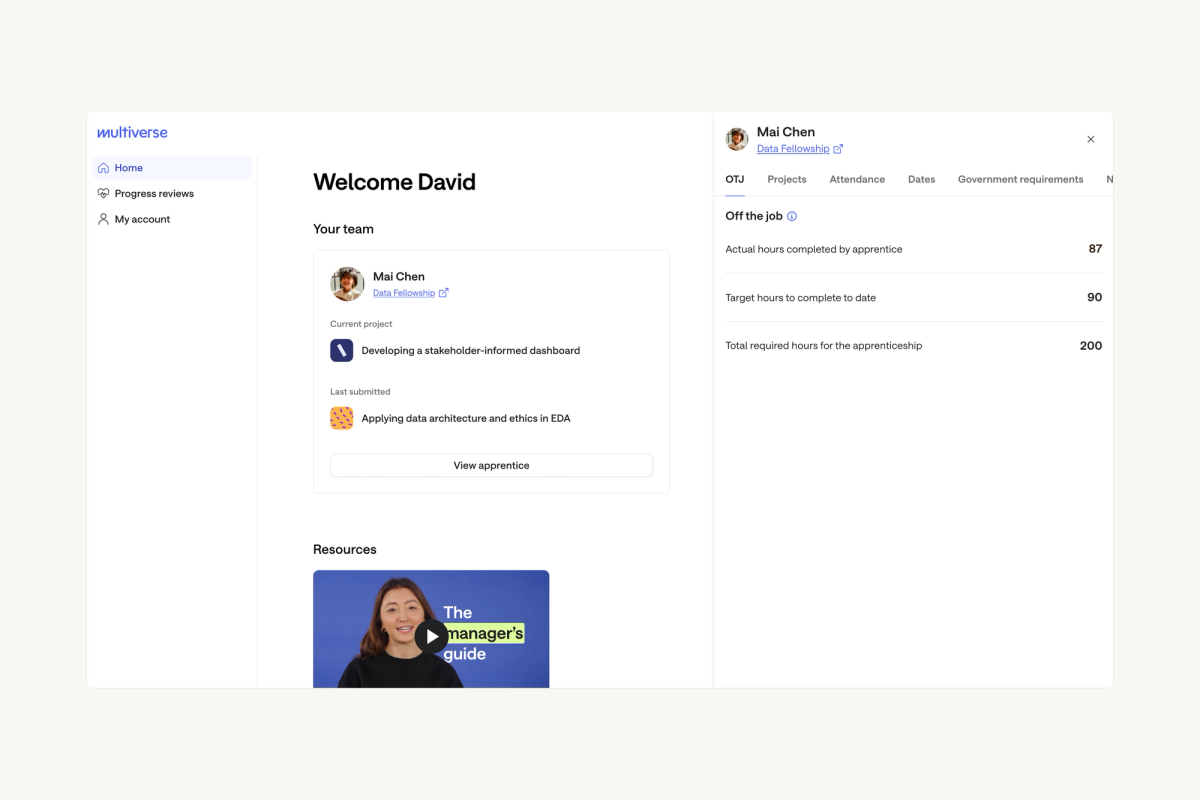
That’s why we’ve launched your new Line Manager Dashboard - a tool designed to give you a clearer view of apprentice progress and empower you to be an even more effective mentor.

A central view of apprentice progress
The new dashboard centralises the progress and support insights you need to effortlessly guide your apprentices.
Gain clear visibility to help your team members as they apply their new skills in practice throughout their learning journey.
Key features include:
- Off-the-Job Hours: Quickly see if your apprentice is on track with their required learning hours, ensuring they meet this core programme requirement.
- Session Attendance: View their attendance in recent coaching and delivery sessions, giving you a clear picture of their engagement.
- Project Status: Understand which projects have been started and submitted, helping you stay informed on their progress with programme deliverables.
From data to development
This visibility is designed for one primary purpose: to help you have more meaningful, data-informed conversations.
When you can easily see an apprentice’s engagement and progress, you can:
- Celebrate progress by acknowledging when projects are submitted and work is complete.
- Proactively support: The dashboard provides clear flags to help you easily pinpoint apprentices needing support, allowing you to step in with guidance at the right moment.
- Drive meaningful discussions by asking informed questions about the specific projects they are working on.
Ultimately, the dashboard empowers you to support your apprentices proactively and helps you feel more connected to their learning journey.
Keen to see it in action?
The Line Manager Dashboard is another step in our journey to build a truly exceptional learning platform - helping you unlock the full potential of your teams and deliver measurable impact for your organisation.
The top skills you need for AI jobs in 2025
Apprentices
Team Multiverse
It's clear that fully adopting and utilising AI workflows can help professionals of all stripes gain an edge in their careers. Those already boasting AI expertise pursue careers in a broad range of sectors. For example, the marketing sector uses generative AI to create personalised content and automate tasks. This versatile technology also has numerous applications in e-commerce, finance, manufacturing, and other industries.
You can help fill this growing demand for AI-related roles by developing essential skills. Below, we’ll explore the top AI career paths, must-have skills, and strategies to build on your AI skillset.
Why AI Skills are in high demand
The demand for AI has exploded in the last decade, and this trend shows no signs of slowing down. Bloomberg Intelligence predicts that the generative AI market will grow from $40 billion in 2022 to $1.3 trillion in 2032. This rapid expansion will create new job opportunities and transform industries worldwide.
Several factors have contributed to the high demand for AI careers. Many businesses use AI to drive innovation and increase productivity. For example, this technology allows organisations to hyper-personalise customer experiences and develop new products. Businesses can also use AI to automate repetitive tasks like data entry and credit scoring. Organisations need skilled AI professionals to leverage these capabilities and create innovative solutions.
The exponential growth of big data has also fueled the need for AI skills. Between 2020 and 2025, the amount of data generated and consumed globally is expected to triple from 64 zettabytes to 180 zettabytes. Businesses can use AI algorithms to process, analyse, and gain insights from this big data.
Top AI jobs for 2025
Spend a few minutes browsing job boards, and you’ll find many artificial intelligence careers. However, some positions have more lucrative salaries and better growth prospects than others. Here are the top AI jobs for 2025.
Machine Learning Engineer
A Machine Learning (ML) Engineer creates and implements self-learning AI models and systems. They design algorithms–or sets of instructions–that allow machines to interpret and learn from data in a human-like manner.
ML Engineers often work in healthcare, finance, tech, and other industries that depend on data to make decisions.
Salary data
- Low range - £42K
- Average base salary - £57K
- High range - £76K
Source: Glassdoor
Data Scientist
A Data Scientist collects, analyses, and visualises raw data to gain novel insights and inform decision-making. They also use ML algorithms and statistical models to classify data, uncover hidden trends, and predict future outcomes.
The US Bureau of Labor Statistics (BLS) predicts that the demand for Data Scientists will grow by 35% between 2022 and 2032—and growth is also expected to be high for these professionals in the UK. Data Scientists often work in e-commerce, healthcare, insurance, and telecommunications, among other industries.
Salary data
- Low range - £39K
- Average base salary - £49K
- High range - £63K
Source: Glassdoor

Robotics Engineer
A Robotics Engineer designs, codes, builds, and maintains robotic systems. They develop algorithms that allow robots to perform complex tasks autonomously or semi-autonomously. For example, Robotics Engineers program robots to interact with humans and navigate the ocean floor.
Robotics Engineers play vital roles in the agriculture, automotive, healthcare, and manufacturing sectors.
Salary data
- Low range - £32K
- Average base salary - £39K
- High range - £49K
Source: Glassdoor
Software Engineer
A Software Engineer develops, tests, and updates software applications. They can use AI to automate repetitive tasks, write code, and troubleshoot bugs.
According to the BLS, the demand for software development will increase by 26% from 2022 to 2032 in the US. Across the pond, there are ample reasons to believe the UK will continue to be a top destination for Software Engineers in Europe. Many industries hire Software Engineers, including business, finance, healthcare, retail, and tech.
Salary data
- Low range - £38K
- Average base salary - £50K
- High range - £65K
Source: Glassdoor
Business Intelligence Developer
A Business Intelligence Developer uses data analytics and software to collect, interpret, and visualise business data. AI-powered software can help them analyse data and design business interfaces more efficiently.
Many Business Intelligence Developers work for consulting firms, government agencies, financial institutions, and large corporations.
Salary data
- Low range - £30K
- Average base salary - £37K
- High range - £45K
Source: Glassdoor
Essential skills for AI jobs
Employers expect candidates to have a broad range of technical and soft skills for AI jobs. Here are the essential abilities you’ll need to succeed in these roles.
Machine learning
AI professionals use data and algorithms to develop and train ML models that learn and improve without human input. ML requires a strong understanding of probability and statistics. You’ll use these mathematical concepts to analyse data, design predictive models, and assess their performance. You can also use ML libraries like PyTorch and TensorFlow to create and deploy models.
Natural language processing
Natural language processing (NLP) is a subfield of AI that uses ML algorithms to understand and respond to complex human language. AI professionals use many techniques to develop NLP models like ChatGPT. For example, sentiment analysis involves assessing text or speech for emotional tone. Topic modelling is another method used to identify themes in data.
AI specialists can streamline the development of NLP models with spaCY, NLTK, TextBlob, and other libraries and frameworks.
Proficiency in programming languages
Every AI career path requires knowledge of programming languages. Python’s simple syntax and vast libraries make it the most popular choice for data analysis and ML. Other useful languages for AI professionals include:
- Java - to design complex algorithms
- JavaScript - to develop web-based ML applications
- R - for data processing and visualisation
You don’t need to master all these languages, especially for entry-level AI careers. Instead, you should research the requirements for careers you're interested in to determine which programming languages to learn.
Problem-solving
AI experts work with complex and cutting-edge technologies, so it’s normal to encounter obstacles during projects. For instance, your algorithm may make wildly inaccurate predictions, or you might struggle to find high-quality data. Strong problem-solving skills will help you troubleshoot issues and develop creative solutions.
Collaboration
AI professionals often work on complex projects that require expertise in multiple disciplines. For example, they may work with Data Scientists, Project Managers, and Product Developers. Strong collaboration skills will enable you to tackle these projects in cross-functional teams. Practice sharing your knowledge with people from different backgrounds and resolving conflicts.
Communication
AI and ML are complex topics that involve advanced technical concepts and specialised jargon. Strong communication skills will allow you to explain these ideas to stakeholders from various backgrounds. For instance, you may need to present your findings to non-technical clients and Project Managers. You can prepare for these situations by practising simplifying complex ideas and translating jargon into plain language.
AI ethics
Many challenging ethical dilemmas surround AI, leading to widespread concerns about this technology.
You can help assuage these fears by following ethical AI practices. Always obtain consent before using data, and practice transparency by documenting the methodologies and sources used.
How to acquire AI skills
Here are four possible avenues to develop the necessary skills for AI jobs.
University degrees
Some people obtain a degree in computer science, data science, mathematics, or statistics. This path allows you to gain relevant skills through a structured curriculum. But, you may not have the opportunity to develop AI-specific projects and experience. A university degree also requires a significant investment of money and time.
AI boot camps
A boot camp is an intensive program that focuses on work-ready skills. Participants also gain hands-on experience with AI projects. Some boot camps have low placement rates and high price tags, so research programs carefully before enrolling.
Self-study resources
Many websites offer free online classes, tutorials, and other resources. Aspiring AI professionals can use these materials to learn about data science, ML, programming languages, and other key concepts. Self-studying lets you learn at your own pace, but the lack of structured guidance can lead to knowledge gaps.
Apprenticeships
An apprenticeship allows you to acquire hands-on experience and follow a structured curriculum designed by AI experts. Apprentices also earn a competitive salary and build a professional network in their chosen industry.
Looking to get started or grow your skillset in AI? Explore programmes ranging from our AI and Machine Learning Fellowship to AI Strategy and Leadership with Multiverse.
Building a portfolio for AI jobs
You don’t need a university degree to pursue a career in AI, but you’ll need to show potential employers you have the right skills. Developing an online portfolio is the most effective way to showcase your abilities.
Start by developing hands-on projects that use a diverse array of AI skills. Here are a few project ideas:
- AI chatbot
- Image classification model
- Music generation model
- NLP-powered virtual assistant
- Predictive analytics model to forecast the weather or the outcome of sporting events
- Sentiment analysis tool to evaluate social media posts
These projects allow you to apply theoretical concepts to real-world scenarios. You can also gain practical experience by using real, free datasets to develop and train your AI models. Potential sources for datasets include Kaggle, GitHub, Data.gov, and the r/datasets subreddit.
As you create projects, assemble them into an online portfolio. Some tech professionals build a website from scratch to house their projects. You can also use a portfolio hosting website like Carrd, Notion, and Webflow.
Provide context with detailed descriptions, screenshots, and other supporting materials for each project. Link this portfolio in your application materials so potential employers can assess your skills.
The future of AI Jobs
AI is reshaping the future of work across industries. Microsoft released a report in 2025 showing high levels of AI applicability to roles associated with finding information, for example — implying large degrees of AI-related workforce reductions could arrive in the future.
This prediction may sound scary, but many companies won’t eliminate these jobs completely. Instead, AI will likely enhance existing roles and allow workers to focus on complex tasks that require human minds.
AI will also open new career opportunities for many employees. 36% of employers are already making a strong effort to reskill workers affected by generative AI. This percentage will likely grow as emerging technologies like multimodal AI and small language models create new roles.
Developing AI skills now can help you future-proof your career and gain a competitive advantage in this shifting landscape. As you gain experience, you may qualify for more advanced–and often more lucrative–roles in AI.
Level up your AI skills with Multiverse
There’s never been a better time to grow your career with artificial intelligence skills.
Prepare for opportunities in this rapidly growing field by developing or expanding AI skills. The top AI jobs in 2025 require excellent technical and interpersonal abilities. You’ll need a strong foundation in programming languages, machine learning, and natural language processing. Many careers also require soft skills like communication and collaboration.
Multiverse’s free apprenticeships will help you develop the necessary AI skills and gain hands-on experience.
Fill out our fast apprenticeship application to start your journey.
Software Developer vs Software Engineer: Roles, skills, and paths unveiled
Apprentices
Team Multiverse
While the two titles are often used interchangeably, we’ve assembled this blog to help you explore the distinctions and similarities between Software Developers and Software Engineers that can manifest in certain organizational contexts.
Below, we’ll breakdown:
- The differences between a Software Developer vs. Software Engineer
- Key responsibilities, skills, and tools
- Salary and job outlook
- And what you need to know to grow in these respective career paths
Software Engineer vs. Software Developer: Defining the roles
Software Developers generally build software applications or systems based on designs created by engineers. Compared to engineers, they might focus on one part of the software development lifecycle (SDLC) rather than the entire SDLC. The SDLC includes the major stages and tasks that take a software application or system from start (planning) to finish (deployment and maintenance).
Even for those who'd argue in favor of a clear distinction between the two, there are crossovers between the roles of Software Engineers and Software Developers. Many professionals with a ‘Software Developer’ title will design, create, test and maintain software applications or systems. Those tasks combined are closer to the traditional role of a Software Engineer.
On the other hand, Software Engineers typically design, build, test and deploy full-stack applications. So, rather than developing a specific software or computer system, these professionals typically have a broader focus on the entire SDLC. Tasks outside the development stage often include project management and continuous improvement. That’s as opposed to software development in isolation.
Software Engineers might also engage in more complex problem-solving and system architecture tasks than Software Developers. In either case, both developers and engineers aim to help create software that meets specific requirements and addresses user needs.
Key responsibilities and projects
Although Software Developers and Software Engineers may work on similar project types, the scale and scope of their work usually differ. A Software Developer may plan the structure and functionality of software applications based on client or user requirements. Meanwhile, a Software Engineer designs the overall architecture. The latter includes defining the structure of components, their interactions, and how data flows through the system.
Another key difference in scope and complexity is creating custom-built tools for the project. Software Engineers may need to build tools to develop a software product, whereas Software Developers usually use pre-built tools.
There may also be differences when it comes to writing code. Both Software Developers and Engineers write code to execute software solutions. But Software Developers typically use programming languages to implement the designed software. In contrast, Software Engineers will need to focus on not just code quality but also maintainability and scalability across the project. Software Engineers might also work on a system's more complex or critical components.
The level of team collaboration can be different, too. The nature of a developer’s work means they tend to work more with ‘things’ (i.e. systems and applications) than people. That doesn’t mean there isn’t any team collaboration, but they will generally work more independently than engineers.
On the other hand, an engineer’s work generally requires more collaboration. So they might work with developers, other engineers and people from different teams. A Software Engineer might also collaborate with people who use the software to help them improve it.
Educational paths and qualifications
You can become a Software Developer through a variety of educational pathways. One option is to earn a relevant A Level or a Level 3 Certificate in a subject like computing. Some developers also attend university, although a university degree isn’t always necessary for software roles. Other Software Developers are self-taught through personal projects or coding boot camps.
Like developers, Software Engineers can come from a range of educational backgrounds. Some might have a Bachelor’s Degree in Mathematics, Computer Science or Engineering. But as with developers, a university degree isn’t necessary, or even the best route, to becoming a Software Engineer.
Many engineers start out as Software Developers and upskill or are self-taught and transition into engineering through a software engineering apprenticeship. Through their apprenticeship, they gain hands-on work experience and an accredited certification. In the case of a Software Engineering Level 4 apprenticeship standard, it’s the equivalent of the first year of an undergraduate degree.
Skills and tools comparison
Software Developers and Software Engineers both need technical skills to do their jobs. They’ll both know different programming languages, such as JavaScript, SQL, Python, and CSS. But a Software Engineer will typically have a more in-depth understanding of the same programming languages and access to a broader range of languages.
Software Developers and engineers both need to understand algorithms and data structures. That said, a Software Engineer must also design, implement and optimise algorithms to solve specific problems efficiently. A Software Developer, on the other hand, will usually work with pre-existing algorithms to complete tasks.
When it comes to soft skills, both professionals need communication skills. However, because Software Engineers collaborate with people outside of their teams, they will need to communicate technical concepts to non-technical people. They will also both need problem-solving skills.
There are a range of software development methodologies that both developers and engineers use, including:
- Agile development methodology: Software is developed in iterations to reduce risk.
- DevOps deployment methodology: This isn’t just a methodology. It creates organisational change to encourage collaboration between the departments involved in the development lifecycle.
- Waterfall development method: A linear model you complete in sequential phases. Each phase has a fixed goal.
- Rapid application development (RAD): The development process is condensed so that investment costs are lower and production is quicker without reducing quality.
There’s also a crossover between the tools commonly used by both developers and engineers. Both professionals use different tools for bug tracking, development, code review and version control. GitHub, Jira, Codenvy and Adobe Dreamweaver CC are common examples of tools that both developers and engineers use.
Career progression and opportunities
There are a few different career progression routes for Software Developers. A linear pathway might involve progressing from Junior to Senior Software Developer and then Software Development Manager. But you can also choose to progress into a different specialism, such as web development, front-end development, or back-end development.
Like developers, Software Engineers might follow a junior-to-senior linear progression route. They might also progress further from Software Engineering Manager to Head of Department. Similarly, engineers can progress to a specialism. That could be a specialist role like Cyber Security Engineer, Data Engineer, or Systems Engineer.
There’s also potential to crossover between software development and engineering roles. For Software Developers hoping to transition into engineers, that will likely mean upskilling. That’s because there are usually extra responsibilities (like specifications, architecture and project management) that you might not have done as a developer.
Salary and job outlook
According to Glassdoor, the average Software Engineer salary in the UK is around £50,000, with a general range between £38,000 to £65,000.
A quick search for “Software Developer” jobs on LinkedIn shows around 15,000 UK job openings advertised on the platform. A search for “Software Engineer” brings up a similar volume of job vacancies.
Data from ItJobsWatch finds around 2,800 permanent UK jobs requiring software engineering skills through the first half of 2025, which is down from over 7,000 during the same period in 2024.
As there will be some crossover in the skill demands between engineering and development, those jobs might be relevant to both professions. In general, there’s a higher demand for Software Engineers and developers who understand Agile software development and programming languages like Java and Python.
Case study: a real-world example
Last summer, we shared stories from our industry-leading team members who transitioned from big tech to Multiverse. Our Director of Engineering, Joe Freeman, started with us after working at industry giants like Amazon and Deliveroo. Freeman has excelled in both software development and software engineering-specific roles. We asked him about his day-to-day work as Director of Engineering.
“Being a builder at Multiverse means solving problems in a product centric way, to help scale our mission. Our problem spaces straddle multiple user types — our apprentices, our enterprise customers and our coaches. We solve problems that consider the interactions between these actors which makes for exciting systems thinking and opportunity for experimentation.”
Joe adds, “We are solving unique problems in a relatively new industry and we want to become the best version of Multiverse - we don’t want to replicate how other companies work. Being able to not only challenge the status quo, but change it, is an important part of being successful here and there are no areas out of bounds. Everything from our process, our development frameworks, tools and technologies are open to challenge and improvement — if it’s not working as well as it could, you can change it!”
Joe explains that Multiverse and the engineering team are relatively early in “our journey building.” That means the technology team often has the opportunity to work on solving novel problems. Even though this can be a challenging role because Multiverse sits within a newer industry with novel problems to solve, the challenge is worth it.
According to Joe, the work is “both exciting and impactful.” To top it off, “When we are successful we make a real difference for our apprentices and provide real impact for our customers.”
Choosing the right path for you
Software Developers and Software Engineers are similar but not always the same. Whether a developer or an engineer, the scope of the role itself will largely depend on the employer. In smaller organisations, the roles are pretty interchangeable. But in larger ones, you’re typically either a Software Developer or a Software Engineer, with the distinct roles co-existing in the same team.
Still, the skills and responsibilities of the two roles will often overlap. That said, when choosing between either specialism, it’s worth considering your interests, strengths and career goals.
Software development might be best for you if you prefer to work with ‘things’ rather than people. On the other hand, software engineering is a better option if you like to collaborate and communicate with technical and non-specialists.
If you’d like to niche down into one area or discipline, development likely offers more specialist career pathways. Meanwhile, engineering could be for you if you’re interested in following a linear career pathway that leads to people or project management.
The future of software roles
69% of UK and US business leaders agree that the emergence of Artificial Intelligence (AI) will create more demand for AI skills in the workforce. Further, the U.K.’s Department for Education finds that 10-30% of jobs could realistically be automated with AI.
It makes sense then that AI, machine learning and automation will likely impact the roles of Software Developers and engineers in the future. That could mean using AI to automate coding tasks or to gather large amounts of data. Meanwhile, machine learning is pivotal in fraud prevention for software professionals specialising in cyber security.
Aside from AI and machine learning skills, a Red Hat survey found that 69% of IT managers need staff with cybersecurity skills. Further in-demand skills for software professionals include cloud computing (68%) and full-stack development (63%).
Resources for further exploration
If you’re interested in exploring careers in software development or engineering further, consider the Multiverse blog. In addition to general career information, you’ll also find articles on specific skills highly relevant to software roles, such as the differences between Java and JavaScript.
Online publications like TechRepublic and techUK.org are a great starting point for staying ahead of emerging tech trends that could impact software roles. You might also consider exploring professional organisations in the UK. The Institution of Analysts and Programmers (IAP) and the Business Application Software Developers Association (BASDA) are two examples.
If you want to take short online courses, these can help you develop entry-level software development and engineering skills. You can then add these to the skills and tools section of your CV.
Upskill your career in software
Ask one software professional, and they'll tell you there’s little-to-no difference between Software Developers and Software Engineers. Ask another, and they’ll tell you there will always be a crossover, but they are distinct roles. Long story short? The biggest determinant of the differences and similarities in either software role is typically your employer.
Even if you apply for roles in a smaller organisation where the positions are similar, if not the same, it’s still worth knowing the distinctions and overlaps. This understanding will give you a clearer idea of which pathway best aligns with your skills, personal attributes and career aspirations.
To learn the skills needed to advance in your software career, complete our fast and straightforward application to learn more about paid learning opportunities provided by your current employer.
Sorry, no results found.