






.jpg)



We couldn’t find what you are looking for. Please try another way.
Employers

Thank you! Your submission has been received!
Oops! Something went wrong while submitting the form.
Princes prioritises data skills with new Academy partnership
Employers
Team Multiverse
The partnership will initially train 50 Princes employees across multiple business functions, with the ambition to empower colleagues, advance data skills, encourage revenue growth and boost efficiency.
Colleagues from areas including Commercial, Finance, IT, HR, Supply Chain, Operations and Strategy & Innovation will embark on one of three Multiverse programmes, each offering a chance to develop data understanding and technical skills.
Participants will take part in either a 13-month Data Literacy course, an 18-month Data Fellowship, or a degree-level Advanced-Data Fellowship. Each pathway is designed to develop data and analysis skills.
The ambition is that colleagues trained by Multiverse will be able to better harness the power of data to establish opportunities for revenue growth, and to help make the transition from manual to automated data processing practices within the business.
The first cohort of 25 Princes colleagues began their studies in December 2023, with over 40 more planned to start in 2024.
This investment comes as Princes outlined its refreshed people-focused company values, which aim to enhance business culture and future preparedness. These include encouraging ‘Trusted & Empowered’ coworkers and allowing employees to ‘Bravely Explore’.
Connie Emerson, Group Strategy & Transformation Director and Programme Sponsor at Princes said: “Multiverse is a proven leader in specialist apprenticeship training, which we are proud to be partnering with to establish this Academy at Princes. Through this collaboration, we’re confident that our Princes apprentices will build expert knowledge and improve the business’s approach to data analysis and planning. Our Multiverse-trained cohorts of apprentices will support Princes in making informed and data driven decisions to turbo-charge our growth and success."
William Hofmann, Head of Analytics & Programme Lead at Princes said: “The launch of our Analytics & Data Academy is a great opportunity for Princes colleagues from across the business to grow their skillset and diversify their value and capabilities as professionals. Across the Group, this increased data literacy will allow our teams to recognise business and revenue opportunities, and modernise our practices across a number of business functions.”
Peppa Wise, Vice President of Go to Market at Multiverse, said: “Enhanced data skills will unlock new opportunities for Princes: both as a business and for the individuals within it. The business will enhance its data-driven decision-making and delivery. Apprentices will enhance their career trajectories, gaining some of the most in-demand skills through our applied learning programmes."
With a commitment to helping people from all backgrounds to develop and build their future, Princes currently employs over 60 colleagues across the UK apprenticeship schemes.
In 2021, Princes was named ‘Employer of the Year’ at the prestigious Grocer Gold industry awards.
Making the business case for apprenticeships
Employers
Claire Williams
Businesses are struggling to meet increasing demand for digital and data skills, and with emerging technologies like Artificial Intelligence (AI) opening up limitless growth opportunities, the pressure to keep up has reached its peak.
But how can leaders create opportunities for workers at all stages to upskill and reskill? By combining real-world training with durable and industry-relevant technical skills, apprenticeships can help close the gap between the skills businesses need and those taught in the classroom - propelling careers forward in the process.
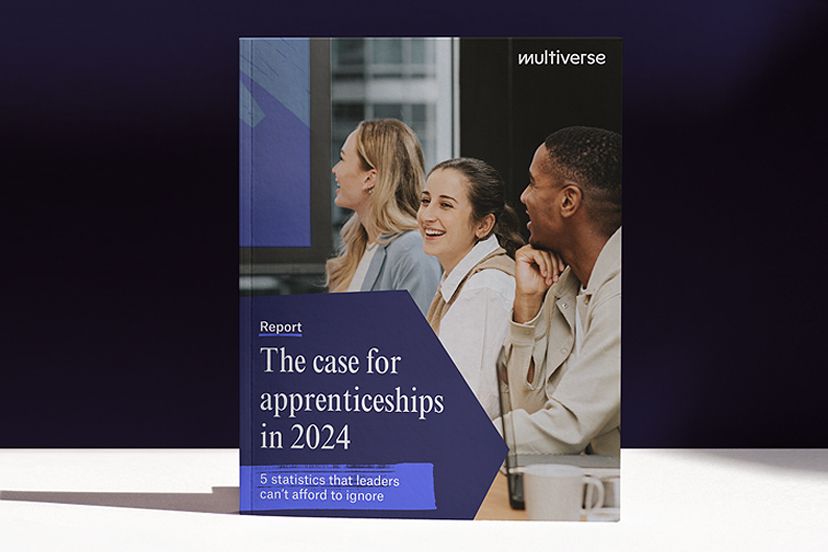
In our new report, we reveal the trends driving the business case for apprenticeships in 2024, based on our original research with hundreds of leaders across the globe. Download the report for full access, or read on for key insights.

Rethinking the way we train our workforce
In all our research, one message is clear: we need a new approach to deliver the skills most needed in future.
Multiverse data shows that the majority of business leaders are concerned about traditional education’s ability to deliver the digital, data, and tech skills in top demand. And with almost 50% of workers saying they’ve received no training in the last five years, the existing workforce isn’t being upskilled to fill the gaps.
That’s where apprenticeships can offer a solution – 70% of business leaders believe on-the-job learning is the best way to develop in-demand skills.
Building tomorrow’s skills, today
According to our research, over two-thirds of business leaders believe their business will need different workforce skills to remain competitive by 2030. They also believe AI will improve productivity and customer experience, and create more informed business strategies.
But a lack of AI skills in the workforce is already being felt. Leaders named AI as their most significant skills gap today, with employees lacking the training and knowledge needed to effectively harness new tools in the flow of work.
To leverage AI now and in the future, businesses can’t afford to leave knowledge in the hands of a few specialists. New methods for building emerging skills at scale are required. And the sooner, the better.
Over 70% of business leaders say they are investing in upskilling and reskilling as part of their future strategy, and 83% say they are moving quickly to implement AI skills training.
By tailoring learning directly to today’s business needs, apprenticeships offer a scalable way to upskill and reskill employees in emerging digital, tech and data skills.
Skills gaps create a clear impact on the bottom line
Our research shows 8.5% of annual revenue is lost as a result of digital and data skill gaps. But just as a lack of skills can hold a business back, new capabilities can propel it forward.
Upskilling and reskilling apprenticeships can help leaders close critical skills gaps while empowering employees in every function to improve speed and efficiency, leading to increased capacity and reduced time per task.
In our report, we reveal how Multiverse apprentices have used their skills to drive business impact worth millions, by identifying revenue generating and cost saving opportunities.
People of all ages need new skills and opportunities
When it comes to career progression opportunities, too many workers are being held back by a lack of skills.
Our research, conducted in partnership with the Burning Glass Institute, shows that in America, three quarters of the workforce (76.2%) are underemployed, facing blockers to upward career advancement, or otherwise in need of reskilling or upskilling opportunities.
By breaking the expensive barrier between education and employment, apprenticeships can help all individuals to gain new skills and access life-changing growth trajectories – whether they’re aiming to restart their career, change direction in their current company, or even enter the workforce for the first time. That’s why Multiverse apprenticeships are open to employees of all ages.
Transforming skills at scale through apprenticeships
In the future of work, businesses can’t rely on one shot of learning at the start of a career.
Apprenticeships can help leaders ensure that employees have the skills required to thrive as technology develops, build new talent pipelines from a broader range of backgrounds, and boost career longevity for their employees – all while contributing toward a more resilient economy.
Reach out to our team to learn more, or download our full report to explore our findings.

Nuffield Health invests in data development enabling staff to improve health and performance outcomes
Employers
Team Multiverse
By prioritising the skills development of their employees, Nuffield Health aims to improve the use of data and digital skills across the organisation, delivering better outcomes for patients and beneficiaries across its services. Employees will benefit from new skills, enabling them to make faster data-informed decisions, whilst becoming more self-efficient when working with data.
The programmes will cover a range of skills including analytics, AI, and predictive modelling. Training will be delivered by Multiverse, a tech company that has trained more than 10,000 learners in digital skills. Staff will enrol on one of two Multiverse programmes; the 13-month Data Literacy apprenticeship introduces apprentices to the use of data and covers the core technical skills required to transform data into insights, as well as softer skills like building narratives and presenting findings.
The 15-month programme Data Fellowship covers more advanced data analytics and modelling, giving learners the skills to clean, analyse and model data; the ability to visualise and tell data stories to non-specialists; and the confidence to lead conversations around machine learning.
Professor Ben Kelly, Director of Data at Nuffield Health, said: “It’s vital that we are data-driven in everything that we do in order to deliver the best outcomes for all who use our services. Our use of data has helped to identify the need for our free-to-access initiatives, as well as establishing and evolving how these are delivered by analysing the outcomes. We have ambitious plans for the future, and offering our people the opportunity to enhance their skillset will, in turn, help us to develop our data analysis, bolstering the health outcomes for all the services we provide. High-quality training is the way to unlock the use of data across Nuffield Health, and our partnership with Multiverse ensures that training is grounded in real-world application.”
Ben Davies, Organisational Development Director at Nuffield Health, said: “We want to see more of our people with these in-demand skills. Whether they are working from our head office, on the gym floor in one of our fitness and wellbeing centres, or working on the ward in one of our 37 hospitals; everyone at Nuffield Health will see the benefit of enhanced data skills and this benefit will positively impact all who use our services. The use of data will help us deliver on our purpose to build a healthier nation, but it will also greatly enhance the long-term career prospects of individuals who do the course by providing them with the most in-demand skills and valuable qualifications that are essential in this modern world.”
Peppa Wise, VP GTM at Multiverse, said: “Nuffield Health has recognised that data skills cannot be concentrated in a single data team or silo, they need to be spread across an organisation. Through this programme, team members across Nuffield Health will be able to use data to do their jobs better, and deliver better outcomes for their patients and beneficiaries.“
North London Mental Health Partnership launches a Digital Academy
Employers
Team Multiverse
The training, which will be delivered by the tech company Multiverse, aims to enhance the Partnership's digital capabilities, making it more data-driven, and ultimately improve patient outcomes and services.
The initiative is part of NLMHP's strategy to upskill its workforce with an emphasis on intelligent use of data to drive improvements and efficiencies.
Sarah Wilkins, Chief Digital Information Officer at NLHMP says ‘‘being part of this initiative means understanding of our data and insights will be embedded through the organisation, enabling us to enhance our services and improve patient and service user outcomes. Not only will it drive operational efficiency, but it will also serve as a stepping stone in our commitment to professional development for our staff."
Multiverse has worked with more than 10,000 apprentices in areas such as data analytics and software engineering.
This is only just the start of the journey, NLMHP will enrol another 50 employees onto the Academy in March to embed cultural change across the Partnership.
Peppa Wise, Vice President Go To Market at Multiverse, said, " The nature of healthcare is changing. Tech and data have the potential to help all of us lead healthier lives.
“Through this partnership, NLMHP is not only investing in its operational efficiency to better support patients and service users, but it is also nurturing its workforce with cutting-edge data skills. This step will enhance patient services and outcomes, reflecting the growing embrace of a data-driven approach across the NHS."
Creating career comebacks at Citi through data skills
Employers
Team Multiverse
For employers aiming to encourage talent back to the workforce, or transition employees into new roles, upskilling and reskilling initiatives offer a vital solution.
We explore how Citi, the global bank, is opening new pathways for individuals to return to work, start a career, or change roles within the financial services industry – while supercharging their development through the power of data skills.
About Citi’s Reactivate Your Career Program
Designed for those returning to work after a career break lasting more than two years, Citi’s program offers job opportunities across a wide range of roles, including operations and technology.
Participants benefit from a tailored professional development package and complete a qualification to enhance their skillsets. Since 2020, Citi has partnered with Multiverse to provide data skills training to participants.
“We believe it’s vital to have a workforce that reflects a diverse range of backgrounds, perspectives, and experiences,” says Jacqui Lloyd, Head of Apprenticeships and DEI Execution at Citi. “Through the Reactivate Your Career program, we’re committed to helping people return to careers they love or carve out a new path in the dynamic financial services industry.
“Apprenticeships are an important tool we leverage to develop future leaders and build critical skills for Citi. In our ongoing partnership with Multiverse, we’ve created career-accelerating opportunities for workers at all stages. We’ve seen first-hand how empowering our colleagues with data skills delivers impactful results and tangible advantages across the business."
Transformative opportunities with data upskilling
Whether they’ve taken time out for family or personal obligations, or simply to reassess their career path, the program is helping a wide range of individuals navigate their way into different roles in financial services.
At the same time they receive further training in high-demand data skills, helping them to transform data into insights and make informed business decisions.
Srilakshmi’s story
Srilakshmi joined Citi’s program in a project management role and completed a data qualification with Multiverse. She found the benefits went far beyond finding her footing back in the professional world.
“When I had my second child, I decided to take a break to prioritise my family. After three years, it felt like it was the right time to get back to work,” she said.
“What stood out to me about [Reactivate Your Career] is that it's not only about getting back to work, it's also about upskilling. Not only am I back at work, I'm also learning something new through the data program. The best part about the apprenticeship is taking those concepts and applying them to your work.”
Driving business impact with data literacy
Participants are leveraging their new skills to drive change in teams across Citi, making strides by streamlining processes, enhancing efficiencies, and crafting data visualisations. 100% of line managers said participants had created business impact for Citi using their new data skills.
Saloni’s story
Saloni is an IT project manager at Citi. Having completed a Multiverse data literacy apprenticeship during the program, she now uses her enhanced Tableau skills to create time-saving algorithms, automating monthly processes that used to be manually done.
“The skills taught on this course have backed up the incredible on-the-job training and work I’ve done in my role at Citi,” she said.
The result? She’s achieved an impressive efficiency boost of 80% when working with data and has been praised by her internal stakeholders.
“Through the Multiverse course, Saloni has also acquired a very good understanding of handling data which positions her to lead related projects within our stream,” said her line manager.
Empower your teams with the skills of the future
Find out more about opportunities at Citi at jobs.citi.com.
Cheshire West and Chester Council achieves success with Data Skills Academy
Employers
Team Multiverse
Over 70 members of staff have enrolled on the programme to date, with a fourth cohort about to launch in March. Training is delivered through professional apprenticeships by tech start-up Multiverse and funded through the Government’s Apprenticeship levy.
Employees are enrolled on one of three data apprenticeships, including up to degree-level.
- The 13-month Data Literacy programme covers the core technical skills required to transform data into insights, as well as softer skills like building narratives and presenting findings.
- The 15-month Data Fellowship course will give apprentices the skills to clean, analyse and model data, and tell data stories to non-specialists.
- The degree-level Advanced Data Fellowship will empower apprentices to develop their skills in data analysis and data science, studying areas like statistical testing, data ethics, predictive modelling and data security.
Research by the UK Government has found that almost a quarter of employees use advanced data skills in their work, yet a shortage of skills in this area is estimated to cost UK businesses £2bn a year.
New data skills are unlocking valuable insights about the needs of residents and communities, enabling the Council to deliver focused digital and transformation programmes. Services are benefiting from a saving in staff time on data management tasks and the Council is seeing wider impact from the creation of the new, Council-wide Data Hive network, supported from the central data hub.
Simon Riley, the Council’s Chief Operating Officer said: “A key focus for us across the Council is to use data and insight to inform strategic decision making. Accurate and up to date data has never been more important for us and accessing the right tools, technology and trained staff to make the most of that data is essential.”
Multiverse delivers world-class training in a wide range of qualifications in tech, data, and engineering. Apprentices benefit from one-to-one coaching with an industry expert and are supported by a thriving community with events, socials, mentoring and leadership programmes.
Peppa Wise, Vice President of Go to Market at Multiverse, said: "Working efficiently with data is absolutely vital for all organisations - and for local authorities it's essential for delivering high quality services to residents. Cheshire West and Chester Council is expanding its skills in this space through its Data Academy. Apprentices benefit from Multiverse’s intensive coaching and applied learning, to develop rich skills in the most high-demand areas that will serve them for their career."
.jpg)
Hays and Multiverse launch apprenticeship academy to tackle national digital skills challenges
Employers
Team Multiverse
The launch comes as difficulty in accessing talent continues to be a key concern for employers - with 95% of tech employers experiencing skills shortages in 2023, according to data from the Hays UK Salary Guide. Hays is working with Multiverse to co-deliver the ‘Data Analysis and Business Transformation Academy’ which empowers undiscovered talent with skills such as data analytics, communication, machine learning and project management, through level 4 apprenticeships.
Those who successfully join the academy are paid during the initial training period, which is front-loaded into a 10–12-week intensive bootcamp at the start of the apprenticeship.
Upon completing the bootcamp, individuals will work at Hays' partner organisations for the remainder of their apprenticeship, gaining accelerated experience within a variety of different markets whilst delivering impact and transformation for the organisations they are deployed with. Each apprentice taking part in the academy will also have the opportunity to go on to gain further qualifications and secure a £10,000 bonus upon successfully completing the 2-year programme.
The first cohort of individuals have already enrolled in the academy in January, with a further 25 enrolling in March.
Harry Gooding, Director of Skills and Learning at Hays, said: "This new academy is a game-changer in the talent world and offers the chance for businesses to access much needed skills from individuals who can create real value from day one.
For the individuals, it’s an opportunity to access world-class training, regardless of qualifications – enabling high potential people from all backgrounds to thrive at the most exciting companies.”
Peppa Wise, VP GTM at Multiverse, said: "Our mission is to provide equitable access to economic opportunity for everyone - and this new academy from Hays will enable people to access world-class training and unlock great careers, regardless their educational background or career history."
The academy fits as part of Hays’ Skills and Learning offering which provides an alternative route for individuals to access tech careers, widening access to high skilled roles for undiscovered talent from disadvantaged backgrounds.
The training is delivered collaboratively by Hays and Multiverse. Multiverse is a tech company focused on high-quality education and training through a unique professional apprenticeship model. Multiverse delivers apprenticeships in areas such as software engineering and data analytics.
Designing a data strategy: 5 steps to success
Employers
Claire Williams
Data-driven insights empower leaders to solve inefficiencies and drive increased value through measurable innovation and cost reduction. But building a data-informed culture isn’t easy.
Today, 70% of transformation initiatives fail, with each unsuccessful attempt draining resources, impacting morale, and increasing risk. So how can you build a data strategy that drives value and stands the test of time?
In this article, we’ll walk through the foundations of a successful data strategy and share insights into the latest best practices, including practical ways to align your data strategy with your business goals and increase organisational buy-in for a winning approach that takes you far into the future.
What is a data strategy?
A data strategy is a plan or framework that guides the way an organisation collects, stores, manages, analyses, and utilises data to achieve its goals and objectives. It involves defining the objectives of data usage, identifying the types and sources of data that will be collected, establishing data governance policies, defining data quality standards, and determining the technology infrastructure and tools needed to support the data strategy at a day-to-day level.
What are the types of data strategy?
There are multiple types of data strategy, including defensive data strategies focused on enhancing cybersecurity and data compliance, data integration strategies aimed at eliminating data silos, and data monetization strategies for identifying opportunities to generate revenue or create value from existing data assets.
While each type of data strategy is important, businesses are becoming increasingly focused on implementing a holistic data strategy that encompasses a variety of business goals, supported by cross-functional partnership and collaboration across the organisation.
Examples of data strategies will differ based on an organization’s specific business goals. Whatever the objective, the key is to make sure the data strategy and business strategy align.
To implement a successful data strategy, many leading organisations are focusing on three key areas — people, process, and technology.

What are the benefits of a data strategy?
A well-defined data strategy is important for making informed decisions, improving operational efficiency, identifying business opportunities, and gaining a competitive edge in a fast-paced digital era.
To remain competitive, leaders must have a data strategy that helps them face external disruptions, like economic uncertainty and the rise of AI, while meeting the growing internal demand for data-driven decision making.
Here are some of the core benefits of a modern data strategy:
- Data capabilities at every level — employees in every department can access data, use data tools and systems, ask the right questions, and collaborate effectively.
- Greater speed and efficiency — teams and individuals are empowered to efficiently process and visualise data, reducing time per data task.
- Empowered data teams — existing data scientists and analysts have more time to enhance their knowledge and develop advanced skills.
- Increased capacity — when business teams are empowered to self-serve, data teams can spend more time supporting strategic initiatives, reducing reliance on external support.
- New opportunities to drive business value — employees can use data to identify opportunities to increase productivity, decrease costs, improve the customer experience, and grow new revenue streams.
Common data strategy pitfalls
Despite the many benefits of a data strategy, businesses are finding it difficult to achieve lasting change, with only 24% of companies saying they have successfully created a data-driven culture.
There’s a common temptation for businesses to test out various elements of their data strategy through short-term transformation projects focused on utilising emerging technology, like machine learning (ML) and artificial intelligence (AI).
However, the emphasis on process and technology often comes at the expense of the people who use these tools and workflows in their day-to-day work. Research suggests 7% is the minimum “tipping point” required to achieve the positive return on investment (ROI), yet most companies engage just 2% of their workforce in transformation efforts.
To achieve the above benefits, your data strategy must include clear steps for engaging your workforce at every level.
5 elements of a successful data strategy framework
From building organisation-wide data management practices to fostering data access and cross-functional collaboration, there are many key components of a strong data strategy.
Let’s explore some of the core elements for a data strategy framework that breaks down costly data silos and paves the way for effective use of data across the organisation.
1. A unified ‘big picture’ vision
A good data strategy must be relevant to the business — otherwise, it simply won’t last.
To engage a greater percentage of your workforce, start by defining an ambitious future vision that includes every team, function and department.
Your data strategy vision may include:
- A clearly defined “Why?” to articulate benefits to both the business, plus tactics for engaging employees across different functions, geographies, and backgrounds.
- A strong answer to the question, “What’s in it for me?” that speaks directly to the individual goals and ambitions of every member of the organisation.
- A defined end state with clear milestones and outcomes to be achieved before you can call a strategic initiative “finished”.
2. Executive buy-in
Successful transformation requires strong alignment across all levels, starting at the top. Transformations are 5x more likely to succeed when senior leaders model the changes they’re asking employees to make.
However, large-scale data strategy success often feels out of reach, even for the organisation’s most visionary leaders. Of the 85% of senior leaders who have been involved in at least two major transformations in the last five years, a whopping 67% have experienced at least one underperforming transformation during this time.
Chief Data Officers (CDOs) can’t do it alone. Early problems arise when leaders disagree on the urgency of the data strategy and the proposed solution, or when they weren’t fully bought in from the start.
Here are some ways to increase executive buy-in:
- Align your data strategy to the wider business strategy.
- Establish clear goals backed by qualitative and quantitative data.
- Determine relevant business objectives and key performance indicators (KPIs).
- Measure your progress at each stage to maintain buy-in after initial launch.
Make it easy for your executive team to connect the dots between your data strategy and business strategy. Then ask for a firm commitment from the C-Suite.
3. Well-defined data architecture
In today’s digital age, there is plenty of buzz about technology and the various approaches to data architecture. But your tools are only as good as the people who use them. Without clear guidelines and a data-confident workforce to follow them, organisations end up investing in technology that yields little return on investment (ROI).
To improve the ROI on your technology investments, create a well-defined data architecture to underpin your data strategy.
Here are some key areas to consider:
- Data storage — including storage formats, backup strategies, archiving plans and any relevant requirements for real-time analytics and operations
- Data integration — including guidelines for moving raw data from data warehouses to business intelligence (BI) applications to increase analytics performance
- Data access — including guidelines for data collection from various data sources, and steps to streamline data governance without excessive user controls
- Data compliance — including strong data security and data privacy practices to protect your organisation’s data
By taking the time to create a detailed data architecture, you can alleviate the pressure on your senior data team and use data to support a variety of business use cases across the entire organisation.
4. Clear success metrics
If you’re launching a new data strategy, keep in mind that post-launch is a crucial window of opportunity for increasing the pace of activity.
To maintain momentum for your data strategy, it’s important to share regular reports on the value delivered:
Work fast to turn ideas into actionable roadmaps and back them up with key milestones that are less than a few months out.- Establish common goals across teams.
Define the metrics you’ll use to track your progress at each key stage. - Update your digital transformation roadmap to include quarterly goals.
By aligning your data strategy with your core business processes, you’ll be better positioned to break existing silos and actively identify end-to-end issues and opportunities. With a clear view of what is and isn’t working — and a well-structured system for measuring your success — you and your employees will also be more likely to stay the course.
5. Commitment to skills transformation
When it comes to executing an effective data strategy, you can go much farther as a team. Yet research shows that only 25% of employees believe they have the knowledge and skills required to use data effectively. To identify these issues before they become a roadblock:
- Conduct a skills gap analysis to quantify your data skills gap, pinpoint your current strengths, and identify your future data skills needs.
- Quantify the cost of skills gaps, including inefficiencies or delays to key strategic projects.
- Calculate the financial benefits of closing them, such as new efficiencies and revenue-generating opportunities.
Change isn’t easy, but it starts with a firm commitment to building a culture of learning – giving employees the confidence to access, interpret, and use data insights to drive decision-making. Here are some key actions to consider:
- Provide learning opportunities to existing employees via data upskilling and reskilling to create data champions at every level.
- Open up alternative hiring routes for entry-level data roles, such as apprenticeships, building a robust hiring pipeline and increasing the capacity of senior data specialists.
- Track the business impact of skills programs as employees use their skills to identify new cost-saving and revenue-generating opportunities.
A strong data strategy will consistently reveal new opportunities to make a bigger downstream impact, while driving full-speed ahead toward the greater business strategy.
With a data-confident workforce, there is no limit. As your organisational data capabilities continue to grow, so does the potential to reach even higher.
The next stop on your data strategy roadmap
An effective data strategy empowers you to use your company’s data for the benefit of your customers, your business, and every individual within it.
Get our free data-driven digital transformation playbook, and learn nine essential tactics to increase your strategic success.
Goldsmiths expands Data Academy to train staff
Employers
Team Multiverse
Staff across all functions of the university will be invited to enrol on the Data Academy, where they will study skills including analytics, AI and predictive modelling through apprenticeships.
The training will be delivered by Multiverse, a tech company focused on high-quality education and training through applied learning. Multiverse has trained more than 11,000 apprentices in areas such as software engineering and data analytics.
Two programmes will be offered on the academy. The 13-month Data Literacy programme covers the core technical skills required to transform data into insights, as well as softer skills like building narratives and presenting findings.
Meanwhile, the 15-month Data Fellowship will give apprentices the skills to clean, analyse and model data, and tell data stories to non-specialists.
The Data Academy was first launched last year, and ten members of staff are currently completing apprenticeships. Goldsmiths hopes that the additional investment in the academy will empower its staff to use data for better decision making and time savings; and ultimately making the student experience smoother.
David Minahan, Chief Information Officer at Goldsmiths, says ‘“Our five year digital transformation plan aims to develop a fully integrated data estate, enabling all of our students and staff to have personalised data dashboards and for Goldsmiths to benefit from data analytics and data driven decision making. The Goldsmiths Data Academy in partnership with Multiverse will provide the technical and data skills we need to achieve these aims”.
Matt Wedlake-Millecam is an accommodation administrator at Goldsmiths and applied to the Data Academy to find ways to streamline the accommodation services offered to students.
He said: “The most valuable aspect of the programme has actually been thinking about the way that I approach problems. The apprenticeship has definitely encouraged thinking proactively rather than reactively about the way that I do things.
“Thanks to the programme, I’m able to save hours of work by processing data automatically rather than manually. That time can be spent on ensuring student enquiries are answered quickly, therefore, improving the student experience."
Multiverse delivers world-class training in a wide range of qualifications in tech, data and engineering. Apprentices benefit from coaching with an industry expert and are supported by a thriving community with events, socials, mentoring and leadership programmes.
Mastercard offers digital and data apprenticeships to its employees
Employers
Team Multiverse
Mastercard is working with tech start-up Multiverse to deliver the courses, which offer advanced part-time training to help apprentices get better at using data, whether that’s by learning how to analyse data sets, or using data to make better decisions.
Half of the employees taking the apprenticeships are aged over 40, reflecting the increasing demand for life-long learning and mid-career training.
The initiative also supports diversity across the company and creates opportunities for those that are traditionally underrepresented. Of those that joined the first cohort, almost two thirds are women, bucking the trend of traditionally male-dominated tech and data roles.
Kelly Devine, Division President, UK and Ireland at Mastercard, said: “Digital and data analytics skills are so important for our business, whether we’re using AI to detect fraud, designing the next generation of payments, or using data to solve problems. People often have preconceptions of apprenticeships, but half of our apprentices are experienced professionals, which shows how important it is to offer training and new skills at any age or life stage.”
Marybeth Altwig, Product Management Specialist at Mastercard commented:"I've had a really positive experience on the data programme and the skills and knowledge gained have enabled me to progress my career at Mastercard. I was able to move into a new role in product management where I use my new skills on a daily basis. I've also become more productive and efficient and have been able to focus on my development."
Josh Berle, Account Management Director at Mastercard, enrolled in the first cohort and said: “The apprenticeship is giving me the opportunity to learn something new and gain really useful skills that I use every day. It’s making my job more interesting as I can use data tools more effectively and gain useful insights.
“Having time to devote to professional learning has enabled me to focus on myself in a way that I know will help me throughout my career. It's about taking some time to invest in yourself in order to be able to develop more effectively for yourself, your company and your customers."
Peppa Wise, Vice President, Go to Market at Multiverse, added: “Getting access to the best jobs of the future will depend on having the right skills, and we know that people want to access the training that will unlock those skills.
“What Mastercard is doing, through apprenticeships, is breaking down the barriers for its people to access that world-class training. Apprentices will learn in-demand skills, fully funded and while they work. And they’ll continually apply their learning, driving results for Mastercard in the process.”
Earlier this year, Mastercard was named a “Best Place to Work 2023” by Glassdoor in their Employees’ Choice Awards in the UK.
Sorry, no results found.