









We couldn’t find what you are looking for. Please try another way.
News

Thank you! Your submission has been received!
Oops! Something went wrong while submitting the form.

Continuous learning at every age and every career stage: Gen Z just as anxious as their parents about getting overtaken by younger, more tech-savvy workers
News
Team Multiverse
In this environment, a single shot of learning early on in life is clearly no longer sufficient.
Instead, we need to embrace a model of lifelong learning, where opportunities for growth and development are available to people of every age and at every stage of their career. That’s why at Multiverse, we deliver programmes that enable everyone to benefit from continuous, applied learning.
In the lead up to National Apprenticeship Week, we commissioned new polling with Public First to understand more about how people perceive their career journeys, from early career starters to more experienced workers - and found some surprises along the way…
Gen Z are just as worried as their parents about the threat of more tech-skilled workers
The rapid pace of technological change, particularly in the field of AI, has led to a widespread feeling of anxiety about being "left behind". And you might expect that this would be significantly more common among older generations.
But no: this concern isn't limited to older workers. It spans across ages and career stages.
Gen Z are similarly likely to think that they’re being overtaken by tech-savvy younger workers as those their parents’ age, with nearly a third of 18-24s expressing agreement compared with a third of the 45-54s.

This tech anxiety is also more pronounced in those who have taken extended leave from the workplace. Women who took extended leave are more likely than average to say they think they are perceived as not tech-savvy (37% vs 34%), and that they’re being overtaken at work by younger, more tech-skilled workers (38% vs 33%).
Career progression slows as you grow — but should it?
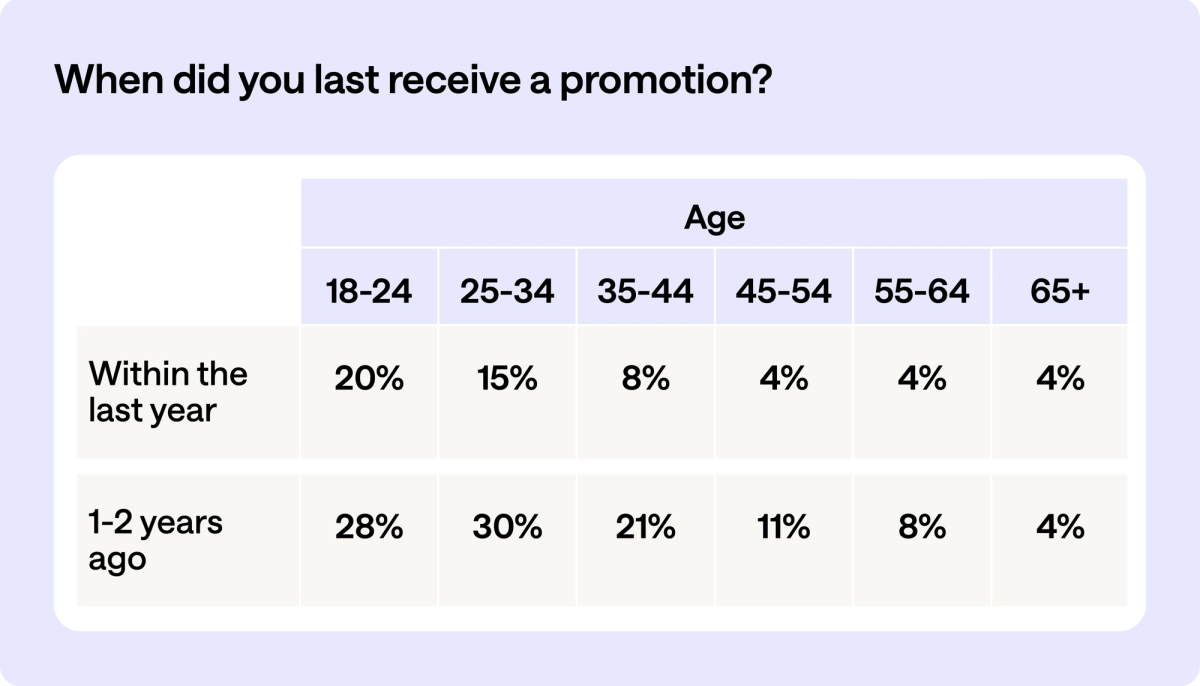
Our research found that those in the first decade of their career (18-24-year-olds) have seen much greater recent progression than those approaching the last decade of their career (55-64s).
Nearly half (47%) of career starters told us they have been promoted within the last two years, compared with just 12% of the 55-64s.
This career plateau needn’t be the case. Particularly with the UK government’s ambitions for growth and boosted productivity, there is no reason why more experienced workers shouldn’t also be enabled to seize the skills opportunity alongside their early career counterparts. After all, AI wasn’t around when most older workers began their careers.
In their working lives they’ve been witness to the death of the fax machine, the rising tide of email, the advent of the internet and the move to mobile. And they’ve tackled them all. Who says there’s such a thing as too old for AI?!
With this stark data, it’s perhaps unsurprising that more than two in five workers aged 55-64 (42%) express negative feelings towards their current pay level, and the availability and frequency of payrises (49%) and promotions (44%). Reskilling could be a solution: not just for individuals. Imagine the national economic upside if those in the last decade of their careers were promoted with the same frequency of those in their first.
More experienced workers recognise the need to reskill in tech
Despite feeling like they are not a priority for training and development (two in five agreed), older workers are more keen to develop their digital and AI skills than younger cohorts.
While some people might have the perception that older generations are tech-resistant, this data demonstrates loud and clear the fact that age doesn’t correlate to willingness to learn new skills.
Women who took an extended period of leave from work are also more likely than average to say that they need training at work to become capable of using new tech (45% vs 37%). They also express the desire to gain improved digital and AI skills from training.
These differences in priorities highlight the need for tailored approaches to skills development, ensuring that everyone, regardless of age or career stage, has access to the training they need to succeed. This was one of the core principles included in our Skills Mission report - we know from polling we commissioned last year that 9 in 10 workers support the right to reskill.
Taking learning out of the classroom and into the workplace
The evidence is clear: learning shouldn't be a one-time event. By prioritising continuous learning, we can help to ensure that there is equitable access to economic opportunity for all.
This helps employers - because it offers them a more skilled and engaged workforce, who they’re more likely to be able to retain.
And it helps learners - because it empowers them with the tools they need to succeed in a world brimming with change.
You’re never too old to try something new. You’re never too young to recognise the substantial effects of technological change.
Methodology
Public First online survey commissioned by Multiverse for the period 17 to 21 January 2025 with 2011 participants. All results are weighted by interlocking age and gender, region, and social grade to nationally representative proportions.

Northwell Health stays ahead of the AI curve through an upskilling partnership with Multiverse
News
Team Multiverse
The companies which embrace these changes and proactively equip their teams with the necessary skills will be the ones who thrive. It’s selecting the right routes to make it happen that is hard.
Northwell Health has partnered with Multiverse to upskill across its information technology workforce to ensure they are familiar with and ready to use the latest, most powerful tools. The training has expanded employees’ skill sets and boosted their productivity, translating to real world impact: money savings and improved operational efficiency.
Through this development partnership, Northwell Health is providing its employees the opportunity to learn new skills and grow their careers through highly personalized training.
The training is being delivered by Multiverse, a tech company delivering high-quality training through applied learning, to 155 Northwell Health learners. Each learner's unique pathway is designed to help them develop their ability to make use of data and AI in a real world setting.
It focuses particularly on realizing the value from the latest data and AI tools, from Microsoft 365 Copilot, to Tableau and PowerBI.
By teaching its employees these critical new skills, Northwell Health is building an AI-native workforce capable of reimagining workflows and business processes. As they explore new AI and data skills, learners believe that they will become more efficient. Already some are reporting they will spend 6 hours less a week on tasks that had previously required manual inputs, and inefficient working practices.
One Northwell Health learner said: “I had no idea what AI could do or how it worked, but now that I understand it better I can see it being valuable in the future for other things I do day-to-day.”
This program has already helped Northwell learners reconfigure their understanding of AI tools and how they can incorporate them in their work. By upskilling their workforce, Northwell Health has supported its employees’ career growth and enabled them to deliver on critical business goals, improving operational efficiency and the company’s bottom line.
Brian Aquart, Northwell Health’s Vice President of Workforce & Community Education said: “We are so excited by the opportunities that this partnership brings for our employees to harness the power of AI to grow their careers and help the company reach its business objectives.”
“Many companies are working towards developing AI native workforces, but Multiverse’s approach to identifying, closing, and preventing skills gaps at scale while delivering against unique business goals has enabled us to continuously analyze and address our skilling needs.”
Elina Petrillo, VP HR Technology, said: “Creating a culture of continuous learning is essential in today’s fast-evolving workplace. By empowering our team to assess their skills and proactively learn new ones, we are fostering growth and driving efficiency. With rising healthcare costs, it’s more important than ever to enable employees to complete tasks faster and strengthen workforce data and software engineering capabilities. Newly acquired skills don’t just improve individual performance—they allow employees to contribute in new, meaningful ways. For just one team at Northwell, upskilling has led to increased productivity and engagement.”
Euan Blair, CEO of Multiverse said: “Northwell Health is a proven leader when it comes to innovation in healthcare. By upskilling its information technology workforce, Northwell is working towards building an AI native workforce capable of transforming and improving its business while ensuring their employees have the skills they need to leverage emerging technologies and to progress in their careers.”
Introducing our AI principles
News
Anna Wang
Artificial Intelligence is transforming the world of learning. The burning need for companies and societies to increase productivity and generate new growth through additional AI capabilities, and the skills to deploy them, is the discussion heard from boardrooms to watercoolers across all industries.
At Multiverse, we believe that AI isn’t just the cause of new skills requirements, it’s also the solution.
AI makes personalized, always-on coaching available at scale. It can assist in tailoring learning materials so that individuals get the education they need to achieve their individual goals. It can reduce burdens on educators by supporting on non-core tasks, so they spend more time supporting learners.
So we have put AI at the heart of what Multiverse does for employers and learners. Whether that’s our AI-driven skills diagnosis that translates business goals into personalised learning pathways for individuals, or Atlas, our always-on coach, that works with our expert human coaches to accelerate equitable outcomes for our learners.
Now it’s time to share the principles for the Multiverse approach to AI. We’re choosing now for two reasons:
- The future of Multiverse involves more AI, not less. Given the success of our initial investments in AI, we’re confident that the next phase of Multiverse will involve additional integrations of AI solutions into what we do. Clear principles help guide our teams as they experiment, build and deploy.
- Transparency for our users. AI adoption will be more successful if its users understand the fundamental motivations behind it.
The Multiverse AI Principles
The following principles outline how we’re thinking about the way we build with AI, now and in the future.
AI first
Our AI features are increasingly core to our product offering. We will continue to build with AI as a fundamental driver of how we deliver an outstanding learning experience, woven into the fundamentals. It is not simply a supplement to the experience or just an enabler of things we’d otherwise want to build.
Contextualised
Our AI solutions are contextualised to our customers and our users. Personalization sits at the heart of being able to educate at scale, and this is a key benefit of leveraging AI.
Fair and non-discriminatory
Our mission has equitable access at its heart, and AI at Multiverse will be no different. When we deploy AI solutions for learning environments we seek to do so with fairness and in a non-discriminatory manner. We firmly believe that it is necessary for AI to neither create nor reinforce bias.
Consequential
At Multiverse we believe the principle value of learning is in the real world application of skills, and the tangible consequences of that application. The same is true of our approach to AI. We will only incorporate AI systems in our products when we have a deep conviction that they will drive real world value. Our AI should be a tool, not a toy.
Transparent
We want our AI systems to be explainable, to foster confidence in their outcomes for both Multiverse and our learners. When we deploy AI, we will ensure it is underpinned by a robust understanding of the logical steps and rationale behind its decisions, including its capabilities and limitations.
Human in the loop
Multiverse AI will always be built and run with the careful guidance of Multiverse people - for feedback, direction and fairness. We want AI to complement and enhance the expertise of our coaches, tech talent and customer support teams, not replace it. This commitment ensures that AI complements human judgment rather than replacing it, allowing us to harness the best of both worlds.
How Multiverse uses these guidelines
Our principles are core to how we are building AI systems at Multiverse, but they are not intended to be static; they will evolve as our understanding of AI and its impact on learning grows. We are dedicated to continuously evaluating our AI implementations and training methods to ensure they remain aligned with company values and ethical responsibilities, as well as our compliance and legal obligations.
These principles have been inspired by input from both our AI Advisory Board, and the Multiverse Customer Advisory Board. As a result, we may update our principles in line with updated inputs.
The end goal: empowering learning and growth
Ultimately, our AI principles are about more than compliance; they are about fostering a culture of learning and growth for our team, for the benefit of our customers and learners. We see AI as a powerful ally in personal and professional development. By embedding these principles into every aspect of our AI strategy, we aim to create a learning ecosystem that not only prepares individuals for the future, but also contributes to society.
At Multiverse, our commitment to the principled use of AI is coupled with our core mission: to create equitable access to economic opportunity, for everyone. As we move forward, our partners are with us on the journey.
L&G launches new AI for Business Value programme in partnership with Multiverse
News
Team Multiverse
L&G has launched a new Artificial Intelligence (AI) for Business Value programme for 50 colleagues in partnership with education technology company Multiverse. The initiative is part of L&G’s drive to adapt to the global changes that accelerating AI technology has brought forward in recent years. [1]
AI adoption is estimated to significantly boost labour productivity growth in financial and professional services over the coming years; the City of London Corporation estimates a boost of 12% by 2025 and of 50% by 2030. [2]
Being that the investment management sector has the potential to embed AI in nearly every one of its functions[3], the Financial Conduct Authority and other regulatory bodies have put a focus on the safe development and deployment of AI[4]. Through the AI for Business Value programme, L&G will equip its employees with the tools needed to responsibly adopt AI in the workplace, as well as taking advantage of potential productivity gains.
Derrick Hastie, Chief Technology Officer, Asset Management, L&G: “We are very excited to provide an opportunity for our colleagues to earn a professional qualification in AI through a business lens. Most importantly, the apprenticeship will help our participants to recognise growth opportunities and leverage AI technologies; creating strategies that can be implemented across L&G’s capabilities.
"Having completed an apprenticeship early on in my career, I am a huge advocate of continuous professional development. Through this programme, we want to support our colleagues’ professional aspirations whilst building a wide net of tech skills that will be key for change resilience.”
Throughout the 13-month course, funded by the apprenticeship levy, participants from across the business will learn to better leverage L&G’s technology tools to develop a robust AI strategy; developing tangible benefits that will drive business value through cost savings, improved operational efficiency, and automated manual processes.
The training will be delivered by Multiverse, a tech company that specialises in high-quality training through applied learning. Multiverse has trained more than 20,000 apprentices at over 1,500 organisations in data, AI, and digital skills since 2016.
Gary Eimerman, Chief Learning Officer, Multiverse: “L&G is an organisation built on principles of responsible investment for long term growth, an ethos reflected in its staff development strategy. By equipping its teams to make responsible data-led decisions, L&G can enhance operations and ensure security and protection in the fast evolving digital workplace.”
As part of the Investment Association’s Technology Working Group, L&G has already played a key role in assessing the ways in which UK asset managers are already leveraging AI to drive efficiency, automating routine tasks to boost productivity, and improving the quality of products and services offered.
[1] A timeline of technology transformation: How has the pace changed? | World Economic Forum
[2] Can AI actually increase human productivity? | World Economic Forum, The future of AI & the workforce
[3] Technology Working Group AI Report Oct 2024.pdf
[4] AI Update, A pro-innovation approach to AI regulation - GOV.UK
Maikai partners with Multiverse on FutureFit programme
News
Team Multiverse
Richard Cotton, Co-Founder at Maikai, said: “In this digitally driven world,
our clients are looking to develop their teams with the latest AI, tech and data skills. It is anticipated that 40% of workers will need to reskill in the next three
years due to AI, and we are excited to be partnering with Multiverse to extend
our capabilities in this area. Their measured and applied human-centred
learning models are transforming how professional apprenticeships work,
helping our clients to build resilient and future-facing organisations.”
Carly Becker, VP, Strategic Alliances at Multiverse, said: “Nowhere has the explosion of data, analysis tools, and predictive insights been more profoundly seen than in the world of professional sport. The pursuit of competitive edge, and performance excellence, is now driven by data. But the ability of organisations to harness this superpower is too often hindered by the skill set of their teams. In partnership with Maikai, we’re excited to play our role ensuring individuals of every age and career stage feel the benefit of technological skills in their careers and in their organisations.”
Our AI coach outcomes, one year on: four-fold growth and new capabilities
News
Team Multiverse
We’re on a mission to provide equitable access to economic opportunity for everyone. Here, we want to set out how Atlas is helping us to do that, because when combined with our industry-leading human coaches, it allows us to offer 1:1 tutoring - which is proven to dramatically improve learning outcomes - at scale. Together our coaches combine with Atlas to deliver highly personalized, effective, guidance 24/7, whenever our learners need it
We also want to explore what we’re doing to improve - because no good tech organization only celebrates its wins. We’re constantly iterating and learning ourselves. We'll touch on what’s new and what's next for Atlas at the end.
We often say that AI is useless unless people can use it. And at Multiverse, we also want to understand how people are using it. So let’s dive in.

Equitable access
First, let’s look at users - and what it could tell us about AI adoption.
We’ve seen tremendous growth in usage, with a roughly four-fold increase in the number of daily users in the past six months. Likewise, the number of messages per day has skyrocketed - we’re now seeing 5x the volume compared with six months ago. We also hit a new peak ‘helpfulness’ rating of 97% in January - which has remained consistently above 95% since August 2024.
But who are those users? We previously reported greater uptake among the over 40s and those with additional learning needs. That still holds true, with 46% of over 40s using it vs. 42% of the 25-39s and 34% of those 24 and under. This stands counter to the trend illustrated in some of the latest UK government AI usage data, which suggests that 18-34 year olds are most likely to use AI tools like LLM-based chatbots.
Meanwhile we have proportionally equal of male and female usage from the past six months, with 42% of each group using Atlas. Again, this bucks the trend of AI usage skewing more male, according to that same government data.
As for the racial demographic of our users, it’s broadly similar across ethnicities, with 40% Asian, 35% Black, 42% Multi-Racial, and 44% White learners using the tool. These proportions have grown steadily among each group, though adoption among Black learners remains slightly lower than average.
Economic opportunity
We also want to explain a little bit about outcomes, and in particular how people are using the tool. We’ve found that some of the top ways that Atlas is being used include:
- As a learning partner: helping learners to unpick how they’ve arrived at incorrect answers within their own work.
- As a curriculum guide: augmenting program material with advice for how to apply it to their particular role, or explaining specific concepts in a new way.
- As an impact evaluator: helping to uncover the impact of a user’s learning, by teasing out insights on what they’ve achieved, and helping calculate outcomes
While we always intended for Atlas to act as a technical and learning guide, we hadn’t anticipated the popularity of using Atlas to understand impact.
This hints at how Atlas could be used to improve individuals’ economic outcomes. What better way to talk to your manager about a promotion or a pay rise, than armed with data and insights on the impact you’ve been able to drive for your team? Could AI be your next career coach?
This also has perhaps even greater implications. It hints at how organizations can start to use AI tools to understand the impact of their wider workforce. We’re really just at the beginning of realizing the full potential for this tool.
Public vs private sector uptake
Of course, not all customers or learners are the same.
Working closely with more than 1,500 partners from every sector means we understand the unique differences in how different organizations learn and apply their skills. As you can imagine, the needs of a financial services company are vastly different from the needs of an NHS trust. The same holds true for what they require from Atlas - naturally, applying skills in a healthcare or local government setting differs from a commercial organization.
To investigate this, we compared behaviours between the public and private sectors. And found something remarkable.
There is an unfair cliché that in the public sector, technology is treated with suspicion or underutilized - that public sector organizations invest into technology without having the requisite skills to make it work.
According to our data, though, that assumption isn’t borne out. Comparing a sample of our biggest private sector customers with over 80 NHS and 50 local council partners, we found that proportionally more people are using Atlas in the public sector (66% vs 57%). This suggests that in the right environment, public sector workers are just as curious about and capable of using AI tools as their private sector counterparts. We just need to enable them in the right way.
What’s more, we know that public sector organizations are under pressure to deliver more with greater efficiency. AI has a huge potential to help with that, and Atlas is just the beginning.
What’s new and next for Atlas?
Finally, what can we do better?
We’re continually iterating to make Atlas more user-friendly and useful to the learners on our programs. Recent areas of exploration for us have included:
- Atlas as a learning co-pilot – we’ve made changes to Atlas to make it more contextually-aware, responsive and discoverable within the Multiverse platform. So Atlas now recognises the content learners are looking at whilst they are learning on the Multiverse platform. This means it can offer more relevant guidance, as well as displaying dynamic prompts based on what learners might want to know more about.
- AI-human handover - we know there are some circumstances where only chatting to a human will help. Atlas can now help smooth that handover by summarising a learner’s interaction when it hands the conversation over to a human coach. This makes it easier for the coaches to provide timely and thoughtful responses rather than spending a lot of time catching up on the chat.

Looking ahead, we want to embed Atlas more fully into the learner experience throughout their program, and find new ways to make it an even more helpful and intuitive learning partner.
And as always, we won’t take ourselves too seriously. You may have spotted SantaAtlas – you can bet there’ll be more surprises up our sleeve when it comes to Atlas’s sense of personal style. Any suggestions? Let us know…

Sheffield City Council set to upskill 150 staff in new Data Academy
News
Team Multiverse
Sheffield City Council is investing in a strategic upskilling initiative for 150 of its team, allowing the organisation to leverage technology to improve operational performance and resident experience.
The Data Academy will contribute to the council’s Future Sheffield initiative, providing staff with enhanced digital skills to modernise processes and improve efficiencies. This will allow the council to focus more time on providing services to Sheffield residents while making the organisation more cost-effective.
Funded by the Apprenticeship Levy, training is being delivered by Multiverse, a tech company that identifies, closes and prevents skills gaps, through personalised, on-the-job learning. Multiverse has trained more than 16,000 apprentices in AI, data and digital skills since 2016.
The Sheffield City Council cohort will embark on a range of Multiverse courses, including ‘Data & Insights for Business Decisions’, a level 3 apprenticeship, and ‘Data Fellowship’, a level 4 programme. Once completed, colleagues will be able to conduct data-led projects and encourage data driven decision making, to unlock cost saving opportunities.
The Multiverse Skills Intelligence Report, released in August 2024, highlighted a significant challenge faced by local governments and councils due to a lack of data skills. This shortfall leads to 26% of employees' time spent on data-related tasks being unproductive. The new academy demonstrates how Sheffield City Council is taking action to reduce the skills gap.
Cllr Fran Belbin, Deputy Leader at Sheffield City Council and Chair of the Future Sheffield Members Working Group, said: “The launch of this 150-strong Academy not only marks a commitment to our colleagues’ professional development, but also to our local community. As we seek to enhance operations and reduce time spent with data, we can focus on what matters – providing residents with the highest quality service.”
Multiverse combines work and learning to unlock economic opportunity for everyone. It works with more than 1,500 organisations to close critical skill gaps in the workforce in AI, data and tech, through a new kind of apprenticeship.
Gary Eimerman, Chief Learning Officer at Multiverse, said: “This is the start of a partnership that will provide Sheffield City Council with the tools for organisational transformation. Residents across the UK are reliant on their local authorities, and this is putting Sheffield on the front foot to deliver real value and efficiency.”
Multiverse bolsters VP team with Spotify engineering head and edtech founder
News
Team Multiverse
Following on from the recent appointment of Jillian Gillespie as CFO and Martha Lane Fox to the board, the tech credentials of the new VP appointees underline Multiverse’s ambitions to be a generational technology company.
Helen Greul joins Multiverse from a varied career at Spotify, having most recently headed up its open source Backstage product, which streamlines workflows for developers. Prior to this she worked on the infrastructure of Spotify’s content platform, contributing to the successful launch of Podcasts in 2018. With more than 15 years in the tech industry Helen will help supercharge Multiverse’s high-performing engineering team, enabling Multiverse to deliver its AI-driven education platform to learners across the world.
She said, “Growing up in a family of educators, I understand the transformative power of education. In the current macro economic environment where upskilling is a necessity for every field, I’m looking forward to creating a learning experience in which the next generation of talent can learn the skills they need to thrive.”
Asha Haji, meanwhile, joins Multiverse having successfully built and exited her own edtech company, Framework, prior to which she spent almost seven years at Education First. In her time as an entrepreneur she secured investment from Google’s Black Founders Fund and earned a finalist slot in Harvard Business School’s New Venture Competition. Haji also secured funding from VCs, founders and CxOs behind the likes of Netflix, Calm and YouTube. Having reskilled many times, working in everything from sales and partnerships, to talent acquisition and product management, she is well-placed to steer Multiverse to success in its operations.
She said, “I'm passionate about helping people from all backgrounds grow further in their careers and develop technical aptitude, so I’m hugely excited by Multiverse’s mission. I’m looking forward to helping it tackle the problem of delivering high quality, applied learning at scale.”
Euan Blair, Founder and CEO of Multiverse, said: “Continuing to build a world-beating senior team is essential for Multiverse to achieve its ambitions. I’m beyond excited to be welcoming two more brilliant individuals to the organisation, who will help continue our rapid growth in the right way and enable us to realise our far-reaching ambitions.”

The University of Manchester partners with Multiverse to build digitally confident and AI-literate workforce
News
Team Multiverse
The University of Manchester is launching AI and data programmes for 70 professional services staff through a new Data & AI Academy, in partnership with Multiverse. This new initiative is part of a drive from the University to better leverage its technology tools and data.
The development of these skills will increase staff efficiency through the automation of manual processes and future proof the workforce for the next decade. The ambition of the Data & AI Academy is to expand across the University’s professional services teams in 2025.
Training is funded by the apprenticeship levy and delivered by Multiverse, a tech company that specialises in high-quality training through applied learning. Multiverse has trained more than 16,000 apprentices at over 1,500 organisations in data, AI and digital skills since 2016.
Programmes include ‘AI for Business Value’, which will help learners to identify operational and commercial gains that can be achieved through using AI responsibly. This will allow them to design AI solutions with key areas like student experience and organisational development in mind.
The ‘Data Fellowship’ will upskill employees in data analysis and help the University develop a team of data specialists to implement its 10-year futureproofing framework. Meanwhile ‘AI Powered-Productivity’ will help teams to boost their output at work through the use of Microsoft 365 Copilot. This will be crucial to help deliver value from the University’s forward-looking investment in the technology.
According to Multiverse’s Skills Intelligence Report, the education sector is most impacted by a lack of data skills, with 38% of employees’ time working with data spent unproductively, compared to the average of 30% across 18 other sectors.
The University of Manchester’s Data & AI Academy will lead the way in mitigating this risk by offering tailored training programmes to enhance data analytics and AI skills among staff. This will foster a more data-driven workforce that can effectively leverage technology to improve student experiences.
PJ Hemmaway, Chief Information Officer at The University of Manchester said: “I’m thrilled to be partnering with Multiverse to offer these unique and highly relevant professional development opportunities to our colleagues. Together, we have developed an approach to increase our digital confidence around data and AI which will help us immensely to prepare for the challenges that lie ahead.
“Data and AI skills will be critical in the future and I’m eager to see the first cohort of colleagues upskill and learn how to harness the power of innovative technologies for the benefit of our University community and our student experience, as we prepare ourselves for what’s to come.”
Robert Williams, Apprenticeships Programme Manager at The University of Manchester said: “We are excited to join forces with Multiverse to introduce the Data and AI Academy, a dynamic addition to our growing apprenticeship offering at the University of Manchester. This partnership underscores our commitment to supporting staff development and highlights the vital role apprenticeships play in driving personal and professional growth across our institution”
Euan Blair, CEO at Multiverse said: “The University of Manchester is adopting a strategic approach to give its skilled teams more time, enabling them to concentrate on what truly matters. Already recognised as a leading institution for students, this new academy demonstrates its commitment to supporting employees as well.”
Hillingdon Council launches Digital Excellence Academy to enhance service delivery
News
Team Multiverse
Hillingdon Council is launching a new Digital Excellence Academy for 75 staff members, as part of a specialist upskilling drive. The project will help the council execute a new digital strategy to better integrate services and improve quality of life for the community.
By building its digital capabilities, the council is looking to empower colleagues to improve their efficiency with digital and data while utilising these new skills to inform better decisions for residents and enable financial sustainability.
Training is being delivered by Multiverse, a tech company that identifies, closes and prevents skills gaps, through personalised, on-the-job learning. Multiverse has trained more than 16,000 apprentices in AI, data and digital skills since 2016.
Hillingdon Council’s new Digital Excellence Academy will see 75 employees enrol onto programmes such as ‘Data & Insights for Business Decisions’, a Level 3 apprenticeship which covers core technical skills including cleaning, formatting and preparing data. ‘Transformative Leadership’, a Level 5 course, is designed to help employees build strong leadership foundations, manage high-performing teams and drive continuous improvement.
Multiverse’s Skills Intelligence Report found that more than a quarter of local government and council employees’ time spent on data-related tasks could be more efficient if skills were enhanced. Hillingdon Council is ensuring it is ahead of the sector status quo by making significant steps to enhance the digital skills of employees.
Matthew Wallbridge, Chief Operating Officer of Hillingdon Council said:“Our Digital Strategy sets out our vision to embrace technology to be more efficient and make it easier for residents to use council services, including supporting those who are unable to use technology. Upskilling our teams in digital and data is a clear demonstration of our commitment to this, and in driving positive outcomes for our community.”
Multiverse combines work and learning to unlock economic opportunity for everyone. It works with more than 1,500 organisations to close critical skill gaps in the workforce in AI, data and tech, through a new kind of apprenticeship.
Gary Eimerman, Chief Learning Officer at Multiverse, said: “We’re confident that Hillingdon Council’s Excellence Academywill both improve its services and create a culture of continuous learning, driving innovation within the organisation. Staff will be better equipped to understand and use data, leading to more effective and efficient service delivery.”
Sorry, no results found.