Every major new technology in history has taken years, or even decades, to affect how work takes place: the steam engine, electricity, the internet.
For each, companies had time to hire their way through the disruption. The technology reshaped organisations gradually, and new job classes slowly emerged to deliver the change, because each shift took a long time to really take hold.
But now the workforce is faced with a new technology that moves at an unprecedented speed: artificial intelligence. Very few organisations can recruit their way through a change that's happening this fast, so the question has become: how quickly can the people inside an organisation learn to work differently?
That speed is not going to be delivered through theoretical classroom-based teaching.
One of the most effective ways to learn a new skill has always been to do it yourself, alongside someone who already knows how. That's what a traditional apprenticeship is, and the model has existed for more than 400 years. In 1563, the Statute of Artificers required anyone practising a trade in England to spend seven years alongside a master first.
Picture learning plumbing this way: you might be under a sink, next to someone who has done this 10,000 times, watching them find the fault and explain it live, then asking you to do the same.
Across the economy, the job itself used to be the classroom. You learned through real work and applied each lesson straight away. You learned from an expert, who taught you at the moment you needed it.
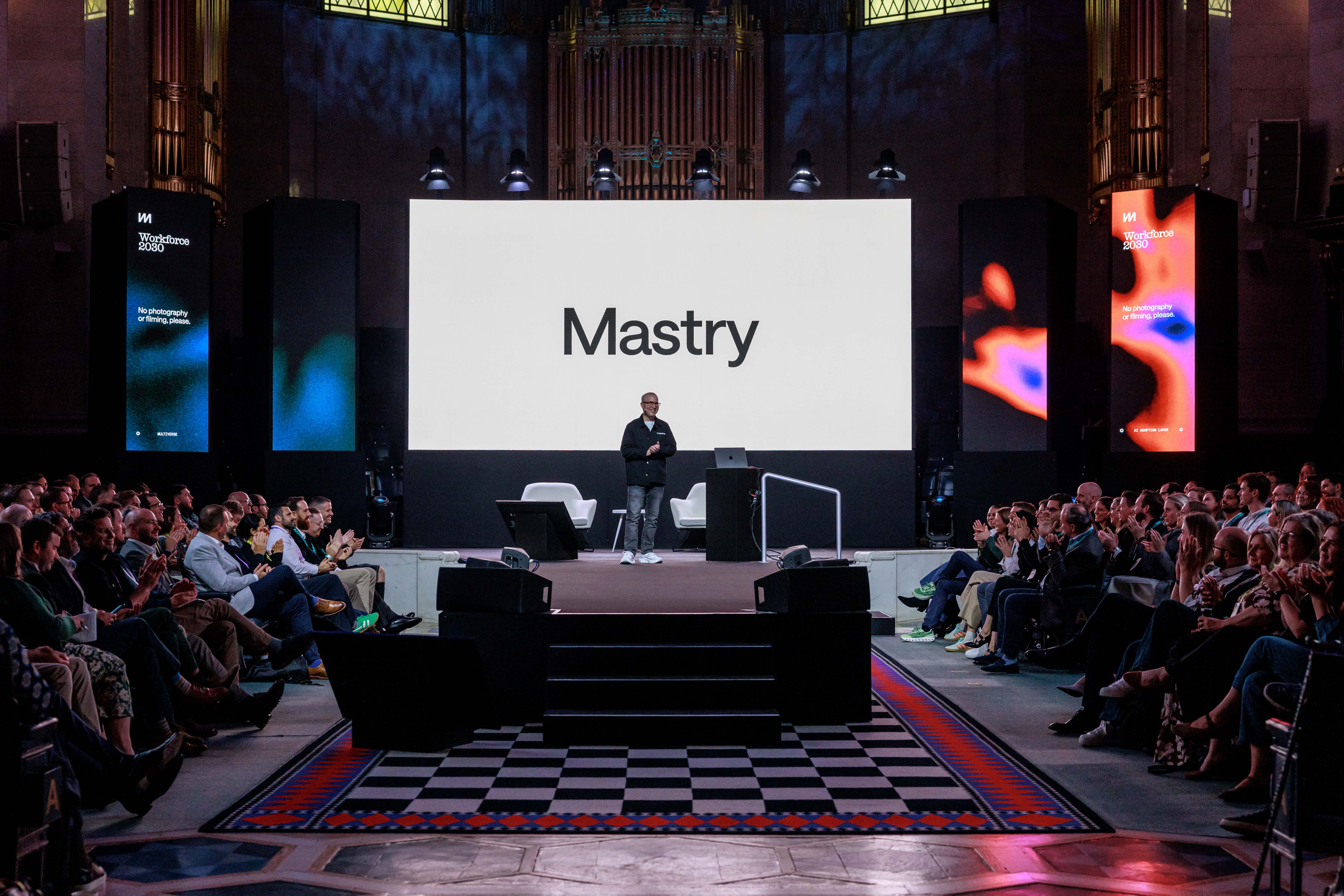
As our Chief Product and Technology Officer, Jay Richman, put it at our Workforce 2030 conference: this was the best learning technology ever built.
The difficulty comes with scale. An expert can only teach a few people at a time. When an economy needs its whole workforce retrained at once, the thing it runs out of quickest is experts.
Attempts have been made to solve the problem of scale over the past few decades, and each step moved the learning further away from the work. Trade schools moved learning from applied and on-the-job to theoretical and inside a classroom. By the mid 1900s, entire departments left the office for days to go and take standardised training courses. Then came the advent of online learning libraries, where learning became modules you could finish at your desk, with the number of hours you spent learning tracked as a metric of success.
Each step bought reach and lost relevance, until there were thousands of programmes built for nobody in particular. But relevance wasn't the only way workers paid for this trade-off - they paid in time too. To get better at your job, you had to leave it for a day, a week in a classroom, or six months of evenings. That's why training has often been the first budget line to be cut: because when learning and work pull in opposite directions, work will always win.
So at Multiverse, we went back to first principles, and asked: what would it take to put working and learning together again? We didn't set out to build a better course, or a shorter one. We set out to take the tenets of an apprenticeship and apply them to build a learning experience that could reach an entire workforce at once.
Scale is what is required to drive mass AI adoption. But learning needs to be deeply intertwined with the work itself in order to deliver productivity benefits.
Mastry is the result. It is an adaptive learning platform we've built from a decade of experience training 40,000+ people at over 1,000 employers. It's available now in early access, and plugs into the AI tools people use at work, such as Claude and Microsoft Copilot. It gives employees a personal AI guide called Mae, an expert available 24/7, who learns about their workflows and the things that are holding them back through a voice or chat conversation.
First, Mae diagnoses where the business wants to go and what's currently standing in the way, through having short conversations with employees by chat or voice. Mae then guides people to do their jobs more effectively from within the AI tools they already have access to. Finally, we capture the evidence of the skills they've learned - for example the time they've saved by rebuilding a repeatable process - and report that impact back to leaders.
One belief has held true throughout our history as a company: the belief that to drive technology adoption and build skills that stick, you have to be able to apply learning directly to the real-world task in front of you. At its core, that's what an apprenticeship is.
For the first time, Mastry puts that possibility within reach of an entire organisation, all at once.