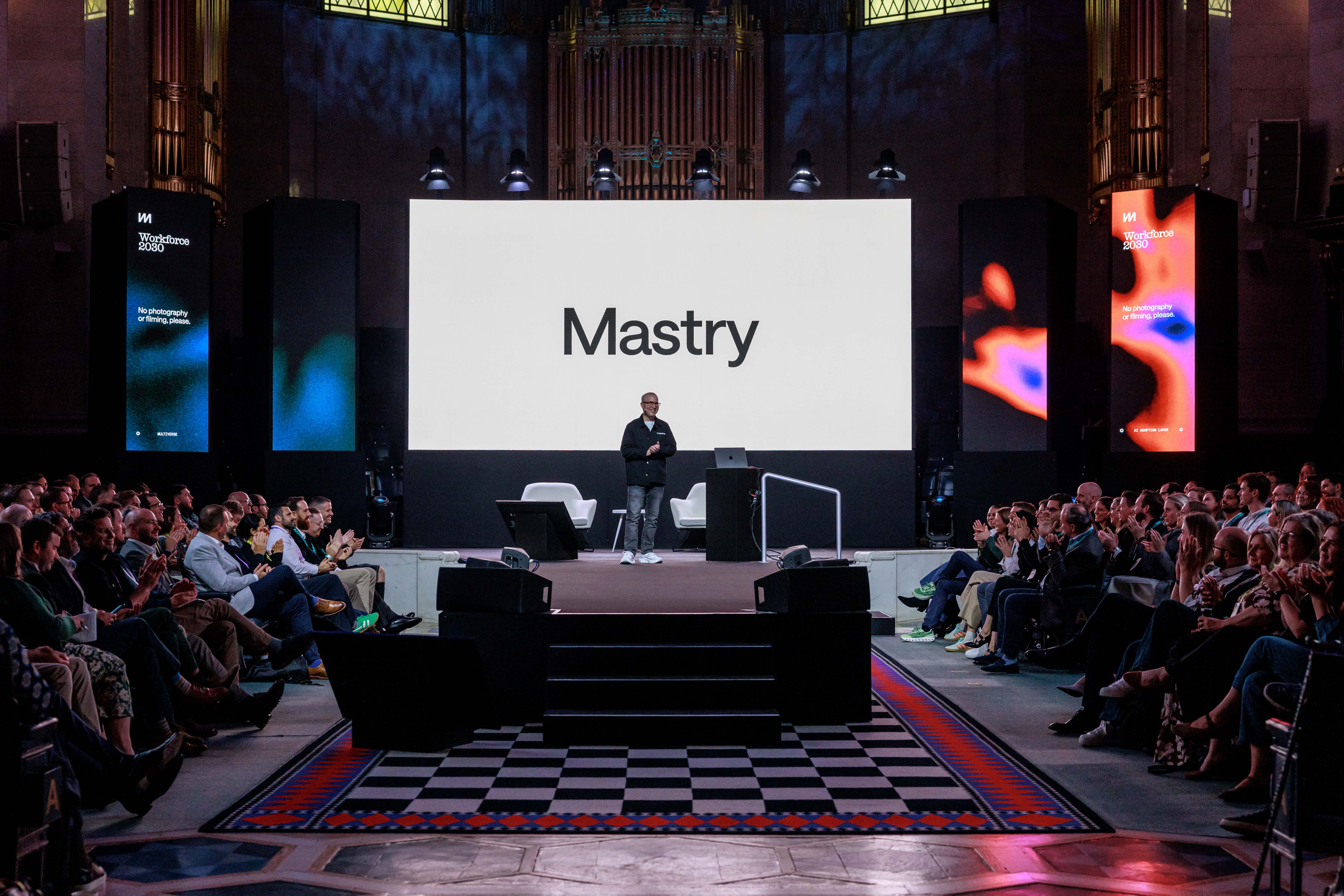
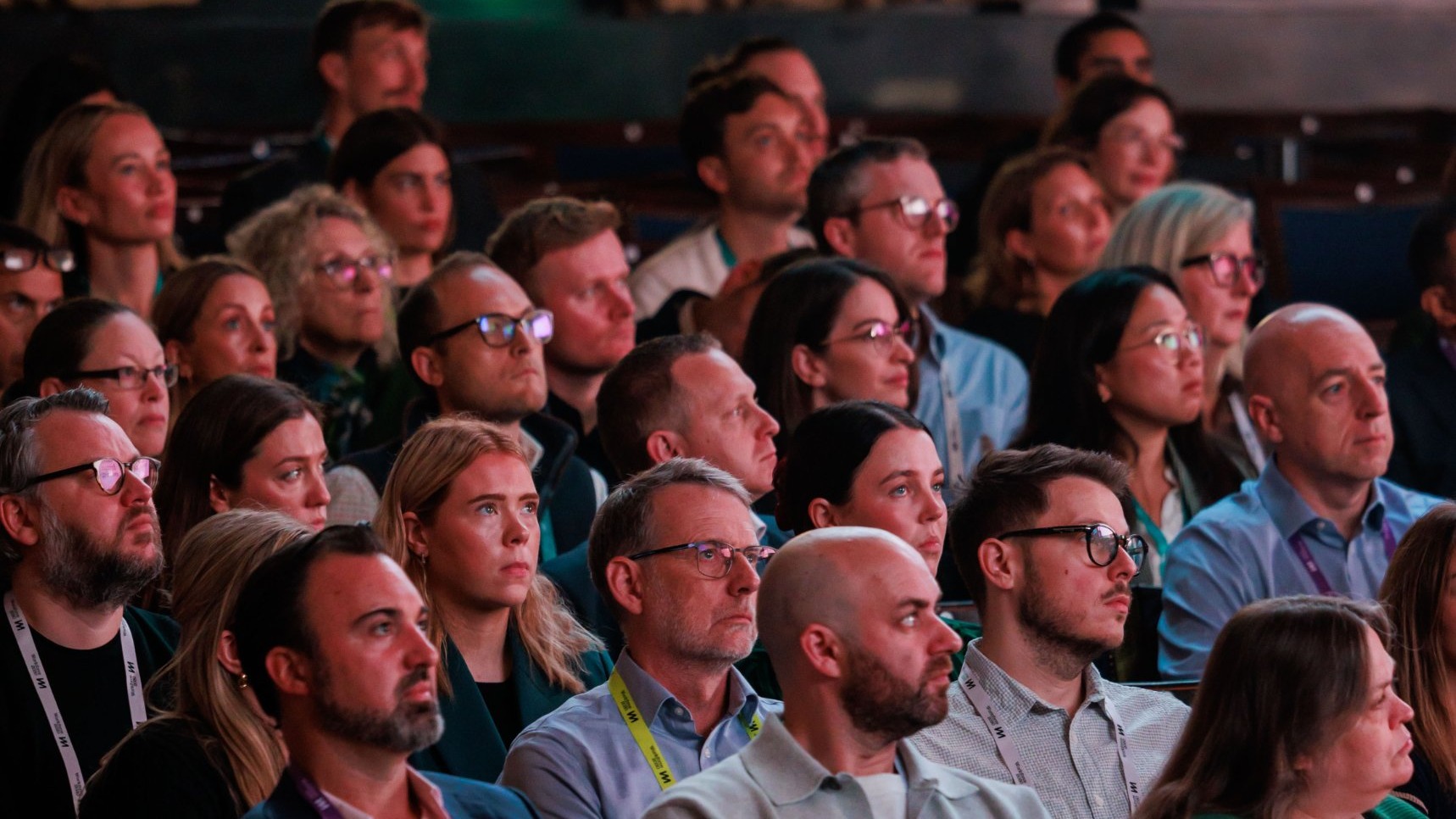
On 14 October, more than 400 Multiverse customers, representing just over three million UK workers, filled 60 Great Queen Street in London for Workforce 2030. The question on the day: how does the UK become the most AI-enabled G7 workforce by the end of the decade?
The answer from the stage was consistent. Technology is no longer the constraint. Capability is. If you missed the event, here are the takeaways from the keynotes, the afternoon breakouts and the launch of Mastry, our new adaptive learning platform. You can also watch the Workforce 2030 sessions.
The highlights:
- Most organisations have bought AI tools. Few have changed how their people work.
- There is a six-times productivity gap between the most and least AI-fluent workers using the same tools.
- Leaders cannot govern AI they do not use, and the change cannot be left to a CTO or a Chief AI Officer.
- Learning has to happen inside the job, not in a course beside it.
- Mastry coaches people inside the AI tools they already use, personalised to how your teams actually work, and shows leaders what changed.
Why is AI not delivering returns yet?
Euan Blair, Founder and CEO of Multiverse, opened the day with a show of hands: who in the room could say AI was delivering widespread ROI? “Every company's bought the software,” he told the audience. “Very few, though, have actually changed how their people work.”
He put a number on the gap. Between the most and least AI-fluent workers using exactly the same tools, productivity differs by six times. What you do with a gap like that is a choice between a headcount plan and a growth plan. Euan backed growth, because “nobody helps you adopt something they think is aimed at their job.”
This is an everyone problem, he said. A Chief AI Officer, a top-down mandate or a handful of champions will not close it alone, because frontline workers hold the context that decides what AI can do. “A good model with the right context beats a great one without it,” Euan said, “and the people with the context are your workers.”
Why does critical thinking matter in the AI era?
Professor Hannah Fry spoke on AI and critical thinking, and how employers can make AI a superpower for their teams. Her theme resurfaced later on the C-suite panel, where KPMG's Melissa Geiger said the skills clients pay for are the ones Hannah described: judgement and critical thinking.
Can AI lift UK productivity?
Sir Jeremy Hunt, former Chancellor of the Exchequer, set out the economic case. Productivity drives living standards, he said, and fixing most of the UK's familiar problems would add between 0.2% and 0.4% to annual GDP growth. The most cautious AI estimate he cited, from Nobel laureate Philippe Aghion, is 0.7% to 1.2%.
The stakes show in the doubling arithmetic. At the 2.5% growth of the 1970s and 80s, GDP doubles in about 28 years. At today's 0.5% growth per head, it takes 140. AI could restore hope for younger workers, Hunt argued, but this wave is moving five to ten times faster than the internet. His advice to leaders: give your people the skills that keep them in demand.
How should leaders respond?
Euan's answer: “Safety comes from literacy because you can't govern what you don't understand, and returns come from adoption, not from buying a tool.”
The C-suite panel, hosted by Martha Lane Fox, showed what that looks like. Adolfo Hernandez, Group CEO of Capita, set up a Catalyst Lab where any employee can submit an idea and see it piloted and tested. Multiverse apprenticeships gave his process specialists the data and AI literacy to imagine better services.
Melissa Geiger, Board Chair of KPMG UK & Switzerland, said KPMG talks about humans in the lead, not humans in the loop. Its senior leaders tested AI against their own answers to tax problems. “If you don't put yourself at some point on the coal face of doing it, it's incredibly difficult to then sit in a governance discussion and work out how are we going to govern it.”
Patrick Gallagher, CEO of Addison Lee, said his blue-collar workforce holds knowledge the business needs to unlock. A 63-year-old colleague with more than 40 years at the company used his training to build a model that tackles lateness, saving £750,000. “Don't underestimate your staff, whoever they are, however old, however young, their appetite to learn.”
One panellist summed up the shared view: “If we leave it to be a CTO initiative, it will fail.” “The tech phase, I think, is done. It's now more around skills, people, and helping our customers adopt.”
What does AI adoption look like on the ground?
Sally Eglin, Matron for Gynaecology Services at Kettering General Hospital, and Ward Manager Linda Sarju showed what applied skills look like. Their team tracked patients on a manual whiteboard, and near misses exposed the safety risk. Linda, halfway through her Multiverse apprenticeship in business transformation, set out to replace it with a digital tracking board that shows staff blood tests and outstanding follow-up actions in one place.
“The apprenticeship didn't give me a problem,” Linda said. “I already had a problem. It gave me the knowledge, tools, and the confidence to turn the problem into an opportunity.”
What did leaders say in the afternoon breakouts?
The afternoon opened with a fireside chat between Daniel Susskind and Julia Shelley, Multiverse's AI Transformation Director, about his book What Should My Children Do? How to Flourish in the Age of AI. It then split into three tracks for executives, HR leaders and L&D teams. Discussions ran under Chatham House Rule, so we have kept them unattributed. These are the four themes that recurred:
- Privacy comes first. When organisations consider an AI tool, their first question is who can see what employees type into it, and who controls what gets shared. Once they have a clear answer, the conversation moves on to adoption.
- Licences aren't usage. Organisations have rolled tools out to a handful of people. The worry now is keeping people using them after launch.
- People want a service, not just an app. When something breaks, they want someone to answer.
- L&D leads feel the AI pain most. They often hold the transformation budget, yet they are too rarely part of the AI conversation.
Introducing Mastry
Jay Richman, Chief Platform & Technology Officer at Multiverse, launched Mastry in front of the room. At NBCUniversal, Spotify and Amazon, he watched technology arrive years before the people were ready. “You cannot recruit your way across a gap that moves this fast,” he said. The real question is how quickly your existing people can learn, and they will not learn on a course. “If learning and working pull in opposite directions, then the work will always win.”
Mastry puts learning back inside the work. It diagnoses where your business is trying to go, guides people to work differently in the jobs they already do, and proves they can through the work itself. At the centre is Mae, an AI guide that works inside Microsoft 365 Copilot and Claude (with more tools on the roadmap), so nobody has to learn another app.
In the demo, Mae spotted that Sam, an account executive, spent about a quarter of his week preparing for customer meetings, helped him turn that hour into a ten-minute brief, and coached him through saving it as a reusable AI skill. Mastry records the evidence from the work against Multiverse's five-stage AI maturity standard, so managers see how capability changes across their teams.
Sarah Gallo, Chief People Officer at News UK, joined Jay on stage after piloting Mastry's diagnostic. It gave her “a really good sense of cultural blockers, organisational challenges.”
How is this different from a Copilot or Claude licence? A licence gives people a tool. Mastry coaches each person through real work, helps one person's method spread across the team, and shows leaders what changed.
Mastry is in early access with development partners, with a wider release planned for next year. Join the Mastry waitlist to hear first.
Watch the Workforce 2030 recordings
Missed Workforce 2030? Watch all of the recordings with our brilliant speakers.