.jpg)








We couldn’t find what you are looking for. Please try another way.
The Multiverse blog
Thank you! Your submission has been received!
Oops! Something went wrong while submitting the form.
Multiverse assembles AI advisory board to guide workforce transformation efforts
News
Team Multiverse
The board, composed of luminaries from academia and industry, will provide strategic guidance on Multiverse's use of AI to identify skills gaps, enable career mobility, and deliver high-quality, personalised learning at scale.
The rapid advancement of generative artificial intelligence has radically reshaped the world of work, necessitating an entirely new set of in-demand skills. However, the current education-to- employment system has struggled to keep pace, resulting in a transition that is both economically inefficient and socially inequitable.
"AI is creating profound change in the skills that both companies and societies need to be successful," said Euan Blair, founder and CEO of Multiverse.
"At Multiverse we believe this shift has AI as both the provocation and the solution - new educational tools built on gen AI are opening access to personalised training at scale, and done right we can use the benefits of AI to drive large scale reskilling programs and mitigate the job losses the technology otherwise might bring. Our AI Advisory Board massively expands the range of expertise we can rely on, and will be instrumental in ensuring we stay at the forefront of this transformation."
The board brings together recognized experts in AI, computer science, workforce development, and education. It includes:
- Professor Mehran Sahami, Professor and Chair of the Computer Science department at Stanford University
- Kersti Kaljulaid, former President of Estonia (2016 - 2021)
- Professor Michael Wooldridge, Head of AI and Machine Learning Research at the University of Oxford
- Derrick Hastie, Chief Technology Officer at Legal & General Investment Management
- Anne Devlin, former Global Head of Learning for JPMorgan Chase AWM
- Dame Wendy Hall, Regius Professor of Computer Science at the University of Southampton
- Doug Gurr, Chair of the Alan Turing Institute and former Country Manager of Amazon UK
“AI is profoundly transforming education, said Kersti Kaljulaid, former President of Estonia and global technology leader.
“Multiverse is leading the way down one of the promising paths. As we explore the application of AI to increasingly complex tasks, it's thrilling to have a front seat on this journey.“
The formation of the AI Advisory Board comes on the heels of the successful launch of Multiverse Atlas in February. Atlas is an AI-powered coach offering personalised, on-demand support to Multiverse apprentices. Early analysis shows Atlas has achieved adoption rates of over 40% and usefulness ratings exceeding 91% across all demographics.
"Our early results with Atlas demonstrate that when designed thoughtfully, AI can meaningfully expand access to world-class education in an equitable way," said Ujjwal Singh, Chief Technology Officer at Multiverse. "With the guidance of our AI Advisory Board, we will double down on our efforts to harness this powerful technology to drive economic opportunity for individuals and workforce transformation for organisations."
The Multiverse AI Advisory Board will meet quarterly, with additional ad hoc sessions as needed. Its initial priorities include developing governance principles for the ethical development and deployment of AI, identifying opportunities for product innovation and enhancement, the content of Multiverse’s AI offering, and showcasing Multiverse's industry leadership and thought partnership on AI's workforce implications.
“We are at a critical inflection point in the world of work” said Annie Devlin, former Global Head of Learning at JP Morgan AWM. “We became obsessed with ‘where’ our people were working but we should be much more curious about ‘how’ people work—which tools they use to augment what they can produce on their own. Imagine having the best manager you have ever had next to you, nudging you and guiding you when you are stuck or bored and need a boost? That’s the potential AI brings to the knowledge worker of tomorrow. And it requires a whole other level of skills training than most employers offer today.”
Capita aims to enhance CX and staff skillset in 100-strong AI Academy
Employers
Team Multiverse
The AI Academy is part of a drive from Capita to grow client satisfaction, alongside developing a team of AI-literate specialists who can provide ethical counsel in the area.
The training will be delivered by Multiverse, a tech company delivering high-quality training through applied learning, to Capita colleagues delivering for clients across both its Public Service and Customer Experience divisions. Multiverse has trained more than 16,000 apprentices in data and digital skills since 2016.
Each of the Capita employees will undergo a 13-month ‘AI for Business Value’ level-4 apprenticeship programme, which trains people in identifying business value gains that can be achieved through using AI, and how to execute AI projects ethically.
In addition to the establishment of a leading AI-focused taskforce across the business, Capita hopes to reduce manual processes that will improve accuracy and allow colleagues to focus on performance-driving activity that is conducive to greater career satisfaction.
The 100-strong team of AI apprentices will also be deployed to unlock new correlative understandings between data and impact and implement a culture of continuous improvement in all areas.
Adolfo Hernandez, CEO of Capita, said: “We are committed to delivering high-quality customer experiences, driven by passionate and high-skilled employees, and we’re confident that our AI Academy partnership with Multiverse will allow us to elevate both.
“Every business is looking to step ahead of the AI curve, but ensuring a business does so ethically and responsibly requires people-centred initiatives and knowledge, which we believe will be delivered and deployed with our new apprentices.”
The partnership is the latest in a series of new initiatives by Capita to enhance its AI capability, improve its offering in the market, and upskill colleagues in the use of AI technology.
Olivia Lory Kay, Director of Performance and Partnering, joined the programme in June. She said: “I’ve been impressed by the depth and rigour of the programme, which takes a targeted, practical approach to delivering AI for business value with plenty of pivot points to expand thinking and stretch horizons, including my own career development. We have some brilliant capability in our cohort and the opportunity to share knowledge and thinking is already sparking ideas for new applications.”
Scott Hill, Chief People Officer at Capita, said: “We know the skills needed to succeed in the workplace are undergoing a huge transformation, and we want to work in tandem with our people to ensure they're equipped to thrive in this new world.
“Enabling access to world-class training in AI is just one of the ways we ensure our teams have the skills and capabilities not only to thrive in their role, but to drive forward their careers.
“We all take value from learning new skills, and I can't wait to see the benefits our colleagues will see from this programme."
Multiverse is a new tech-first institution that combines work and learning to unlock economic opportunity for everyone. It works with more than 1,500 organisations to close critical skill gaps in the workforce in AI, data and tech, through a new kind of apprenticeship.
Euan Blair, CEO at Multiverse said: "Capita plays a crucial role across a number of core sectors, who are reliant on its capabilities and services. By equipping teams with AI skills and confidence, Capita and its clients are ideally placed to harness the potential of ethical, accurate and efficiency-boosting AI.”
The Multiverse Approach to Learning Effectiveness
Learning Science
Team Multiverse
Bridging the Skills Gap: The Need for Effective Learning
We are facing a future where a majority of the workforce faces skill gaps, yet not everyone has the opportunity to bridge them. According to the World Economic Forum (WEF; 2023), by 2027, 60% of the workforce will have an urgent need to reskill. Critically, however, the WEF reports only half of these workers have the training opportunities they need today. At Multiverse, we believe in education as a lever for business transformation, as opposed to being an added benefit to the workplace. As demand for new skills, particularly around big data and AI continues to surge, the notion of a single training session being sufficient is outdated. Instead, continuous educational initiatives that align with real-world demands are crucial. This arms employees with new skills that can directly improve job performance and facilitate, en masse, an adaptable and agile workforce. Consequently, understanding what makes learning effective to support these skills gaps and organisational needs is increasingly important.
A Dynamic System: The Zone of Optimal Learning Effectiveness
While complex, learning can be understood through its key components—cognitive, emotional, and environmental influences. In the workplace, this complexity is further intensified by the need to align diverse stakeholder priorities, ranging from individual career development to organisational performance metrics. It involves not only technical skills but also critical thinking, problem-solving, and the need to transfer learning to new situations—abilities that are not easily measured by conventional educational assessments. Workplace learning is therefore characterised by a complex ecosystem containing diverse stakeholders, interconnected elements, and dynamic interactions (Wang & Wang, 2018). At Multiverse, we have created the ZOLE framework—the Zone of Optimal Learning Effectiveness—to deliver a comprehensive and dynamic approach to building an effective learning experience that aligns educational initiatives with organisational goals and individual skills gaps. Recognising the complexities of workplace learning, we emphasise the critical need for alignment among three dynamic, dependent and interactive systems: the learner’s educational environment, the learner, and their workplace environment.

How ZOLE works in practice
Creating ZOLE involves a dynamic interplay among multiple factors:
- Multiverse (the educational environment): This refers to the curriculum, methodologies, resources, social context, and delivery methods used in Multiverse’s programs. Our environment is designed to be engaging, challenging, relevant, and practical, ensuring that learners can connect theoretical knowledge with practical application seamlessly. At Multiverse, we also have an emphasis on guided learning, where we provide a dynamic ecosystem of support using a blend of on-demand AI and human-centered support systems so that no learner is ever alone in their journey.
- The learner: This encompasses the individual attributes of learners, including their readiness to learn, cognitive abilities, motivation, prior knowledge, and specific skills gaps. We use a model of Learning Agility to understand the full spectrum of an individual's learning capabilities, focusing on their cognitive strategies, motivational drives, and actionable behaviours. This approach allows us to create personalised learning pathways that not only cater to each learner’s unique needs and skills gaps, but also optimise their ability to apply and benefit from their learning in the workplace to address organisational goals.
- The workplace environment: The workplace environment includes the culture, support systems, and opportunities within a learner’s organisation that facilitate continuous learning and the application of new knowledge, skills and behaviours. A supportive workplace culture that encourages learning and provides opportunities to apply these new skills is crucial for achieving learning effectiveness. Managers, in particular, play a pivotal role in creating opportunities for learners to apply new knowledge in both low- and high-stakes situations, while also offering essential and constructive feedback to support the learning process. At Multiverse, we also tailor our learning pathways to align with specific organisational goals and learner skills gaps, ensuring that our educational initiatives facilitate the seamless application of knowledge, skills and behaviours to support this learning process. This also sustains a feedback loop that continuously refines and enhances both learner engagement, performance and overall effectiveness within the workplace environment.
ZOLE encapsulates the dynamic nature of workplace learning—it's not a one-size-fits-all scenario. Instead, it’s a tailored approach that caters to the specific skills, needs and contexts of both the learner and the organisation. This concept illustrates that learning effectiveness is not a static achievement, but a constantly evolving state that occurs when three key factors—the learner, the educational environment, and the workplace environment—are aligned. By maximising this alignment, ZOLE ensures that educational experiences are impactful and create tangible, long-term organisational benefits.
ZOLE in action
At Multiverse we have 1,000+ employer partners across the UK and the US, where 93% of learners remain with their employer post their learning experience. The driver for these results is ZOLE. Imagine you are an Online Merchandiser working in the e-commerce team for a consumer products business. Your main responsibilities are to oversee online product presentation to optimise the shopping experience and drive sales. Both you and your employer see a big opportunity for the use of AI in your role and so you have enrolled on Multiverse’s AI for Business Value program. The programme begins by equipping you with foundational AI knowledge, its potential for business transformation, and methodologies for identifying real-world applications. You're immediately encouraged to apply this new understanding to your current role, identifying impactful AI solutions for your business. This involves collaboration with departmental stakeholders, ensuring that the ideas you develop are both practical and validated through feedback, embodying a seamless integration between educational learning and workplace application. Your Multiverse coach, an industry expert, also considers your specific needs. This personalised approach includes setting relevant objectives and goals, as well as celebrating your achievements, and fostering a feedback loop that aims to enhance your confidence and success within your organisation. Throughout the rest of the program, you'll further analyse business needs, implement AI solutions, and lead change, taking others through the change process and demonstrating its impact. Unlike traditional learning environments that may rely on hypothetical scenarios, Multiverse's approach is deeply rooted in the realities of your workplace and is driven by the Zone of Optimal Learning Effectiveness (ZOLE). This ensures the learning is not only relevant but also impactful, providing you with opportunities to apply AI innovations that significantly benefit your business and consumer experience. Ultimately, this enhances your career prospects and trajectory, exemplifying what effective workplace learning should achieve.
Final Thoughts
In today’s rapidly evolving world, the importance of learning effectiveness cannot be overstated. Understanding and optimising the processes that make learning impactful is crucial for individual and organisational success. By focusing on ZOLE, we enable a dynamic and adaptable learning ecosystem. This holistic approach ensures that our learning initiatives create impact.
For more information, please read:
- Di Battista, A., Grayling, S., Hasselaar, E., Leopold, T., Li, R., Rayner, M., & Zahidi, S. (2023, May). Future of jobs report 2023. In World Economic Forum, Geneva, Switzerland. https://www. weforum. org/reports/the-future-of-jobs-report-2023
- Wang, M., & Wang, M. (2018). Understanding Workplace e-Learning as a Complex Dynamic System. E-Learning in the Workplace: A Performance-Oriented Approach Beyond Technology, 75-84
Is Python hard to learn? A beginner’s guide
Apprentices
Team Multiverse
According to the 2024 Stack Overflow Developer Survey, 65% of professional developers worldwide used Python for development work in the previous year — making it the third most popular programming language overall, behind JavaScript and SQL.
Professionals at companies of all sizes use Python to manage data and create machine learning algorithms, among other data-oriented efforts. Learning Python can open the door to an in-demand, lucrative career as a Software Engineer or Data Analyst — or even help you streamline and broaden the depth of the work you do in your current career.
Do you want to learn Python? Then this article is for you. Below, we’ll be answering some of the top questions for beginning programmers at any stage of their professional careers, including:
- Is Python hard to learn?
- How long does it take to learn Python?
- Is Python worth learning?
- What can you build with Python?
Let’s dive in.
Is it worth learning Python in 2024?
Dutch programmer Guido van Rossum created Python in 1991. It’s still one of the most widely used programming languages today.
Many developers and tech companies prefer Python because its syntax is easy for humans to read. And they can use it to build scalable applications.
Here are four top reasons for learning Python in 2024.
1. High-demand
Professionals at companies of all industries and sizes — including Netflix, Amazon, and Reddit — use Python. So, it’s in high demand.
Moreover, Python is the most popular programming language among people learning to code. Approximately 62% of developers across all skill levels use Python.
An August 2024 LinkedIn search for jobs specifying Python skills in the UK returned 90,835 results overall.

How many is that? For example, you can compare that figure to the number of results in a search for jobs asking for C# (the ninth most popular coding language in the Stack Overflow survey) skills, which returned less than 10,000.

The bottom line is that among technical competencies, Python is a highly sought after skill.
2. Flexibility
Python’s versatility makes it one of the best programming languages to learn for aspiring tech professionals.
Learning Python doesn’t mean you need to pursue a job as a Python Developer. As for job prospects, Python skills are easily transferable, so you could work in data science, software engineering, marketing, or even artificial intelligence.
3. Lucrative job options
Not only are there many careers that need Python skills, but they also pay well. Mastering Python could help you land a job with a high-paying salary or even advance in your current company to greater responsibilities.
Some Python-adjacent titles in the UK net high median salaries. For example:
- Python Developer: £73,000 (source: devITjobs)
- Machine Learning Engineer: £60,000 (devITjobs)
- Data Engineer: £70,000 (itjobswatch)
- Full Stack Developer: £60,000 (devITjobs)
- Back-End Developer: £67,500 (devITjobs)
4. AI applications
ChatGPT, MidJourney, and other AI applications are booming. The size of the artificial intelligence market is projected to reach a staggering £145 billion in 2024, growing to a market size of close to £600 billion by 2030. To support that growth, companies will need to hire more Python Engineers.
Python powers many machine learning and artificial intelligence technologies. As adoption of AI tools grows among the general population, it stands to reason there will be opportunities at the intersection of Python and artificial intelligence for professionals in an array of fields.
Examples of Python in action
Companies typically use Python to develop back-end services. These services refer to server-side or behind-the-scenes functions, like retrieving information from databases and authenticating login information.
Businesses can also use Python to perform data analytics and learn more about customers.
Here are a few real-life examples of how companies are using Python:
- Netflix: The streaming service uses Python to create machine learning algorithms that personalise the user experience. Specifically, it creates personalised recommendations for shows or movies users should watch. Also, Netflix uses Python to manage its content delivery network, which stores content on servers around the world for streaming.
- Spotify: Spotify gathers and analyses data about users’ music preferences using Python code. Based on this information, it generates personalised recommendations for artists, songs, and people to follow.
- Amazon: The biggest online retailer in the world uses Python ML engine to analyse shopping and search habits to recommend relevant products and serve ads.
How long does it take to learn Python for beginners?
Python is one of the easiest languages to learn. It uses a simple and intuitive syntax — the way you arrange code — that resembles the English language. With regular practice every week, most novice coders can learn Python basics in three to six months.

If you’re new to coding and don’t know other programming languages, becoming proficient in Python will take longer. Mastering it will take years of practice and experience. While this might seem like a long time, Python is still faster to learn than more complex languages like Java or C++.
Is Python hard to learn?
It can seem intimidating to beginners. But is Python hard to learn?
Some languages are more difficult to learn than others. And everyone starts their coding journey in different places. But there are some tips that can make learning Python a little easier.
For starters, you can build your foundational coding knowledge before diving in. Many people find it helpful to start learning simple languages like HTML and CSS, which developers use to structure and style web pages.
How to learn Python
You don’t need a university computer science qualification to become proficient in Python.
Learning Python is similar to learning any other coding language. Start with the fundamentals like the syntax. Then, move on to practising real-life coding projects.
If you’re looking to uplevel your career with Python skills, these tips can make the Python learning process faster and smoother.
1. Build a foundation
Jumping straight into reading and writing complex Python code would be like picking up a novel in a foreign language and immediately understanding it. It’s not likely to happen, and you might feel overwhelmed and give up.
Instead, study the basic syntax — structures and rules — before you start writing code.
Many free online tutorials and videos explain how Python syntax uses structures like parentheses and quotes. This will help you make sense of what code means and how you can write your own.
Once you get the hang of Python syntax, you can expand your knowledge by studying built-in functions, or pieces of reusable code, that perform specific tasks.
2. Practice problem-solving
Many developers are strong problem solvers. Building your problem-solving skills will help you adapt to unique situations that the typical course or tutorial doesn’t cover.
For example, think about the common problems you may encounter at work and how you can use Python to solve them. You may not be able to anticipate every problem you might encounter, but you can build your problem-solving skills.
There are thousands of free practice problems online. For example, websites like Edabit and w3resource offer challenges with varying difficulty levels and provide thorough explanations of solutions.
3. Think about what you want to accomplish
Understanding syntax is the first step to learning Python. But it can be easy to get too caught up in trying to format your code perfectly.
As you work through Python coding problems, you may find it helpful to hand write an outline of what you want each line of code to do without worrying about syntax. This technique is called writing pseudocode, and even experienced Python Developers use it to plan out their programs.
Now, with AI tools, you can even ask an LMM to review your code for you. But you should always double check this work for accuracy.
4. Practice coding in Python consistently
Learning Python requires consistency.
Set aside time daily to practise, and dedicate at least a few days a week to learning Python.
It may be helpful to block off small amounts of time in your schedule. There are many free online Python courses and tools that you can use to practice practise, including Practice Python and HackerRank.
5. Join Python communities
Because Python is one of the most popular coding languages, many programmers have formed in-person and virtual communities dedicated to it. Joining a group can motivate you to keep learning and help you figure out solutions to challenging problems.
Here’s a few examples of helpful Python groups:
- PyLadies
- PySlackers
- r/Python and r/learnpython subreddits
- Real Python
Also, Pycon is an annual conference that brings together coding enthusiasts to discuss Python and its many applications.
6. Gain hands-on coding experience with an apprenticeship
An apprenticeship is an excellent way to learn Python and other programming languages.
Multiverse offers a variety of apprenticeship programmess that can help you upskill or reskill without the need to leave your current role. Some of these, such as the Advanced Data Fellowship, can help you develop your Python coding skills by completing real projects under the mentorship of coding experts.
In the Advanced Data Fellowship, apprentices learn to build intuitive dashboards with business intelligence tools, manipulate data using Python, and apply machine-learning algorithms for deeper insights. They’ll also develop skills in system security, technical requirements gathering, and systems development management.
Ideal for professionals aiming to elevate their organisation’s data-driven strategies and product enhancements, this apprenticeship leads to a Level 4 Data Analyst certification upon completion.
Want to learn more about Multiverse’s Advanced Data Fellowship and other opportunities to advance your career? Fill out our quick application to determine if you’re eligible.
Mencap aims to create over 50 apprenticeships in a new Data Academy
Employers
Team Multiverse
Starting in September, the training will be delivered by Multiverse, a tech company delivering high-quality training through applied learning. Multiverse has trained more than 16,000 apprentices in data and digital skills since 2016.
Programmes will include the 13-month ‘AI for Business Value’ programme which trains apprentices to identify business value gains that can be achieved through using AI, giving apprentices the skills to leverage AI responsibly to drive business outcomes.
The degree-level Advanced Data Fellowship will empower apprentices to become leaders in data analysis and data science. Apprentices will build core capabilities in areas like statistical testing, data ethics, predictive modelling as well as data security - and will graduate with a BSc degree at the end of their programme.
The new Data Academy will train colleagues from a number of Mencap’s business functions, including Finance, IT, People, Quality, CEO Office, Governance, Communications, Advocacy and Activism, and Fundraising.
Jackie O'Sullivan, Executive Director of Strategy at Mencap said: “Investing in data skills isn’t just for big business, it’s pivotal for navigating the dynamic landscape in the Third Sector too. This new Data Academy will harness Multiverse’s expertise in critical areas such as AI and data literacy and develop our team’s skills. This will not only improve our business practices and help drive efficiency at scale, but it also represents a strategic investment in the skills of our colleagues that will support the attraction and retention of skilled and valued colleagues.”
Multiverse is a new tech-first institution that combines work and learning to unlock economic opportunity for everyone. It works with more than 1,500 organisations to close critical skill gaps in the workforce in AI, data and tech, through a new kind of apprenticeship.
Gary Eimerman, Chief Learning Officer at Multiverse said: "The effective use of data and AI has the potential to radically transform organisations. For a charity like Mencap, this could not only increase the number of people, families and carers that they can support through their exceptional services, but it’s also an investment in their employees: enriching the career trajectories of the team at Mencap.”
Lewisham and Greenwich NHS Trust launch Data and Digital Academy
Employers
Team Multiverse
By building critical digital, data and AI skills in-house, Lewisham and Greenwich NHS Trust aims to reduce time spent on manual processes, enhance data-driven decision making, and ultimately improve patient outcomes.
The Academy will see more than 100 Trust colleagues trained on professional apprenticeships, across a diversity of job roles and functions. Frontline medical and clinical colleagues have enrolled on the programmes, as well as team members working in IT, quality assurance, administration and finance.
Apprenticeships will be delivered by the tech company Multiverse, best-in-class training in data analysis, visualisation and interpretation. Learners will be enrolled on the company’s new ‘AI for Business Value’ programme that will equip learners with the ability to drive improvement through the use of AI.
The training is fully funded by the Apprenticeship Levy.
Meera Nair, Chief People Officer at Lewisham and Greenwich NHS Trust, said: "I am thrilled to announce the launch of our Data & Digital Academy. This initiative empowers our employees with the skills to make better data-driven decisions, positively impacting the patients we serve, saving time in their day, and developing into the practitioners of the future.
“By unlocking the value of data, we aim to improve patient and community outcomes, both directly and indirectly. Our goal is to enable data-driven decision making to improve pathways, drive efficiencies and identify opportunities. We are committed to building a data and digital-first organisation and are thrilled to have Multiverse support us on this journey."
Alice Long, Apprenticeships Lead at the Trust, said: “We are excited to launch the Data and Digital Academy, a transformative partnership with Multiverse, which will help us empower our staff with the data and AI skills to drive cutting-edge healthcare decision making. Our aim is to for our colleagues to have the skills to help them transform the way they work, deliver best in class patient care and foster innovation at the Trust."
Since 2020, Multiverse has partnered with over 60 different NHS bodies, and more than 1000 NHS employees have enrolled on Multiverse programmes. Research by the company has found that UK employees working in healthcare are spending more time on data tasks than any other sector, but 29% of that time is spent unproductively.
Euan Blair, CEO of Multiverse, said: "I could not be prouder of our work with the NHS, where enhanced skills in data and AI have the potential to save lives, and better support patients and communities.
"Lewisham and Greenwich NHS Trust has recognised that emerging tech and data have the potential to help clinicians treat more patients, more reliably - improving outcomes and helping all of us lead healthier lives. The Data and Digital Academy will drive skills that will serve both their colleagues and patients for years to come."

Hyde launches Data Academy to boost skills in predictive modelling, data security and data ethics
Employers
Team Multiverse
The programmes aim to equip team members from various business functions with advanced, industry-relevant data capabilities.
Programmes will be delivered by the tech company Multiverse and include the Advanced-Data Fellowship. In this degree-level program, participants will develop skills in areas like statistical testing, data ethics, predictive modelling, and data security.
Staff are enrolled on the 15-month Data Fellowship which focuses on comprehensive training in data analysis, where they will master data wrangling and analysis techniques.
The Data & Insights For Business Decisions programme is a 13-month course designed to impart both core technical skills required to transform data into insights and softer skills such as building narratives and presenting findings.
These programmes are launched to improve data-driven decision-making at Hyde and promote efficiency within the business. The programmes will also boost the skills of apprentices who are enrolled.
Multiverse is a tech company delivering high-quality education and training through a unique professional apprenticeship model. It offers apprenticeships targeted in areas including software engineering and data analytics.
Neal Ackcral, Chief Operating Officer at Hyde said: “Using data more effectively will undoubtedly help us improve our service for customers. Understanding their needs and working more efficiently will ultimately help us do more for them. It will also help build a more positive data culture throughout our organisation and support those who wish to enhance their data skills.”
Gary Eimerman, Chief Learning Officer at Multiverse, said: "Our partnership with Hyde is driving data skills transformation throughout their ranks. With this apprenticeship programme, Hyde Housing is not only investing in operational efficiency, they're also enriching the career trajectories of its team members. It's a solid step towards a more data-driven housing industry."
How universities can bridge the data skills gap with employee upskilling
Employers
Gabriela Wasilewska
The UK is home to some of the world’s most prestigious universities, leading education, research and innovation on a global stage.
However, Higher Education Institutions (HEIs) are grappling with data skills gaps in the workforce – so much so that qualitative research from WONKHE and Advance HE reported the sector is facing ‘a crisis in data skills.’
This shortage of data skills can undermine student outcomes, hold back progress and result in universities falling short of the expectations of students, funders and even regulatory bodies.
So, what can universities do?
By improving data skills, university leaders can make better data-driven decisions and promote the best outcomes for students and staff.
In this article, learn how universities can close the HEI skills gap and address challenges in higher education with employee upskilling.
Digital transformation presents new challenges and opportunities to universities
Digital transformation has made higher education more reliant on data to optimise processes and inform decision-making.
However, there are data skills shortages in the workforce. And extensive recordkeeping requirements for enrolment, academic histories and research data make it challenging for HEIs to streamline data management. Staff are often left trying to manage complex data environments without the required skill sets.
As a result, the opportunity to make university workforces more productive through digital transformation has not yet been realised. By building workforce data skills, university leaders can improve data quality and how it is used.
Democratising data skills
One of the largest barriers to success is the culture around data skills. Currently, most workplaces view data as the domain of a ring-fenced IT department. It’s not usually a priority to train the wider workforce in data literacy.
However, to run a modern university, data skills are needed across departments.
Upskilling in the workforce spreads skills and increases knowledge sharing across the organisation. By boosting data literacy, capabilities can sit across every function, rather than just a time-poor IT team.
The business case for upskilling university workforces
Data upskilling programmes enable teams to build internal capability without relying solely on expensive hiring drives. This way, HEIs can improve the ways they work not only for enterprise-level ‘big data’ solutions but for everyday activities too.
For example, administrative staff may introduce automation for data processing tasks they would usually perform manually
When staff feel greater ownership over data, they become more interested in finding areas to apply it. Over time, an upskilled university workforce can build better services for students without relying on the IT team as an island of data skills. These are some of the key benefits:
Upskilling creates new opportunities for staff
According to higher education think tank HEPI, members of the GuildHE group saw their student-staff ratio double from 8.3 to 17 between 2014 and 2021. Many HEIs face high employee turnover rates that make it difficult to provide the best quality of service, and at the same time, could damage remaining employees’ work-life balance.
Improving data skills can create new progression paths for employees and increase retention. By building their capabilities, staff become empowered to get the most from their technology, feel more satisfied at work, and are more likely to remain in their jobs.
Upskilling underpins a better student experience
Data skills enable universities to understand student needs and make data-driven decisions to improve experience. Students become more engaged, leading to higher levels of satisfaction – and better National Student Survey (NSS) scores.
As a metric used by many prospective students to decide whether a university is right for them, improving student satisfaction can also improve future enrolment levels.
Upskilling enables optimised resource allocation
As declining international student applications force universities to stretch budgets further, upskilling teams to leverage data-driven insights can be help to improve how existing resources and talent are used. HEIs can also draw on their Apprenticeship Levy funds to pay for the cost of training at no commercial cost to staff or the university. Find out more and read our guide to the Apprenticeship Levy here.
How Goldsmiths University unlocked new benefits from closing skills gaps
Multiverse helps universities build digital skills in the workforce through dedicated upskilling apprenticeship programmes.
Goldsmiths, University of London, partnered with Multiverse and invited staff across all functions to enrol in the Data Academy. Here, they learn skills including analytics, AI and predictive modelling that can assist with their day-to-day tasks.
Throughout the programme, employees at Goldsmiths learned how to:
- Build a data culture – upskilling has empowered individuals across the organisation to become ‘digital professionals’, reducing their reliance on the IT department.
- Create new efficiencies –teams at Goldsmiths have optimised internal processes using skills learned on the programme, streamlining workflows like manual data entry.
David Minahan, Chief Information Officer at Goldsmiths, said:
“Since beginning with the Data Academy, we’ve felt the benefit of improved day-to-day data capabilities across the organisation. Individuals have started thinking in ways they wouldn’t have before, identifying opportunities and working on achieving the outcome themselves.
"For example, I recently spoke to one of my colleagues in the accommodation department, who used to have to transpose data from one spreadsheet to another and into a system on a regular basis. He’s now developed a Python script to automate this.
"Everyone has their own example of a piece of automation that has helped them to streamline their tasks. You’re creating a more efficient organisation, and that starts with individuals.”
Upskilling the workforce at your university
Data skills have transformed how staff at Goldsmiths work, take ownership of data, and provide the best possible experiences for students.
Learn more about how Multiverse can support your university to identify skills gaps and build new opportunities through apprenticeship programmes.
Driving business value with AI: 4 useful skills your team needs now
Employers
Claire Williams
AI is here to stay, and holds real potential for businesses and employees that know how to use it. It’s likely your teams are already using AI to improve workflows or efficiencies, and you might have employees experimenting with AI tools on-the-job.
But the skills needed to leverage the technology to its full potential don’t begin and end with prompt engineering. For AI usage to be effective and strategic there are other skills employees can build – and will likely need very soon for organisations to remain competitive.
That’s because the increasing use of AI in the workplace has arrived hand-in-hand with an ever-pressing skills gap. In fact, nearly half (45%) of leaders name AI as their most significant skills shortage, according to our Preparing for the AI Revolution report – one that must be addressed if businesses are to get the most value from the technology.
Here are four things your team needs to understand to drive real value with AI, this year and beyond:
How to collect, clean, and prepare data
AI has exciting potential applications for data analysis. It can help businesses quickly transform large datasets into actionable insights and predictions, and increase the speed and accuracy of data-driven decision-making. But the ability to drive real value comes from the state of your data.
Before everything else, data must be collated, cleaned and prepared for analysis. Only then can it support AI use cases effectively and deliver the outcomes businesses want and need.
For this to be possible, upskilling your teams in core data skills is vital. Whether that’s understanding the data lifecycle in relation to AI or being able to evaluate your organisation’s data infrastructure effectively, it’s about making sure your teams are skilled in the fundamentals of AI and data.
If your employees are struggling to get to grips with the data that underpins your AI tools, check out our beginner’s guide to data analysis methods here.
How to experiment with AI safely and ethically
As businesses implement new AI-enabled solutions, processes and policies need to evolve, to help employees navigate the application of these emerging technologies.
Setting out clear guidance is the first step towards helping employees understand the organisation's stance on AI and any approved tools they can use to experiment.
Adhering to this guidance is fundamental. But, employees today must also know how to identify ethical risks and considerations in AI applications themselves. That means having the skills to mitigate biases and risks associated with AI.
Upskilling employees to be able to experiment with AI safely and ethically will help to arm your organisation with technically minded individuals. Ones that can take advantage of opportunities while also implementing fair, transparent and accountable practices in AI algorithms and decision-making.
How to identify opportunities for AI
There’s a lot of potential for skilled employees to deeply understand business needs. From aligning AI solutions directly to business problems, to optimising processes and implementing AI projects that deliver on tangible business impact – and ROI.
But the fundamentals of business analysis with AI require employees to apply different techniques, approaches and understandings to a variety of scenarios. For example, being able to conduct comprehensive analyses of internal and external business environments to gain strategic insights. Or the ability to surface business pains and gather input on potential solutions from key stakeholders.
Being able to spot opportunities for AI means having employees in-house who are skilled in not only evaluating the state of your business, but also in understanding its needs.
How to manage and communicate organisational change around AI
Whether it’s the ability to identify opportunities or implement new solutions, extending AI use throughout your organisation is vital for driving future progress.
But managing change through AI initiatives isn’t simple.
Communicating critical information about AI projects to technical and non-technical stakeholders is an ongoing challenge for those using data and AI in their everyday roles. But it’s inherently important to the overall success of AI usage in your organisation.
For instance, being able to effectively describe the process for taking an AI project from idea to implementation is vital to secure buy-in from key stakeholders across the business. Or the ability to identify different models for ways of working on AI projects that enable teams to collaborate more efficiently.
While communication is typically considered a ‘soft skill,’ it’s fundamental to delivering ROI and measuring the business impact of AI initiatives effectively.
If you’re looking to upskill your employees with soft skills training, check out our article here.
Drive business value with AI
Check out our AI for Business Value programme and help your team leverage AI responsibly to drive business outcomes.
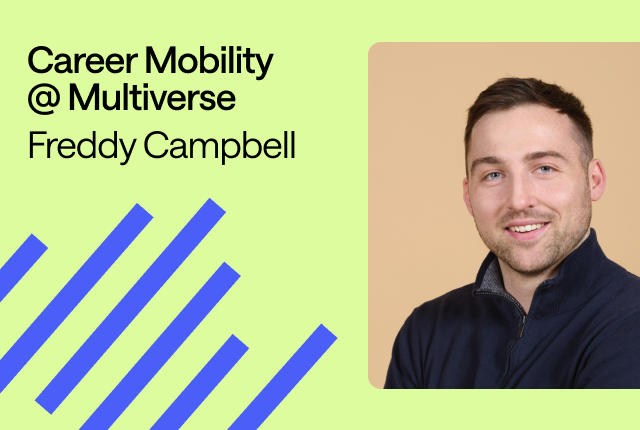
Career Mobility @ Multiverse: Freddy Campbell
Life at Multiverse
Team Multiverse
Tell us about your recent career change at Multiverse.
I recently moved across from the Delivery side of the business to our Sales team. When I joined Multiverse three years ago, it was as a Data Coach delivering our apprenticeship programmes, and after 12 months I was promoted to Technical Lead. Coach roles are a fantastic opportunity to interact with our product, understand our learners and customers, and be at the frontline of making our mission come to life. It was in my Technical Lead role that I started collaborating with the Sales team, working alongside them to develop our programmes and ensure they continued to meet customer and learner needs, as well as providing them with the right resources to communicate the value of Multiverse to potential customers.
I felt I was at the point in my career where I could take a risk and make a change and ultimately, I was lucky to have the opportunity to move internally at Multiverse. Throughout my onboarding into the Sales team, I was enabled to learn our Sales process and playbook That was about 15 months ago, and it’s been an amazing rollercoaster journey since then - I am now an Account Executive (AE) sitting within the mid-market region, and carrying my own quota!
How are you enjoying your new team and remit?
It’s been brilliant for my self-development; I’ve never learned so many things so quickly. Sales is exactly the change I was looking for - the role is demanding and you need to build new skills and resilience to achieve success. While part of a team, as an AE you’re very independent, so you get out what you put in. I’ve had to adapt to a new environment, and I’ve been taught a lot of lessons about setting yourself up for success; it’s all about laying the right foundations, having patience, and setting a strategy with a result in mind. I have brilliant colleagues and regional directors who push me to be better and to learn, its been a really exciting change of perspective.
Any career change comes with its challenges, what did you have to overcome and how did you approach this?
I think the main challenge, which I’ve already alluded to, has been throwing myself into a high-intensity, successful, and demanding sales environment with no prior sales experience. It has been a huge change, from understanding losses are part of the role and building my resilience to deal with rejection, to finding my own sales process, to keeping on top of the strategic pivots we have made as a business and GTM team. Here, you transition fairly quickly into carrying a quota - which is exciting, because you are trusted to just get into the work, but also intimidating at first. I am grateful to have had a lot of support in my new role, from our Marketing teams who make great materials and case studies, to our Operations teams, our Enablement teams for coaching, and from my colleagues and leaders in Sales.
Besides this, I have also focused on improving my organisation skills to ensure I operate a more proactive mindset. It’s easy to focus on the ‘now’ and be reactive, but long-term thinking is crucial to ensuring personal success and ultimately Multiverse achieving its revenue targets.
If you could share one piece of advice for someone looking to develop their career or move internally, what would it be?
I would sum it up as ‘exposure’. You support your own development, both in your current and future roles, by gaining exposure across the business. Widening your understanding helps you have an idea of what you might want to do in the future, as well as how to improve in your current role. Make the most of your internal network by talking to as many people as possible; in my experience, everyone at Multiverse is happy to chat and share their insights, so don’t be afraid to ask for someone’s time!
If you can, get involved in cross-functional initiatives and projects - working cross-team is a great way to gain real insight into other business areas and what the roles actually involve. I was lucky to have a brilliant manager in Delivery, Lily, who was amazing at aiding my development and finding opportunities for me to gain exposure. She was also supportive and understanding when I expressed my desire for change, and we’ve kept in touch since. Talk to your manager or team lead, or seek out a mentor internally - having a sounding board can be really helpful in supporting you to take action from your learnings, and their network can help you identify those projects. The dream role doesn’t always appear overnight, but seeking exposure and learning opportunities will help you find it.
Freddy’s journey from Coach to AE showcases our Career Mobility approach at Multiverse and highlights the importance of the right mentality when wanting to execute a career change. Want to join a company where career mobility is a priority? We’re hiring.
Sorry, no results found.