







We couldn’t find what you are looking for. Please try another way.
The Multiverse blog
Thank you! Your submission has been received!
Oops! Something went wrong while submitting the form.
Announcing our new Chief Learning Officer: Gary Eimerman
News
Team Multiverse
Eimerman joins Multiverse from the online education company Pluralsight where he served for nine years, most recently as Chief Product Officer. Earlier in his career he helped build TrainSignal, which was acquired by Pluralsight in 2013. Throughout his career, Eimerman has excelled in combining learning expertise with commercial responsibilities, building on a strong foundation in product and tech.
Gary said: ‘Our mission couldn’t be more urgent. Right now people are either switching off from learning, or taking over a trillion dollars of student loan debt to the grave. It doesn’t have to be that way.
‘Applied learning combines the best of learning with paid work, and opens the door for people to get the education on tomorrow's technologies while earning money and becoming productive and motivated team members. This is a huge win both for the individuals and the companies in need of today’s most in demand roles.
‘It means our team isn’t just transforming careers by teaching people how to learn, we are delivering meaningful system change in the process’.
Multiverse works with over 10,000 apprentices and 1,000 businesses already, training individuals on programs in the tech, data and engineering skills needed to thrive across a variety of different roles. When inspected most recently by UK regulators, assessors praised Multiverse’s ‘outstanding’ provision for having an ‘ambitious curriculum that closely reflects what employers need so that apprentices make rapid progress’.
Our learning team is constantly innovating to give apprentices the tools to make an impact in their roles and careers. Just this month we launched an AI Jumpstart module, available to all apprentices at no cost, to give them the fundamentals to make use of AI tools in the workplace.
Illinois-based Eimerman is one of a number of senior leaders to join the business this summer, including Alex Varel who has been appointed Chief Revenue Officer, and Ujjwal Singh, our Chief Product and Technology Officer.

Introducing AI Jumpstart: A new AI fundamentals course available to all Multiverse apprentices
News
Team Multiverse
AI will fundamentally change the way we work — putting some jobs at risk, but undoubtedly creating many more. In fact, our forthcoming research shows that nearly two-thirds of business leaders believe AI will create new jobs that require human skills and creativity. Ultimately, it’ll be important for all of us to learn and understand how to use AI effectively in the workplace.
We consider the ability to use AI a core skill for workers over the next decade, just as literacy and numeracy are core skills in today’s modern workplace.
That’s why we’re excited to announce that our apprentices will have access to world-class AI training through our first, full AI module: AI Jumpstart.
The AI Jumpstart training module will launch in September, and will be offered to every apprentice on a Multiverse programme – regardless of which course of study they are pursuing.
The module will equip learners with foundational knowledge of AI that will enable them to identify opportunities to leverage AI while staying aware of potential risks, utilise AI tools, and generate real business value for their employer.
It will cover the fundamental principles of how AI works, how to critically evaluate AI outputs for ethical considerations and accuracy, and perhaps most importantly, teach apprentices how to apply AI in their day-to-day work, for example through the use of effective prompts.
To deepen and stretch the skills and knowledge gained from this module, apprentices will also have access to AI Unlocked; a series of supporting content and events available exclusively through the Multiverse Community.
For many years, our apprentices on advanced programmes have been trained in machine learning and advanced data mining, but the new AI Jumpstart module will enable all Multiverse apprentices to go deeper into AI – regardless of what programme they are in. Whether it’s business, data science, or software engineering – we’re creating opportunities for Multiverse apprentices to learn how to harness AI and use it effectively in their roles, because we believe every worker will need these skills in the future world of work.

As we look ahead to the next decade, there will undoubtedly be an increased demand for AI power users. We recently polled over 1,000 business leaders, and 69% agreed that AI will create more demand for professionals specialising in it. And yet, when we polled apprentices earlier this year, about half were not using ChatGPT in their daily work – either because they don’t know how to use it, or did not have access to it via their employer. It’s a massive missed opportunity which, unless corrected, could leave them behind their peers, and companies behind their competitors.
Our AI Jumpstart module will build apprentices’ skills so that they can adequately use the AI tools of today and the future. And we’ll teach these skills on-the-job, in real-world settings, as they take on real projects — because active, in-context learning is the best way to set employees up for success.
The impact of AI on the workplace will be radical, but by learning how to use AI effectively in our roles, we will build a more skilled, and more strategic workforce.

Multiverse opens new US and UK headquarters in New York and London
Life at Multiverse
Team Multiverse
Now a global team of 800 employees, we’re elevating our office space and experience to truly embody our vision and values.
With our new locations in SoHo and Paddington, Multiverse is staying right in the heart of New York and London respectively. Making for easy commutes for our hybrid workforce, while keeping us at the forefront of the tech-scenes on both sides of the Atlantic.


Our offices aim to be inspiring places to work, for the benefit of all of our teams, and the customers and apprentices they serve. We’ve got plenty of room for meetings, events and training sessions, as well as outdoor space via rooftop terraces - alongside a strong emphasis on wellness and inclusion.
Our new offices offer more room to collaborate and meet, and more space to socialise and unwind.
Check out some photos below:



Multiverse has been listed as one of LinkedIn’s Top StartUps and as one of Flexa’s most flexible companies. Our new offices reflect our commitment to being a great employer, and empowering our people to achieve our ambitious mission.
Want to join us? Check out our current vacancies on our careers page.
Announcing our new Chief Revenue Officer: Alex Varel
News
Team Multiverse
He will be responsible for leading, developing, and growing Multiverse’s go-to-market team, who have successfully launched apprenticeship programs at 1,000 companies worldwide. Through their efforts, they have built strong partnerships with the world’s top employers, helping companies address skill gaps, diversify their early talent strategies, and prepare their workforces for the future of work.
In Alex’s own words: “The rapid pace of technological change requires relevant, up-to-date human skills. This requirement has never been more important. With AI, our workforce faces opportunities like augmentation and productivity gains, but we also face huge risks around the potential displacement of human talent. At Multiverse, we’re positioning our customers and their employees to succeed in the face of so much change.
Joining Multiverse is a unique opportunity to partner with a very talented team, grow our company together and drive forward a solution that has been tested again and again by the most demanding, high-expectation employers.
I’ve been fortunate to learn, on the job, from some of the most elite go-to-market teams out there. I’m excited to bring that experience to Multiverse. Our continued excellence in go-to-market will ensure a powerful customer experience for companies and apprentices.”
Alex’s experiences have made him one of the most in-demand leaders in tech. He has led sales teams across markets, regions, and segments at some of the most exciting growth companies in the world including: Udacity, MongoDB, and Zscaler.
Alex has a strong track record within EdTech and human capital. He ran enterprise sales at CareerBuilder and founded the enterprise sales business while at Udacity. His experience spans the start-up and scale-up ends of the tech company journey — spanning pre and post-IPO experiences.
At the start of 2023, Multiverse reached 10,000 apprentices, and continues to partner with a growing number of the Forbes Global 2000. We’re actively hiring in this team in both the US & UK. To learn more about life in Multiverse’s go-to-market team read Peppa Wise’s journey from Account Executive to VP in just 4 years.
What is OTJ and how do I complete it during my apprenticeship?
Apprentices
Team Multiverse
What counts as OTJ?
‘OTJ’ counts as any time you’ve spent learning during your apprenticeship outside of the recurring tasks in your working role. There’s two types of OTJ activities you’ll need to complete in order to meet the UK government standard for apprenticeship.
Protected learning: Protected learning refers to dedicated periods within a work schedule that are set aside for learning and professional development.
Applied learning: Applied learning is defined as the hands on application of skills in the workplace
If you work 30 hours a week, 6 out of 30 hours need to be spent on OTJ related activities.
What can I do to complete my OTJ?
There’s lots of ways to fulfil your OTJ time and a portion of these will already be scheduled in your calendar by your coach during your apprenticeship. Other activities you will need to seek out yourself. Think about how the OTJ activities you choose relate to your apprenticeship before you complete them. Below are some areas you could focus on to collect OTJ hours and learn on your apprenticeship.
1. Apprenticeship bootcamps
During your apprenticeship, you’ll attend online bootcamps led by coaches who are experts in your apprenticeship field. The coaches will deliver your course curriculum, assign tasks to help you apply your learning and help you prepare for any exams you need to complete on your apprenticeship. Apprentice bootcamps will count as a big portion of your OTJ time, as they’ll be delivered in block sessions of 3 hours up to 1 day at a time.
OTJ time earned: 3 hours - 8 hours at a time (depending on session length)
2. Coach sessions
In-between bootcamp sessions, you’ll have a 1:1 monthly catch-up call with your coach to assess your progress and work on your personal and professional development.
OTJ time earned: 1 hour monthly
3. Applied learning
As well as professional learning that will be scheduled in by your coach, you’ll also need to seek out opportunities for ‘Applied learning’ which covers a broad range of activities you could complete. For an OTJ activity to qualify as ‘applied learning’ it needs to relate to the hands on application of skills in the workplace. For instance, using your recently learnt skills outside of your apprenticeship bootcamp. For example:
- Completing a coding project based on skills learnt during a software engineering bootcamp
- Completing an online course linked to your apprenticeship topic
- Organising a team building activity at work as a result of a related apprenticeship module
You’ll work with your coach on areas for personal and professional development and these areas could include development of key soft skills needed in the workplace. The following would count as applied learning for soft skills:
- Building on active listening skills by carrying out regular note taking during meetings or creating an organised note template and system for you to lookover
- Practising reviewing documentation in detail using examples and methods to retain information
- Researching tools and methods to help organise time effectively and then implementing them in your day to day schedule
OTJ time earned: 30 minutes - 8 hours plus
4. Community
The Multiverse community provides a wide range of opportunities to take part in in order for you to earn OTJ hours for your apprenticeship.
You could attend events. For example:
- Multiverse meet-ups which are social events organised by apprentices
- Lunch and Learn sessions with special guests
- Online seminar in a topic of your choice
- In-person workshops
The community hub also offers a great range of articles to read and video content to watch, all of which adds to OTJ time. To generate regular OTJ time, you could aim to attend 1 community event per week. Please note, not every community activity will count towards your OTJ time. Check with your coach if you're unsure.
OTJ time earned: 20 minutes - 6 hours
5. Exam completion
Exam revision and completion during your apprenticeship also counts as OTJ time.
You can log:
- Time spent revising for upcoming exams
- Practise papers, questions or quizzes
- Actual time spent completing the exam
- Study sessions with other apprentices
OTJ time earned: 30 minutes - 4 hours plus
Where do I log OTJ time?
After you’ve completed an OTJ related activity for your apprenticeship, you’ll need to formally log it with evidence.
Multiverse apprentices have access to a specialised platform in order to do this, where they can log OTJ activities with categories, dates and times. The platform also helps apprentices organise their apprenticeship, track their progress and keep track of key upcoming dates like exams.
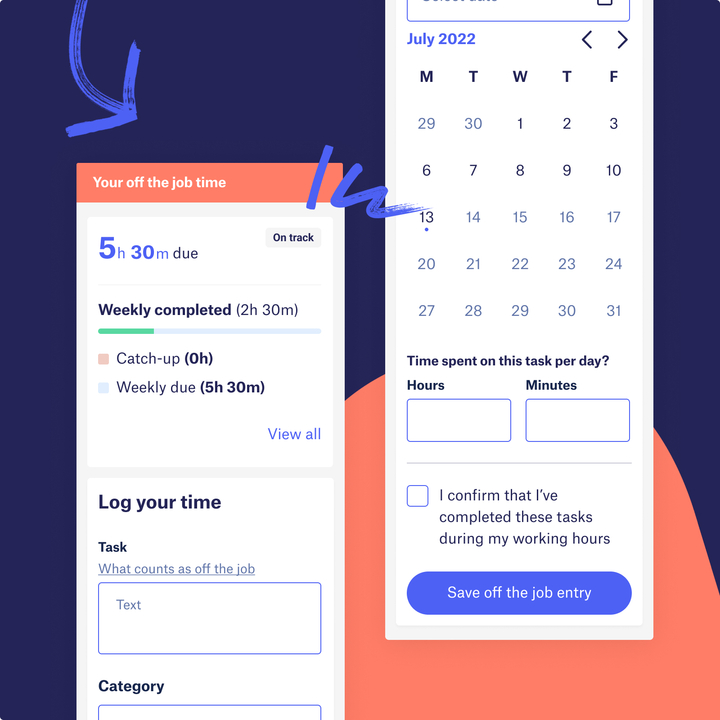
Multiverse apprentices also have access to a 1:1 coach they can reach out to for support. If you’re stuck for what to do for OTJ time or you’re falling behind, you could send an email to your coach asking for advice, ask peers on the community hub or reach out to your apprentice manager.
If you're looking for an apprenticeship, Multiverse offers apprenticeships in tech, data and digital skills all year round.
Start your application here.

Presenting Peppa Wise: from Account Executive to VP of Go-To-Market in 4 years
Life at Multiverse
Team Multiverse
Previously you’ve held roles including Commercial Director at Darktrace & Head of Sales at SenseOn - why did you make the move to Multiverse as an Enterprise Account Executive?
Taking a ‘step back’ into an individual contributor role at Multiverse was a strategic and conscious decision, made with the confidence that I would progress more quickly and be a better leader in the future by following this path.
My goal was to be recognised as the go-to Sales Leader for high-growth scale-ups and I knew that to achieve this I needed to reinvest in my own development and learn a proven playbook for success. It’s really hard to lead a high-performing team without a winning formula, so in order to become a better leader, I wanted to learn and execute the playbook on the ground myself.
I was comfortable with taking the risk of moving to Multiverse back in 2019 because I had done my research and spoken to top-tier VCs in my network who backed Multiverse as the next big thing. When you look at our Series D funding and recent strategic hires and investment in technology, including our new Chief Product & Tech Officer Ujjwal Singh, ex-CTO of GoFundMe and Head of Product at Meta, it’s clear that it was the right decision!
What advice can you share about successfully advancing your career at pace?
I truly believe that the best way to progress your career is to be 100% committed to your own development. It may look like I’ve been chasing promotions throughout my time here but I really haven’t! I’ve been chasing feedback and owning my professional development, and Multiverse is a meritocracy that recognises and rewards that.
For example, before I even joined the team as an Account Executive (AE) in 2019, I asked for my territory and access to resources and materials so that I could hit the ground running. And from day one, I totally embraced learning and executing the playbook at the highest standard. Now as a leader, I’ve seen that our most successful rampers do this too - if you truly commit to learning and living the playbook, and to hitting our Leading Indicators with quality, you will be successful.
Throughout my career, I’ve always asked my leaders for feedback and development. Building strong relationships with leadership and understanding what they want to see from you and what you need to improve is critical for progression.
And finally, I am committed to excellence and I have very high standards. I hold the whole team to a high standard because I do the same for myself!
What drives you as a leader?
My main motivation as a leader is to create a supportive and high-performance culture. I feel a big responsibility to the brilliant people we hire and I am totally committed to giving them the development that they join Multiverse for.
In the early stages of a hyper-growth company, it’s not always easy to get this right, but now in my role as VP, I am committed to doing just that. I want to be remembered as a leader who is focused on creating an inclusive, high-performance and development-centric environment, and I hold myself personally accountable for this.
Additionally, I’m driven by my belief in Multiverse - what we sell, what we do and who we are. I believe in every single AE, leader, and myself, and I know that we can continue to achieve incredible things together. This belief sustains me when things are challenging and motivates me further when things are going well.
Has Multiverse delivered on your expectations?
Oh, it’s delivered far more than I expected - in every way!
From a development perspective, since I joined Multiverse, our Average Selling Price (ASP) has increased exponentially. We achieved this enormous increase by pivoting from selling tactically to selling strategically. Today, we leverage value-based selling and work directly with the C-Suite at some of the biggest companies in the world. This shift towards strategic enterprise selling has naturally delivered increased earnings too.
It has also been more intense and challenging at times - but I think that is the reality of working for one of the fastest-growing companies in the world!
One of the unexpected bonuses of joining Multiverse was the life-long relationships I’ve made. There are people I’ve met here who will be in my life forever because we've been on this crazy journey together - through the highs and the lows, which is when you need those relationships the most!
At Multiverse, we pride ourselves on offering an exceptional learning and development environment. Our structured sales playbook and world-class leadership team are designed to support your growth and development. We believe in promoting from within and operate a meritocracy, so you know that your progress will be unrivalled. Join Multiverse and transform your career, because your development is our priority. Apply here
NHS Data Academies launched in training push
Employers
Team Multiverse
Royal Free, Manchester University NHS Foundation Trust (MFT), Croydon Health Services NHS Trust & Bart Health NHS Trust, some of the largest NHS organisations in the UK, will enrol more than 40 of their staff on data apprenticeships.
The National Institute for Health and Care Excellence (NICE) has committed to training 40 of its staff in data skills through apprenticeships.
The training will be delivered by Multiverse, a startup tech company focused on high-quality education and training through a unique professional apprenticeship model. Multiverse delivers apprenticeships in areas such as software engineering and data analytics.
The use of data has the potential to free up clinician’s time, improve patient outcomes and ultimately save lives. The BMA reports that 27% of doctors lose more than 4 hours a week because of inefficient hardware or systems. A shortage of skills in this area means many systems remain outdated - across the UK more than 100,000 data positions remain unfilled.
The launch of Data Academies across the NHS will improve efficiencies, create learning pathways for staff and, crucially, improve patient outcomes.
During the programmes, apprentices will learn through work - applying their skills in real-time to projects across the NHS.
Roxanne Moran, at National Institute of Health Care Excellence, said: “Our aim at NICE is to help practitioners and commissioners get the best care to patients fast. We have partnered with Multiverse to develop our staff with data skills, with a first cohort of 40 colleagues. Our increased capability in data skills will enable us to provide useful and useable advice for our users, and create a future-ready workforce, whilst providing a valuable personal development opportunity for colleagues.”
At Manchester Foundation Trust, 20 employees across Finance and Procurement will be enrolled on training programmes.
Edd Berry, Director of Finance Innovation at Manchester Foundation Trust, said: “In Finance, data is at the heart of much of what we do. Having the skills to validate, analyse, and forecast with data are essential. We want our staff to feel supported and confident in using the right tools to help them do their jobs as effectively as possible. We are really excited to be developing our staff with digital training from Multiverse”
Sean Hession, Deputy Director of Information Analytics at Royal Free London Trust, said: “Improving data literacy and upskilling our existing data teams is key to making the most of the information that we produce as a trust and is a key component of the Royal Free’s data strategy and trust strategy of becoming a data driven organisation. We recognise the potential that can be unlocked by giving analysts or those that work with data opportunities to develop their skills and understanding of data and how working with Multiverse can help us achieve that.”
The rollouts follow the success of the Data and Analytics Apprenticeship Pilot — launched by NHS England last year, in partnership with Multiverse. Multiverse also began a partnership with Leeds Health and Care Academy (LHCA), in a unique collaboration between health and care partners including Inspire North, Leeds County Council, Leeds Community Healthcare NHS Trust, Leeds Student Medical Practice and many more — to improve data skills within the sector.
Multiverse has worked with more than 200 NHS employees, in a wide-ranging partnership that helps the vital organisation grow its in-house data, tech and engineering skills.
My apprenticeship expectations vs reality: Laura's story
Apprentices
Team Multiverse
No one told me how competitive it would be to find a decent apprenticeship program. After months of interviewing and numerous rounds, I felt defeated. Jobs that seemed too good to be true ended up being too good to be true. Companies posted descriptions with ‘entry level’ requirements, but were looking for ‘experts’ with multiple years of experience in the field.
My Multiverse Experience
After months of job searching at various apprenticeship providers and job boards with no luck, I came across Multiverse. Multiverse had a specific platform for people like me to apply to roles and did not require any prior work experience: just a GCSE at 4/C in English and Maths.
I put in my application and landed a role pursuing a business apprenticeship. Now nearly half way through my Digital Business Accelerator apprenticeship program, I truly did not expect this level of nurturing for my ideal role, which I could not be happier in!
While my journey has not been easy, I strongly believe everything happens for a reason. The admission’s team were helpful with the application process, transparent about my options and true to their word from the start. Now in my working role, I’m not afraid to ask seemingly simple questions or ask for help with more in-depth tools that I don’t know how to use - I’m confident my manager will walk me through it and go over it again if I don’t understand.
Starting the new job
Prior to starting in my new role, I had a different perception of what my apprenticeship course as a whole would look like. Everything I am taught here intertwines. My new Excel skills help me complete my other work faster, and I also have access to the Multiverse community hub with all sorts of information, events to attend and articles to read to help me throughout my career. Apprentices need to spend 80% of their time at work and 20% completing ‘Off the job’ learning. At first I thought my ‘Off the job’ learning time would be away from my job and unrelated to my work, but I quickly discovered that the majority of my ‘Off the job’ time is decided by me, so I can choose tasks and activities that I feel relate to my role.
Growing beyond imposter syndrome
Despite the initial excitement of starting a new job, transitioning into a new role was nerve wracking! Prior to my apprenticeship, I studied business at college and had two years of sales experience. When I received the apprenticeship offer from Multiverse, I was worried that after so many rejections I wouldn't have the skills needed to do the job.
Perhaps you’ll see yourself in my previous position. It’s a competitive and difficult market to land a quality apprenticeship, and you may feel like an imposter once you finally find a good one. Just because you’ve been knocked down before, please know you are not alone: you have earned your position! Continuous growth during an enriching learning experience is something to be proud of. If you look back at where you are now in comparison to five years ago, you’ll see just how far you’ve come.
Multiverse Tech: Multiverse joined by EduFlow and hires CPTO
News
Team Multiverse
When our apprenticeship model works, it’s because it uses the transformational power of working and learning combined. Our apprentices learn in a meaningful way: developing skills on-the-job, and applying those skills straight away to drive business success.
But we aspire to truly world-class apprenticeships, available to everyone: and that depends on enhancing and building the technology that powers apprenticeships.
Our provision, which was ranked Outstanding by Ofsted, already uses technology platforms to personalize the learning experience, connect apprentices to the best opportunities and the most relevant content, and help our coaches have impactful connections with apprentices.
And now, we’re accelerating our investment into this part of our business.
Today, we’re delighted to be joining forces with Eduflow, one of Europe’s most dynamic education start-ups. The team at Eduflow have built a world-class education platform, used by thousands of learners.
The move represents our first acquisition and will mean we can give greater levels of personalization to apprentices, ensuring the skills that they learn are relevant and delivered more effectively.
Eduflow CEO David Kofoed Wind said: “When it comes to learning the skills needed to navigate the workplace, it’s clear that the future of learning isn’t lectures and textbooks, it’s delivered through the transformational power of working and learning combined.
“By integrating Eduflow's technology and team into Multiverse's existing stack, apprentices will benefit from more specialization to ensure their skills are directly applicable to their careers, and a greater level of peer-learning, to help build the connections, communication skills and teamwork necessary to thrive.”
This week, we’re also welcoming Ujjwal Singh to Multiverse as our first Chief Product and Technology Officer. Ujjwal joins us from Meta, where he led the development of Facebook’s suite of workplace tools, and has driven product innovation at Google and GoFundMe.
With our first acquisition and the appointment of our first CPTO, this marks our largest single investment into our technology stack to date, and one that we are confident will accelerate the learning for our apprentices, and the results that businesses see from their programs.
Ujjwal said: “Even after all the studying I’ve done, my best lessons came from the workplace, not the classroom. That’s why I was so driven by the mission of Multiverse, and the opportunity to build the future of applied learning.”
Technology has always been at the heart of how we deliver a brilliant experience to both apprentices and their employers. That’s how we scaled to reach 10,000 apprentices earlier this year.
Now, our ability to continue scaling applied learning relies on our ability to build the tools and technology that can underpin the future of apprenticeships.
This is an investment in our apprentices’ success - because we know that when we accelerate learning for our apprentices we accelerate results for employers.
Data Analyst salary in the UK: How much can you make?
Apprentices
Team Multiverse
To answer "How much do Data Analysts make?" and help you decide whether data analytics is the right path for you, we'll cover:
- Data Analyst salary in the UK
- Types of Data Analysts
- Data Analyst salary by job title
- What does a Data Analyst do?
- Are Data Analysts in demand?
- How to get a Data Analyst job in the UK
Data Analyst salary in the UK
A Data Analyst career can be rewarding because it's in high demand. You can also earn a higher than average salary. According to Indeed, Data Scientists make around £35,500 annually.
Salary in the UK is broad and fluctuates by city, industry and experience. For example, in cities like London and Edinburgh where the cost of living is higher, salaries are higher.
Your specialism and seniority level also impact what you earn. You might start your career path as a Junior Data Analyst, then specialise in data science.
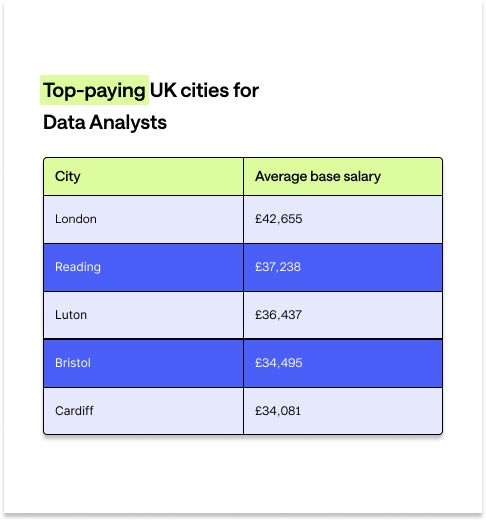
Highest-paying cities for Data Analysts in the UK
Aside from experience, role and employer, your location can affect what you make as a Data Analyst. In London, Data Analysts make around £42,000 on average, while in Reading, they earn around £37,000.
According to Indeed, the five highest-paying cities for Data Analysts in the UK are:
- London
- Reading
- Luton
- Bristol
- Cardiff
Types of Data Analysts
Data Analysts sometimes specialise in an industry or area of expertise. With Data Analytics training, you might pursue one of these careers:
- Media Planner
- Data Scientist
- Data Modeller
- Business Analyst
- Financial Data Analyst
There are many ways to progress through a career in data analytics. One way is with a Data Analyst apprenticeship from Multiverse. This programme allows junior and new Data Analysts to broaden the depth of their data analytics knowledge and prepare for lucrative mid to senior-level positions in the field. You’ll develop durable, future-proof data skills without having to put your career on pause — and get support from your manager, coach and the Multiverse community. The best part? When Multiverse partners with your employer, your on-the-job training is free to you and all learners on your team.

Data Analyst salary by job title
Data analytics is broad, so there are many types of jobs you can pursue. All industries need data experts to assist them in organising their data. Since data analytics skills are in high demand, there are many well-paying roles.
Let’s look at Data Analyst salary by job title, including the average base, entry and senior-level wages for each.
Data Analyst
Data Analysts collect, clean and interpret company data. They also collaborate with other colleagues and leadership to find data-led solutions. If you enjoy technology, mathematics and solving problems, a career in data analysis could be a fit for you.
Here average Data Analyst salaries in the UK according to Glassdoor, using London as a frame of reference:
- Entry-level salary: £32k
- Average base salary: £41k
- Senior-level salary: £54k+
Let’s look at the salary for other roles that need data analytics skills.
Business Analyst
Business Analysts find data-led solutions to business problems and create growth opportunities.
To become an entry-level Business Analyst, you'll need a grade of 4/C GCSE (or equivalent) in Maths and English. Relevant A Levels (Business Studies or IT/ Computing), and prior work experience with translatable soft skills will also help strengthen your application.
Business Analyst salaries in the UK:
- Entry-level salary: £35k
- Average base salary: £42k
- Senior-level salary: £52k+
Media Planner
Media Planners analyse marketing data and create advertising strategies connecting brands with their target audience. To become an entry-level Media Planner, you'll typically need a higher qualification in a relevant subject. That could be advertising, marketing or a data-focused programme.
Media Planner salaries in the UK:
- Entry-level salary: £23k
- Average base salary: £30k
- Senior-level salary: £38k+
HR Analyst
Human Resource (HR) Analysts collect, organise and review employee data. They may focus on hiring, onboarding and compliance. Their data-informed insights help to solve recruitment, retention and compliance problems for companies.
HR Analyst salaries in the UK:
- Entry-level salary: £33k
- Average base salary: £39k
- Senior-level salary: £46k+
Data Modeller
Data Modellers are engineers and system analysts. They design database management systems that help companies manage data. You'll typically need a higher qualification in a relevant field to become a Data Modeller.
Data Modeller salaries in the UK:
- Entry-level salary: £37k
- Average base salary: £49k
- Senior-level salary: £67k+

Financial Data Analyst
Financial Data Analysts work with financial institutions. They collate and review data from financial records to help institutions make better business decisions. You’ll need an interest in mathematics or economics to become an entry-level Financial Data Analyst.
Financial Data Analyst salaries in the UK:
- Entry-level salary: £31k
- Average base salary: £36k
- Senior-level salary: £43k+
What does a Data Analyst do?
Data Analysts collate, clean and review raw data. They spot trends and help make data-led decisions. Data Analysts also make company data more accessible to leadership.
Job responsibilities include:
- Using specialist tools to gather, clean and organise data
- Finding patterns and anomalies in data
- Reporting and presenting data insights to non-specialists
- Collaborating with Business Analysts to create data-informed systems and processes
- Sourcing new ways to use company data
- Keeping up with training needs and best practices
To become a Data Analyst, you should be interested in developing these skills:
- Knowledge of mathematics: Linear algebra, statistics and probability play a significant role in data analysis.
- Problem-solving: You identify starting points for overcoming project and technical problems.
- Technical skills: You use (or you’re willing to learn) SQL and data visualisation techniques to gather, clean and segment data.
- Database fundamentals: You know how to manage and navigate databases.
- Commercial mindset: You understand the data analytics lifecycle and how to meet business requirements.
- Communication: You communicate data insights to non-specialists.
Aside from demonstrating relevant skills (or a commitment to learning them), employers may require specific qualifications:
- At least a grade of 4/C GCSE (or equivalent) in Maths and English
- A relevant higher qualification like L4 Data Analytics or a BSc (Hons) Digital and Technology Solutions. If you don’t already have a higher qualification in data, you’ll need to demonstrate the willingness to work toward one
To strengthen your application for a data role, the following could also increase your chances of landing one:
- A Levels in a relevant subject like Computing, Mathematics or Business Studies
- Prior work experience that includes transferable interpersonal skills
Are Data Analysts in demand?
The job outlook for data analytics in the UK is healthy. A quick search for "Data Analyst" jobs on LinkedIn brings up over 2,600+ results across multiple sectors.
The Department for Culture, Media and Sport (DCMS) anticipates data analysis demand will grow 33% by 2026. DCMS also predicts data analysis will become one of the fastest-growing digital skills in the UK.
Accelerate your career as a Data Analyst
A Data Fellowship apprenticeship with Multiverse is the fastest way for junior Data Analysts to accelerate their careers. The free programme helps apprentices build in-demand data skills that can ultimately help them unlock promotions, increase productivity, and future-proof their careers.
We make it easy for you to get started — it takes less than 15 minutes to create a profile. Our team can then double-check your eligibility and discuss apprenticeship options with your current employer. Apply today.

Sorry, no results found.